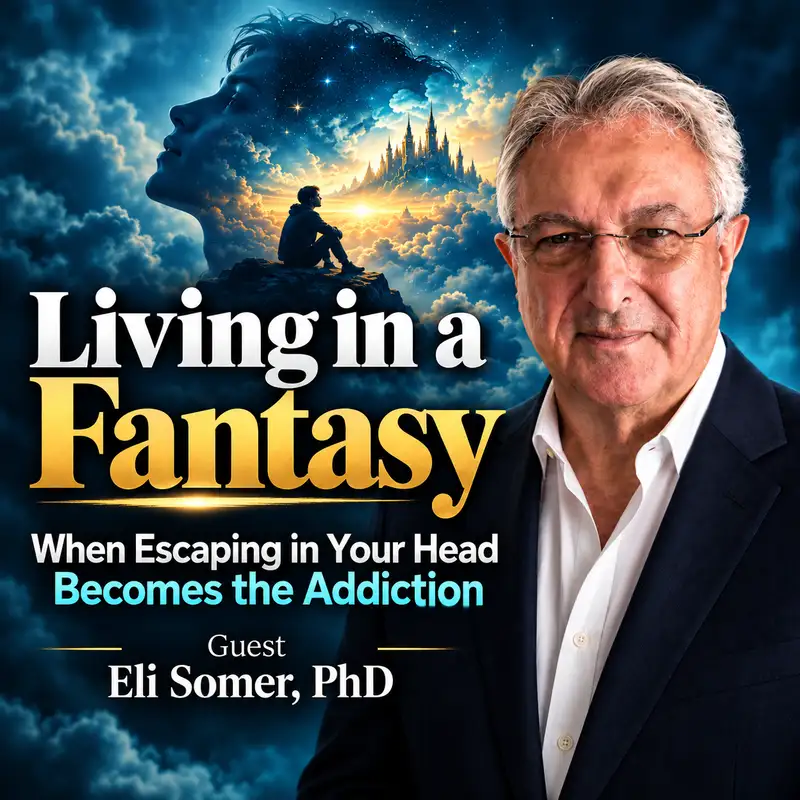
Living in a Fantasy: When Escaping in Your Head Becomes the Addiction with Guest Eli Somer, PhD
Download MP3And let me tell you, you know, I have patients and I have met people and talk to people who can spend 5, 6, 7, 8 hours a day. Some some most of their waking hours. Just you know out there in their inner world. And they are in for all purposes. They are they are they're handicapped because they they're not functioning in the real world. So that helps people in recovery live their best recovered lives and welcome back to the recovered life show today's guest is Professor Eli Somer a clinical psychologist at the universe at the University of Haifa. In Israel, who's first identified the maladaptive daydreaming this whole concept when escaping into fantasy stops being a break from life and starts taking over Welcome to the show. I'm so glad that you're able to come on. Thank you for having me. Oh, this was this was so interesting. I have to tell you when I read the study I was like, okay, we must have him on to discuss this because one of the things that we find with people that have addiction is this idea of daydreaming this idea of fantasy. And you know, obviously it plays out in addiction but what we find is that this escapism. I'm just going to call the scapism is there early on in childhood. So when I read this, I thought, oh, man, I have to talk to the expert about this about living in a fantasy and what you found here. You coined this term maladaptive daydreaming in plain words. What is that so people can understand what we're talking about? Well, first, let's differentiate between mind wondering and daydreaming and then we'll go to the more intense form of daydreaming that I'm interested in. Mind wondering is this condition where the mind is off task and thoughts jump from one mundane thing to the other. What to prepare for dinner? What should I tell my co-worker? How should I speak to my boss? Where should I spend my next vacation? So this, the mind goes from one thought to the other, but they are usually thoughts about real life. And the episodes jumping from one topic to the other are quite brief. In contrast, what I call daydreaming is about fantasizing, is about creating scenarios that are not necessarily real, that could be sometimes fantastic. Now we come to a third form of mental activity that is of great interest to me, and this is what I call immersive daydreaming. Now, this is the kind of, I think it's a trait that some people have, some people don't. I don't have it, but others, some of my patients have it. And that's the ability to really absorb yourself in the fantasy in a way that gives you a sense of presence there with complete emotions, with auditory effects, with the visuals being very vivid. It's a powerful experience. Now as you can imagine, this can be extremely gratifying. And some people want to return to it because I could talk about the gratification because it really relates to the main topic of your channel. And some people are more prone, I would say, need the kind of emotional regulation that this kind of immersive fantasy can provide. And they can be at greater risk of finding it hard to control this form of mental activity. And some people get addicted and may spend hours every day in fantasy at the expense of meeting their daily obligations. You explained that so well. Thank you. I was just thinking, everybody daydreams, right? Everybody daydreams, whether you're in the car or you're in the shower, you're thinking about things, maybe daydreaming about how something will turn out or something that you wish or desire. What point does this cross a line from harmless to a real problem? Yeah. Well, I think it's the issue of control. First of all, I mean, are you capable of getting into this fantasy world as easily as you can and leave it unwell? And the other issue of great relevance is to what extent does your daydreaming interfere, impact, compromise, your daily obligations, your functioning, your social functioning, your vocational functioning, your academic functioning. And the other the other criteria that I suggest using in trying to differentiate between normal and abnormal daydreaming is the degree of distress it creates because like in any addiction, there is there is a great gratification in engaging with this kind of activity, but there's also distress associated with remorse, guilt, shame about, you know, the time wasted in idle fantasies rather than advancing one's goals in life. So it's, you know, this brings me back when you were saying regret, remorse, you know, I think of the word resentment, which is used a lot in the recovery world is that having a resentment is very dangerous. And somebody explained to me one time in a non-scientific way that resentment was just a replay in a tape over and over again. And what I'm, what I'm hearing from you is that there are some people who are not as good as differentiating when to start and stop that tape and play it over and or have control over that, right? They spend more time in this fantasy daydream than they do in the actual here and now. That's correct. And the themes of the daydreams are not arbitrary. They most of the times have deep psychological meaning and they serve to regulate emotional pain, to create corrective emotional experiences, to correct environments that are soothing, that are comforting, that they feel safe and protective. So they do some kind of psychological work in trying to self-medicate, to use another term from the addiction world, they're trying to self-medicate. And, you know, if used in a measured way, of course, you know, daydream can be creative and can be a fantastic tool of emotional self-regulation. The risk here is that we're talking about a mental process that is legal, accessible. It's between your ears. And very easily triggered and is, does not involve any risks in, you know, buying illicit substances. So those who have this trait and have the underlying psychological pain that they need to self-medicate are at greater risk of losing control over this otherwise potentially helpful defense mechanism and become addicted to a mental activity that actually paralyzes them and becomes maladaptive. You know, as a clinical psychologist, you know, you're dealing with how people think, their thinking patterns, how it works out in their life, how they're trying to improve their life by the way that they think and act and behave. And this gets me thinking about this trend right now of trauma, right? And I'm going to say trend because this word trauma is everywhere. And there are people who have trauma like and and one of the things that was interesting about this episode when I wanted to do it is I realized that my first addiction, I'm a recovered alcoholic, but my first addiction was escapism. And I think it was because things were not going well. Right. As a child and I learned how to vividly escape. And that does become addicting. Right. Yeah. Have you found that people who have certain things in their childhood, for example, trauma or some sort of other mental health issue are more likely to move into this maladaptive daydreaming? Yeah. Well, there is a significant correlation between the trend, the likelihood of people to engage in this form of fantasizing and the ability to do it. There's a correlation between that and a adverse adverse childhood experiences. It doesn't mean that everyone with maladaptive daydreaming had problematic or difficult childhood because some people just have this trait, discover it and just simply enjoy it too much and just overdo it. But of course, those who have been neglected, emotionally neglected, those who have been shamed, those who have been isolated, those who have been abused have this, I would say, miraculous ability to create alternative families, alternative relationships. Those who have been born and raised to be shy and self-conscious can experience themselves as more self-confident, as engaging and surrounded by friends or even people who admire them. So, yeah, people who have deeper needs to feel recognized, to be attached meaningfully, to feel appreciated and for some reason cannot materialize these needs and have this internal ability, of course, would be tempted to go back to this inner world that is completely separate and therefore it's a dissociative experience because it's dissociated from reality and spend more and more time there. And let me tell you, you know, I have patients and I have met people and talked to people who can spend five, six, seven, eight hours a day, some, some, most of their waking hours just, you know, out there in their inner world and they are in, for all purposes, they are, they are, they are handicapped because they, they are not functioning in a real world and that's the good news is, however, that they can be helped. It's, it's not, it's unlike a physical addiction. It's a behavioral addiction that has less of these dependency issues, the chemical dependence, the dependency issues. So we already have experimented with some clinical trials and found out to much to our satisfaction that you can train people to focus their attention externally and be more present. But that is, you know, that is a symptomatic intervention because if you train, if you take this away from people and teach them to be more present in a, in a reality that is unpleasant, for example, being very self-conscious or socially anxious, then it's unfair. You must give them in return some other skills. So a good therapy, you might have to, does not only help people control their fantasizing, but also treats the underlying issues, provides them with better skills and helps them process painful, traumatic childhood experiences. I love how you're putting this because I think this intersects a lot of addiction, mental health. This just really can be used everywhere and the, you know, it was a couple of episodes back. We did a series on trauma and I had no idea that the biggest form of trauma is neglect. Right. And I can see now how it would be very easy to use this escapism, this maladaptive daydreaming, to create this alternate world that does, that is not being practiced in your, in the here and now, let's say, right? Right. And escape into this because it is a safe place where your needs are being met. Correct. I mean, your needs in maladaptive daydreaming, no matter what it is, whether you're, if you're homeless and see that you're maladaptive daydreaming, that you're a multimillionaire and have a learch yet, your needs are being met. Yes. You know, the sad part is the coming to the, just getting out of this and waking up to a reality where nothing has changed because they don't get a chance to practice their skills, to improve their skills, to improve their lives. And this transition from the fantasy to the reality creates an increased pain and deepening of the suffering that they self-medicate with more fantasizing, ironically. Yeah. And you know, this is, you know, this brings up a lot of things here that I want to ask you because now we've gone down the rabbit hole, as it was saying. Thank you for being patient and explaining it to me in the audience, all these little details. Because I think, I think it's important. Okay. So let's talk about manifestation because when I first read this, I used manifestation, I used manifestation to get out of a horrible situation as a mid-20 something alcoholic, got sober, stayed sober, like recreated my life. I used that kind of process of, okay, slowing down. Where do I want to go? What would that look like? And we're finding, being able to paint out, what would that look like? What would it look like if you were stable? What would it look like if you had a business, had a significant other that you love, right? What would that, this is very powerful. Like we're, as I'm going to call it spiritual technology, manifestation can be very powerful. I've also seen people be trapped in manifestation. How are you saying that maybe it isn't as helpful or it's helpful if it's used in a certain way? Well, let me tell you, we borrowed a lot of our intervention for this clinical trial from, from addiction research and addiction therapy. I've, we found very helpful ideas there. For example, motivational interviewing. When, when we begin working with people with maladaptive daydreaming, we try to help them clarify. What prices are they paying for being gone internally for hours a day? What, what, how does it impact their lives? And we also try to find out what do they stand to gain from better controlling this mental activity? And we try to help them formulate this into self affirmation, self statements that they could use in order to counteract the lure of, of this pleasure of the bliss of the fantasy of being admired and loved and accepted internally. So they can free up more time to dare and risk and, and try to form real relationships. So we're working with, with, with this kind of motivational interviewing, we're doing another thing that we borrowed from the addiction clinic is self monitoring, of course, because people tend to deny how much time they spent in fantasy. So self monitoring is not only for us to gauge the, how effective the treatment is, but it's intervention itself because it calls for accountability. And we also train people to become present, to be mindful of sort of, sort of, to, to, to direct their attention rather than internally to the external presence. And on top of that building skills and working the other arm of the therapy, as I told you, is working on the underlying emotional issues. And that is through the therapeutic relationship. So there's a lot of, there's a lot of correlation between the kind of work that we are doing and what is happening in recovery clinics. You know, I love this. I always said, no matter what drug you're addicted to, it all has one thing in common, not okay in the here and now. Right. And this, this is why I found this so interesting. And a lot of the questions like in advocacy and in peer support, we're helping people. One of the things I will say is, what's, what's wrong with the here and now? What's going on? And you know, it's interesting that people that have this, that live in a fantasy all the time and they're thinking is all the time going that when you ask that question right here right now, what's so wrong? What's wrong? What's right about right here right now? Is anybody out to get you? Is anybody chasing you? Because I noticed a lot of people in addiction recovery, they have fight or flight constantly. I know I did, right? Right. And when you slow it down and you start asking the question, I found nine out of 10. People cannot tell me what's wrong with the here and now. I said right here, right now you're safe right here right now. Everything is okay. But there seems to be this attraction and compulsion. I'm just you were compulsion to live in a reality that is not true, even though that the real reality that the here and now of it is absolutely fine. Matter of sometimes even better. Yeah, but they can't see it. They can't take. Could you speak to that a little bit because this is fascinating. The person cannot see it. They cannot get into the here and now. Well, the truth of the matter is that if you waste your life away in daydreaming, your here and now becomes pretty dismal because there are a lot of missed opportunity. So I agree and that the here and now is not necessarily and not always painful and traumatic. But it is it is the onus the onus is on the patient to make the here and now a better place to live in and it's possible. It's doable, but they know many people just lose hope and they need some help, some support to regain confidence in their ability to borrow some of the elements in the fantasy that are really pointing towards the ideal self, ideal life. So borrowing some of these ideas and working slowly to implement them and integrate them in their real lives. It's possible. We are seeing this in the clinic. It's possible. But like in any recovery work, it takes courage. Let me tell you just one other thing that in contrast to dealing with the chemical addictions in my adaptive daydreaming like in eating disorders. You cannot take away food and and you cannot eliminate fantasy completely. You cannot eliminate daydreaming completely because it's a normal mental activity. So the challenge here is and also something that is quite encouraging for some of my patients is that we don't want to take this away from you. This is good. This could be a wonderful gift, you know, unlike heroin or even alcohol, although, you know, wine appreciation is something that they know we could discuss later. But the idea here is that you could allocate some time when you are off duty, when you completed your daily responsibilities in the evening and and and be creative inside. So the ability, the capacity, this talent, I would even dare say, stays for you to use and enjoy. But do it in moderation. Do it in moderate. If you find yourself, I guess what you're saying is if you find yourself spending more time in your head than actually playing out your life, participating in your own life, that's a huge warning sign, I would assume. It is. And Damon, I would just remind the listeners to the two criteria that I suggest using. Does it impair your functioning school relationships work? Does it impair in any way you're functioning and does it create? Ultimately, does it create the stress? These one of these two or both if they are present, that's a major red flag. Okay, so as you start to put these together because you know, the interesting thing is and I'm going to admit as a child, thinking back now, I'm thinking back as a child, I had huge portions of my life where I was in total fantasy land. Right. I was in my head a lot. I was in my head a lot and I had to learn and it protected you. It was 100% it did. Right. It did. It protected me because it was a safe place. And now I'm a very, I'm a very big thinker, right? Now I want to talk with you about OCD. I want to talk with you about ADHD. If there's a link to this a little bit because I could see some of this with people that have ADHD too will just be so overwhelmed right slide back. They're just like, I'd rather live in a fantasy world because I really can't execute anything day to day. Do you see any, is there anything with maladaptive daydreaming that links to a co-occurring disorder with people? Do you see this? Absolutely. More likely to have this if they suffer from something else. What what is that? Well, we don't know about causality and the directionality of causality, but there is co-morbidity. There is a there is a correlation between maladaptive daydreaming and many psychological disorder. We call it a trans diagnostic phenomenon. So and it's like many other DSM conditions. So we see it coming with depression. It's associated with anxiety. It's associated with avoidant personality disorder and with social anxiety, but you were really hitting it very precisely when you suggested that if it might be related to ADHD. In fact, we were astounded to find a 77% prevalence of ADHD among people with maladaptive daydreaming. And we were really shocked at this figure thinking, wait a minute, maybe it's the same thing. So we went and investigated a population of people with ADHD and there we found that only about 20% have maladaptive daydreaming. So what does it mean? It means that there could be a subtype of ADHD that is associated with the inattention caused by paying attention internally at the expense of where did I put my keys or what do I have to do next because that's the external world and that is of less interest. So people who are absorbed internally of course cannot pay very good attention to the external world. And there's another interesting thing here that people reported when they are immersed in their fantasies. They feel very present. However, when they come to, when they wake up from their fantasy, they feel depersonalized, derealized. They feel detached from their environment. That also can interfere with attention. And that's a really a whole other interesting thing. I mean, these paradox of people feeling more present in fantasy than in real life. You know, I, this is, you are really tapping on Eli a bunch of things that in recovery culturally, what I'm going to say culturally is talked about a lot, right? There's a big thing in 12 step groups called in the action. And, and one of the things that I think we find is that people, especially in early recovery are really, even if they weren't like this as the addiction grow will become this because the hearing now is very uncomfortable. So they will go internally. They'll go into a fantasy. They'll start playing things out. And this is why peer support is so good. I think because having relationships with people who know you talking out what's going on and what you're thinking and feeling brings you into the present moment. Absolutely. Right. You're connecting with another brand. And what I've found is that people who can't get this never end up getting sober or struggle go in out or people who are unwilling to connect with other people because it's too uncomfortable to stay in the present moment. There is there's their tense and I'm not I'm saying it from a very non scientific way, right? Like I don't have I don't have charts and graphs to prove this, but I can just tell you day to day dealing with people who are in recovery for mental health and addiction recovery, their inability to get into the present moment because they believe their thinking in this fantasy is their friend and it's not they think it is it's not the friend. They think it is true, true. And you know, if if we can if we can help some some of these clients, some of these individuals take the risk and form connections and form relationships that is totally mutually exclusive to daydream because as we talk, for example, you and I neither you or I can can fantasize at the same time because our tensions focus externally on the other person what they're saying what they're thinking. So connecting with other people is not only grounding is not only cannot only provide a nice growing support system, but it's also mutually exclusive and it cannot go together with with daydreaming simply mentally. It's impossible. So it's an interesting point. So sometimes one of the when I read some of the interactions on the online support groups of people with maladaptive daydreaming, they advise each other to call, connect, make you know, make friendships when they feel the need not not only to get the support to overcome the urge and the yearning, but also because it's impossible when you're talking with somebody you present your attention is focused externally because that internal dialogue is part of the fantasy as well. So when you write so I mean this is this is the thing I you know, I learned early on that I was very I'm a doer right. So thank God I'm a doer. I'm somebody who likes to do things. So I learned very early on that I had to schedule my thinking schedule a bit like there I found and I want to talk with you about this specifically because when we look back at it at all of these manifestations spiritual technologies, all these motivational speakers all the way before Dale Carnegie going way way back. There is this modality that they talk about. I guess that would be the way to say it. Of using fantasy to be in a place to to retrain your nervous system to feel what it's like. And I knew this I do this sometimes and things that I'm uncomfortable with. Let's say it's a crowd of people. I'm going to speak, you know, you know even doing the show or having a community or that that was like a little maybe outside even though I had good business success that was a little outside. I had to go to that place in my nervous system. Stay there and feel what it would be like to do that for that to be easy for that to be normal. But then I found that that can also be very addictive. So I have to spend schedule that. Oh, it's an hour. That's it. That's all I get right to do that. So is is there some also superpower? If you can tweak this a bit. Yes, yes, absolutely. You know, I'm in here because they've been talking about this for for hundreds of years. No, I'll confess sometimes I am I am envious of those who have this trait because you can you can rehearse. You can build skills. You can creatively solve problems. This is a good thing. The it becomes a problem when it's at the expense of your other obligations and developing skills in real life. But if it helps you improve what you're going to do plan ahead. You know, imagine different scenarios. This is wonderful. You know, and to me, I don't have this visual ability. I can think I can plan. But my fantasy capacities are very shallow. And so sometimes I feel envious and jealous of those who I can't have this internal. I would say a fantastical reality, a virtual reality. This is the word I was looking for. Yeah, well, this is the weird thing about consciousness. What is reality? Right. So, you know, you could take two different. I listen to some technologists sometimes and I'm like, man, I'm not even quite sure the reality I'm living in is the reality that I thought it was right. So this is a very kind of blurry area. But I think what is what is it blurry is. There's part of this that is just part of us being able to create ourselves, recreate ourselves, live a life that is great. And then there's this part that's maladaptive. And for those people, you know, final question here, we're going to get more into how to break these in the after the show a little bit. We do it, but for the people who are listening to this and are like, oh, man, everything that he likes, you know, at least saying right now is like, this is me bad. I am about there. They're looking for the diagnosis. They're in the DSM. They're like, what do I need to do? Is there any way out of this? And maybe they even look back and they said, man, I've done this my whole life. Is there a way out of this? Is there a way out? Absolutely. And let me reassure your viewers that we're not looking to pathologize something that is normal. Actually, the process was just the other way. When when I first published my first, you know, the first paper on this subject. The reaction was complete silence from the scientific world that initially there was no interest. However, people were Googling their symptoms and they discovered this little paper. And I got, you know, first a trickle of emails than, you know, a growing barrage of emails. I mean, I have thousands of people have contacted me throughout the world imploring, begging me to pathologize this, to make it a disorder because they they they firstly, they felt many of them felt that the only weirdos in the world who have this said that this is a childish behavior that they ought to be ashamed of. And when they dared finally go to the doctor and tell them about it, they were either diagnosed for their comorbid disorder, many of them have depression, anxiety, PTSD, etc. Or dismissed as having something normal. So they learned not to talk about it and the huge online communities with people with maladaptive daily meaning form. But the point I'm trying to make is that this is a bottom up phenomena. It was discovered in the clinic. The paper was written scientific world when silent about it. But then the pressure from the from from from the people who cope with this from the consumers started building up Dr. Somer, please continue to research it. We need to have it in the DSM. So the process was the other way round, but I'm not sure by by me getting swept away in this. I forgot what was your question? How do you get out of this? How do you get out of this? And they're like, this is great. I got it. Now this is my label. What? How do you get out of this? Well, I think I already alluded to some of the principles. First, you need to become self-aware and accountable for how much time you spend doing this. In parallel, you need to clarify to yourself. What is your motivation of giving up this fun gratifying rewarding mental activity? Why give it up? Why control it? And then people you when when people get the training of how to be present, they can learn to be aware of the here and now of the body sensations of the different stimuli stimuli around them. But at the same time, as we take away some of their self-medication, we need to offer them support and a way to process some of their old pain and develop new skills to make a long story short. It's possible. I mean, you I mean, we already have documented research that shows that treatment can be effective. Our next challenge is not only to produce more knowledge and more research on this, but actually to get it into one of the major diagnostic manuals such as the DSM American Psychiatric Association DSM diagnostic and statistical manual because this will result in this being taught in medical schools and schools of psychology. More grants would be allocated to studying this and will it will increase the likelihood of people turning to professionals saying, yeah, I know about it. I learned about it in school. I got some training. Let me offer you some help right now. They're being dismissed because the condition is not known well enough yet. Dr. Somer, this has been amazing. Thank you so much for coming on in the after the show. We're going to dive a little bit deeper into this and you know how to get out of this a little bit more. Thank you so much for coming on. This is so helpful because I think, you know, so many people have this that are in recovery. And so thank you so much for coming on. Thank you for inviting me.