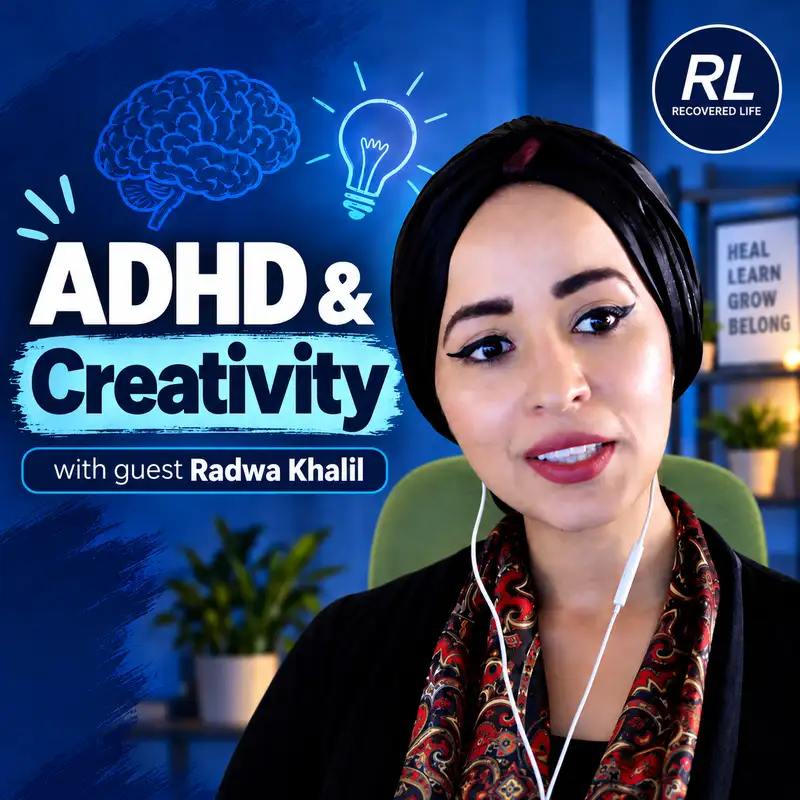
ADHD & Creativity with guest Dr. Radwa
Download MP3[Damon Frank]
What are the benefits of being ADHD for everybody out there? What is the big benefit of being ADHD?
[Dr. Radwa]
Well, I would say the benefit if the people with ADHD started to know their point of witness, their point of strengths better, and they try to focus in a consistent way, because being consistent is very, very important to train their mind and their brain to move with a particular focus on something, for example, that they like most.
[Damon Frank]
And welcome back to The Recovered Life Show. I'm happy to have my guest on, Dr. Radwa. I was intrigued by a very interesting article that was released on Science Daily about ADHD and creativity.
So I'm so glad to have you on the show, Dr. Radwa.
[Dr. Radwa]
Thank you. Thank you, Damon. It's my pleasure as well.
[Damon Frank]
Oh, I'm thrilled to have you and you're coming all the way from Germany. So we're doing this on a Saturday so we could coordinate the schedules. So thanks so much for coming on.
So ADHD, listen, this is an issue with a lot of people in our community in mental health and also in addiction recovery. Many people self-diagnose themselves having ADHD or somewhat of ADHD features like I did. And others are intrigued by it because maybe they have some sort of symptom or something in their life that looks like a pattern of ADHD.
And when I was talking with you before we started recording and one of the things that was very exciting about this article was that you're looking at ADHD not as a deficit. You're looking at ADHD as something that honestly could be very beneficial to somebody. Can you tell me a little bit about what you guys did in this article, in your findings?
[Dr. Radwa]
Yes, definitely. So it's true. ADHD usually get handed one story that something broken, something to manage, something to fix.
And no, that is not wrong. Exactly. It's just incomplete.
And this is actually what I wanted to point at. The very same attention patterns that make ADHD hard, the mind wandering and destructibility. The double looking onto one narrow thing can also be a hidden engine for creativity.
Once someone learned to work with it instead of constantly fighting it. And this is actually was the core part of this story.
[Damon Frank]
Yeah. You know, what's interesting is that I always found that people with ADHD think differently. The way in which they get things, you know, and I'm, I, I, I, when we were talking about your name, I have such a hard time with names and I went over your name like four times before we started.
I am, you know, I'm very dyslexic. And so I was, you know, I was dyslexic as a, as a child, had tons of learning disabilities. And, but, you know, as I grew up, people would say, you know, you think differently.
You think very quickly. You can, you can think really out of the box. And at the time, honestly, in the, in the eighties, uh, Dr. Radwa, that was not considered a good thing. Uh, but now it is considered a good thing to kind of think out of the box. And I noticed most of the success I've had in my life has been thinking kind of not in this traditional pattern. Do people with ADHD, what is it?
Do they think differently? Is that what's the scientific, uh, theory behind this?
[Dr. Radwa]
Yes. Oh, this is excellent question, but, uh, let me go, uh, just one step back. So, um, you know, I think the biggest misconception out there is that attention, uh, is only good when it's a later focus and anything else is failure.
This is actually is, is, is, is completely not correct. And this is what we're trying to tell in this perspective. It's actually no, the wondering the mind wondering could add actually much more value than what we can thinking.
And this is the condition with the ADHD and, um, you know, uh, I think has anyone ever told you your mind wanders too much? Uh, I guess a lot of people told you that, and this is the same with so many people with the ADHD. So, um, if we actually look at the, um, people with the ADHD, we are talking actually about from the name ADHD.
So it's attention deficit, right? Hyperactivity disorder. So when we are talking about the common mechanism here, it would be about the attention, how creativity is working.
One of the neural mechanism about it is actually about the attention, right? And what is needed is that you are focused and defocus your attention, you know, like in and out, in and out. And this process is actually is a spectrum.
It's not just on and off as many people actually are thinking. And this is actually is one of the conception. So misconception here.
And that's why we came and said, okay, why we can't actually tell about the overlapping brain network that it actually can tell something actually better if we could refocus, you know, or readjust this attention.
[Damon Frank]
So is it, is it that because I, what I see is that people with ADHD can think about multiple things simultaneously.
[Speaker 3]
Yes.
[Damon Frank]
And, and this is the thing it's, I think there is a little bit of a, um, a confusion with people who are not ADHD because they think, well, you're, you're going from one thing to the next thing to the next thing rapidly. And yes, that, that is true, but you can kind of, in a way, and I'm going to use a, a, a, a word like consciousness here. You can kind of hold all the ideas and all the channels simultaneously at the same time.
And this is where I think the creativity thing is so important because I know I was super creative, ended up going to art school after I, you know, got rid of my dyslexia or was able to manage my dyslexia, kind of concentrate a little bit more. And I think it is important to be able to concentrate on a channel at a time that there's benefit to that. Um, but I noticed I was a really out of the box thinker.
I would think in business, in art, in, in, in, in ways that other people could not. Is this, is this true? Are people with ADHD, do they have a much bigger funnel at being able to see possibilities?
[Dr. Radwa]
Um, yeah, exactly. So the point is that the, the, the, the scheme or the broad scheme of them, as I say it, we always have what is called focus and defocus attention. And let's think about it as you have a background, you know, that would, what exactly you are mentioned, you know, it could be a different knowledge that you have different interests and so on.
So this would be actually the solid background that you are having. And then you are zooming in a particular focus, let's say art or, or some, something that is really, uh, attract your passion or your attention. Right.
And then you are making this free association between what is from this, uh, this background that you are having for this knowledge, you know, establish this knowledge from, uh, defocus attention to focus attention and so on. But exactly, as you mentioned, it's not binary, it's not one to zero or zero to one, you know, and so on. But again, it's a spectrum, you know, it's a spectrum of styles that can keep going on and off, you know, and even have a gradient with it.
And this is actually the thing that we need to pay more attention and to do more research about it, you know, because most of the time, again, our perspective or our view need to be fine-tuned better. It's instead of looking at the things as it's broken, it's wrong, you know, and so on, try to take the positive side out of it, try to actually take the benefit out of it and try to make just a fine tuning. And believe me, it would be completely something extraordinary, you know.
[Damon Frank]
You know, I, I, I love this and it, I remember now I, I was listening to something on the news and it was talking about how employers always look for hard skills and now everybody's looking for soft skills. And I think this is the ultimate soft skill.
[Speaker 3]
Yes.
[Damon Frank]
Honestly, right? Because to be able to read the room, to be able to take in a lot of different information, see different options, be able to skip from one to another without such, such a hard attachment. Because I know people who are not thinkers like this, they're in my life, they're in my family.
It's very hard for them to shift to, to another point of view very, very quickly. And I find that people with ADHD, they can shift all over the place very good without so much attachment. There's not as much attachment to it.
But you mentioned that, that there's some benefits. What, what are the benefits of being ADHD for everybody out there? What, what is the big benefit of, of, of being ADHD?
[Dr. Radwa]
Well, I would say the benefit, if the people with ADHD started to know their point of witness, their point of strengths better, and they try to focus in a consistent way, because being consistent is very, very important to, to train their mind and their brain to move with a particular focus on something, for example, that they like most, you know, then, and they keep it regularly. Let's say, and now I started to work on a particular project. And I got my aha moment in this particular project in this particular topic, you know, I started to be very activated within that.
And my attention is really in the focus with that. Then, after, after, afterward, I would zoom completely to something completely different. And then I ignore what I actually started.
This is actually is the problem, the point. So I need to train myself to stay a bit longer in the focus or come back again to what I started, you know, with a therapy training, this is actually is require more therapeutic training. And this is actually is what we try to transfer as a message here.
We never say that it's, it's something, you know, stop taking, if you take medication, stop doing this, or we are just a marketing, you know, the ADHD, we just trying to see no, there is actually a positive side that you can see here. And with a better intervention, better therapeutic training, by using the whatever, actually attach it to your passion, you like most, you know, that can keep your focus on, you know, so that you are not bored of this. And then you, you finish this project or these things beautifully, perfectly, you know, this is actually was the main, the main point that we wanted to refer to.
[Damon Frank]
You know, Dr. Radwa, a lot of times, people that are in addiction recovery, will have a later diagnosis of being ADHD. And most of it is the discussion around that as well, you're chasing the dopamine hit, just like addiction, you're just chasing this dopamine hit. Now, I think there's obviously something to that, or we all wouldn't be saying it, right?
But what does that get right? And what does that get wrong about ADHD? Is it really the dopamine hit?
Because when people say you're chasing dopamine hit, I honestly find when ADHD is out of control, it is tiring. It's not like thrill seeking, or like when I first got sober, I mountain biked a lot, and I hurt myself and did crazy stuff. It's not like that.
In my experience, it's not like that. What is right and what is wrong about this dopamine conversation? Are people with ADHD just chasing dopamine?
[Dr. Radwa]
Well, this is a very, very interesting question. And I couldn't say too much about, honestly, dopamine there. I would say for most of the research that had been done on the ADHD, they just found that there is a particular commonality and the neural network pathway that are involved in it.
And which is mostly are related to or based on the attention circuit somehow. And the brain wiring that is related to ADHD is somehow having more distinction or having more signature than in compared to the others. Honestly speaking, the dopamine story is too much complicated.
It might need another broadcast by itself.
[Damon Frank]
Yeah, we're going to have to do another one.
[Dr. Radwa]
Because dopamine, as you already talked, you are talking about reward, you are talking about seeking, you are talking about so many other aspects. And definitely, it would be wonderful to break all together with the neural mechanism, but it's completely another story by its own. But I would say it's not the dopamine wouldn't be the very primary hub of the story, rather than the brain circuits based on the attention itself could be the hub there.
[Damon Frank]
So how do you use this to your benefit? Because I think as we said before, so many people are looking at ADHD as a deficit. How do you use this?
What did your research show about how you use this, especially with creativity? How do you use this as really an advantage in life?
[Dr. Radwa]
Yes, this is another excellent point from you. So neurodivergent attention pattern that we are when we are talking about ADHD are not just a problem to solve, they can open up real pathways to powerful creative thinking, when they, again, as I say, it directed the right way. So, as you mentioned, yours, you yourself and just so many other famous people, they admitted that they are openly saying that they have ADHD.
And both are very creative and high performing. And this is not a coincidence that I am pointing at. Now, I wanted to hear say something, there is a crosstalk between unstructured mind wandering, which yes, generally get in the way for people with the ADHD.
And then this is guided the structure creative expression, which is the real potential that we are having. So the thing that we are not paying more attention to the attention mechanism beyond the creativity, which could be the core point, which is actually the core point that is affected in the ADHD. Most of the research in creativity, they are talking about, okay, what is actually going on on the brain, what is the interaction between the neural network that is happening, or the association, for example, with memory and so on.
But actually, attention is a very core neural mechanism that happened. And a very early research that we referred to that happened many, many years ago, that we're referring to the fact that there is association, the free association, you know, and defocus and focus attention. And we brought this back to the stage.
And we talked more about it. It's like, it's kind of, I wouldn't say ignored, but there could be a lot of light in this kind of research.
[Damon Frank]
I love that. You know, it's so funny, because I talk a lot about the dangers of free range thinking, just uncontrolled, right. And I know in mental health, addiction recovery, anything in this area, this free range thinking can be very dangerous.
Just constantly either thinking about yourself, thinking about the situation, rehashing things. I find this is really draining from an ADHD standpoint, just very, very draining. But I love what you're saying about almost mindfulness thinking, right.
And I've found for me, mindfulness is such a gateway to being able to use kind of what if you're going to call ADHD gift, because you're right, just focusing, kind of calming down in the fact of, yes, there are a range of possibilities. But now I'm focusing on this range, and then this, and then getting down to one, and then being able to go a little deeper into things have really helped me. What did your research show you about mindfulness?
Or what's your experience with the practice of mindfulness and ADHD recovery? I guess you wouldn't even want to call it recovery. You don't even want to do recovery.
According to this, we don't want to recover from ADHD.
[Dr. Radwa]
Well, definitely for, let me be honest with you in this regards. Not so many research, I mean, relatively, not so many research in comparison to other areas and so on, consider about the link between the creativity and the ADHD. I remember that some years back, Anna Abraham, one of the greatest creativity researchers that she pointed this out on the link between, you know, the ADHD and the creativity.
But I couldn't tell you that there are so many work in this relation, but I can tell you that for a mind wandering, that is one of the common mechanisms also that is involved in creativity or creative thinking itself, you know. So it's one of the process that is required in order to reach to the expression phase of the creativity. Because, you know, you have three stages, which is the input.
So it's whatever stimuli that you are receiving from the environment. And then the processing, what you do with this stimuli and what is happening in your brain. This is the attention mechanisms that we are talking about now.
And then you express this, either in art or in work or whatever it is, you know, so this would be the output. Now, and I would like to use the chance from this podcast to ask more researchers to give more focus on this, you know, we still have a lot of open questions that we need to answer, you know, in this relation. And we have amazing great examples from those who are having ADHD.
And I know a lot of friends, myself, who are having ADHD, they are super creative, super creative. And the degree of adaptation, as you talked about earlier, the adaptability, you know, in terms of decision or flexibility, and so on, is really very high, which always amazed me, by the way, and they always keep asking, say, Oh, because for me, I always like to pick the good part, the people or talent part and the people that what's make them really, you know, unique, because no one is perfect, no one can do everything.
But there could be a nature that make or remark everyone and make this person different from the other.
[Damon Frank]
Did your research show at all, the applied creativity that people maybe with music were much more so? Is it all types of creativity? Or is it certain types of creativity?
[Dr. Radwa]
Oh, this, again, is another creative question. And I think 2023, we pointed this in one review article in CNS and neuroscience and therapeutic with a neurologist, great neurologist from Croatia, Vida Demirian. And then we for from her perspective, she was considering the creativity as a kind of therapeutic values, something that can bring hope, even for people who could have dementia, Parkinson's, stroke, and so on.
And what's really was very astonishing that they were, I think the first time that they found that this case study was a 1996, something called the de novo emergence of creative abilities. So basically, they what they found that the people who had developed later, kind of neurodegenerative disorders, they show a great ability in artists, in art, in painting, or in music, you know, and they actually feel themselves to show better communication, even when they're there, they have a progress with a disease, even what they found is something really very interesting in that the way of painting was improving, you know, their, the complexity that they have, they, the way how they tell the story, the narrative beyond it was actually more particular, more special. And this was actually something was very special to tell that there is a hidden talent inside you that can be expressed to show something that you liked, probably not, doesn't have to be completely verbal, but it could be through drawing, through the painting, where you can use your imagination, and you express it or music, something that you used to do, and do you like, and this was really very astonishing. Now, coming back, precisely to your questions, yes, they, we have a different kind of the creativity. But unfortunately, sometimes we put the creativity inside the box.
So it's it, it has to be only painting or only music. But it could be also kinesthetic creativity, we can see also in the Olympic Games, you know, some, some kind of, of amazing arts and, and so on. Dance could be also kind of the creativity, writing novels, could be a sort of the creativity.
And what they found that it's a very common across all these kind of the creativities, when you are practicing or doing this sorts of creativity, that it's improved brain plasticity. With the music, you can clearly see that definitely we understand that with a musician, like the opera musician and professional musician, they have the stage of improvisation. So they also have a regular training on this and so on.
But within this also, they can come and surprise you at a certain point with something very special, you know, it happens sometimes you go to the high performers and then you you find that the singer came with something completely outside the box that you are not expecting. But within that, they keep actually improving, you know, train and working on it, the same in the Olympic was a sports, you know, and, and so on. So there are from the clinical sides.
There are a lot of cases studies that showed improved in the brain plasticity, the neuroplasticity and recovery, you know, and so on.
[Damon Frank]
And this is Dr. Rod, well, I have to ask you, what was your, what was the thing that surprised you the most about this? When you came in, did you have a certain idea of something that you thought, well, maybe it's like this. And then you were totally shocked by what was the most shocking thing or the thing that surprised you the most about the study?
[Dr. Radwa]
Well, I wouldn't say something completely surprised me. But I would say, let me just tell me what was the story beyond this study. So I was sharing the symposium in Mediterranean neuroscience conference.
This was October. 2023. And then in this symposium, it was talking about the creative process across different animal models, you know, and here I met the two contributing authors.
And
(This file is longer than 30 minutes. Go Unlimited at https://turboscribe.ai/ to transcribe files up to 10 hours long.)
Creators and Guests