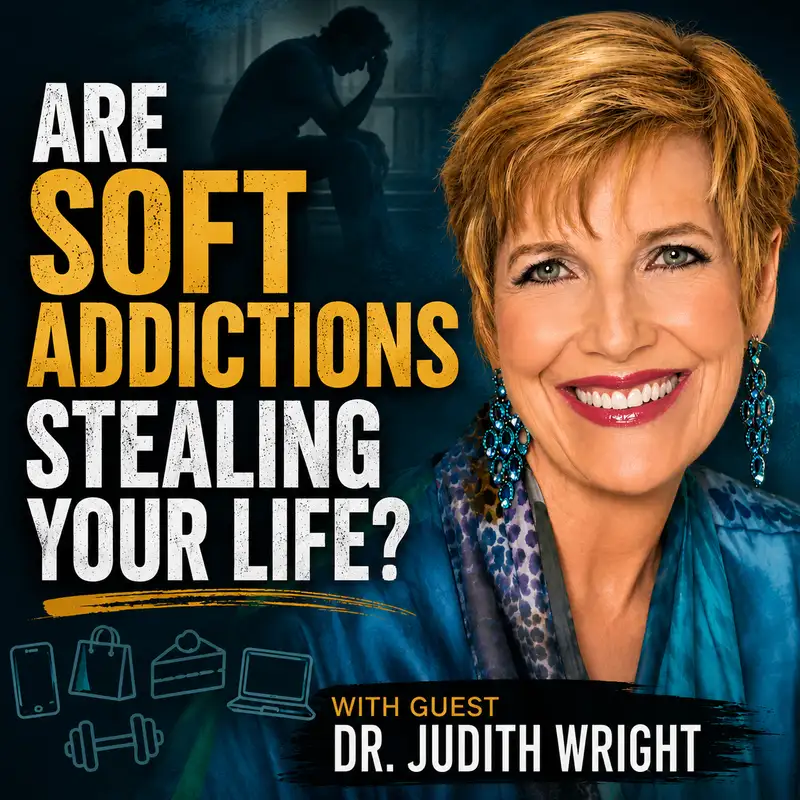
Are Soft Addictions Stealing Your Life with Guest Dr. Judith Wright
Download MP3The thing I knew is I did not
want to live my life unconsciously.
It's like Don Darkova's book, you know, I
will not live an unlived life.
I finally got to that place about it
and that's what started the spirit.
But that did, what I really, and when
in the self-denying solution, I hadn't done
the other research yet and I called those
yearnings spiritual hungers.
So that tells you something right there.
I just felt like there was, there's a
spiritual hunger underneath all that.
You know, when we're drinking spirits, there's spirit
that we're really looking for.
You know, there's something that we're hungry for.
At a deeper level.
And that's what I started to really explore
more fully.
So was it spiritual?
Yes.
Was it emotional?
Absolutely.
I really needed to get in touch with
what my feelings were to experience life instead
of numbing myself from it.
You're listening to The Recovered Life Show.
The show that helps people in recovery live
their best recovered lives.
And welcome back to The Recovered Life Show.
Listen, if you're like anyone in recovery, you
get into recovery, and maybe you recover from
the main addiction.
Maybe it's alcohol.
Maybe it's drugs.
Maybe it's gambling.
But then there's these things that pop up.
Let's just call them soft addictions.
I brought on my guest, Dr. Judith Wright.
She is the author of The Addiction Solution.
Also an executive coach, teacher, trainer, and a
very nice person.
So welcome to the show, Dr. Judith Wright.
Glad to be with you.
Thanks.
So thrilled that you're here today with us.
I do have a question for you.
This whole thing, soft addictions, and literally you
wrote the book on it.
What do you consider a soft addiction?
Because I see this a lot.
People say, well, I'm addicted to this now.
I'm addicted to that.
What is a soft addiction?
Soft addictions are those seemingly harmless habits, over
-scrolling, and over-shopping, and over-eating, and
too much Facebook, and too much sports, and
too much of normal everyday activities that we
don't often really realize the cost that they
have.
They're taking time, money, energy.
They're muting our consciousness.
They're numbing our feelings.
They're causing us more problems.
What I found is that it has this
felt sense similar to hard addictions, but you
don't die from soft addictions.
You could from drugs or alcohol, though it's
super overdone.
But you don't really live either, and that's
the bigger issue with them.
That's why I named them soft addictions as
opposed to hard addictions because there's some similarities
that do rob us, and we're not always
that conscious of it.
I love how you put that, not conscious
of it.
On the Recovered Life show and when we
do live TikToks and in our community, we
talk about the whole process of getting sober.
Obviously, drugs and alcohol, even disordered eating, there
are things, gambling.
You can actually see what's happening.
But the whole awareness of it is fascinating
to me because I know in my own
33-year recovery journey that there were things
that I was not aware that were unhealthy
patterns.
And these popped up.
They didn't pop up all at once.
They didn't pop up in my mid-20s.
They didn't even pop up in my mid
-30s.
Some of them popped up when I was
beyond 50.
So how do you become aware that something
is not necessarily healthy for you?
Because this is the big thing because people
all the time say, well, at least I'm
not drinking.
At least I'm not using drugs.
At least I'm not disordered eating.
But how do you know when it's maybe
crossed the line?
It's just not working for you anymore.
Well, that's a really good point that it's
just not working for you anymore.
It's actually part of that.
It really is that becoming the awareness.
Partly it's like what are we feeling or
what's the state we get into when we're
doing something?
Because that's more of it.
Because even good things can become addictions.
We can overwork.
We can overwork out.
I had a woman who came to me
because her family was upset because she was
over praying.
She was addicted to praying.
I said, how is that possible?
What I saw though, she kept praying rather
than talking to her family, rather than doing
whatever.
She wouldn't face things.
So even a beautiful thing can become a
problem if we over do it.
But what are we using it for?
That's part of it.
Are we numbing?
Are we escaping?
And how do you feel?
Because oftentimes when we're overdoing things, we're getting
a little in a trance.
We're a little numb.
We're a little checked out.
We can get a little buzzed.
You get a little forgetful.
You're a little foggy.
There's a state you get into that's not
clear and open and learning and connected.
It's a more unconscious kind of zone that
we get into.
And that zone is what's robbing us.
Yeah, I love how you put that.
I always say addiction is all about not
being okay in the here and now.
Here, here.
Yeah, because being, you know, and many people
that watch a show have, they're either recovering
from a mental health disorder or they are
recovering from alcohol or drugs or some other
pattern that no longer works for them.
And as they start shedding that and maybe
even stop using the substance or doing the
pattern of their main primary addiction, these other
things pop up.
So I have to ask you, why the
book?
Why did you write the book?
Because you obviously saw this in your day
-to-day practice and dealing with people.
It was two things.
One is my own journey, and I'll weave
that into this as well.
But it was also working with people because
my clients were doing beautiful work.
I mean, they were learning and growing and
their feelings are coming up and they're doing
things.
But then I would notice that they would
plateau.
That's not everybody, but they were plateauing.
They weren't going any farther.
And yet they were putting in a lot,
or we'd have a big weekend retreat training
and their feelings are coming up, whatever.
But then it felt familiar.
It felt like people that we've been working
with that were using drugs and alcohol, but
they weren't drinking and they weren't doing drugs.
So what's going on?
So that was my first clue, because there
was something happening.
So then I discovered, well, they might have
this great weekend of having feelings and the
flowing, but then they go home and they're
numbing themselves from those feelings.
Again, they're uncomfortable with what had gotten stirred
up.
That was one of the things.
It was actually undoing the progress that they
actually had been making unknowingly.
That was kind of part of it.
But I also noticed in my own life,
and I feel okay if I go into
my own journey.
Yeah, please.
That's why we do the show.
Great.
So I was overweight.
Eating was an issue for me.
I was overweight.
I would just, even as a little kid,
I'm coming home from school and I'm stuffing
my face with cookies and milk and the
whole thing.
It was my coping device when I was
uncomfortable, had feelings I didn't know how to
be with, didn't know how to comfort myself.
That was what was happening.
And I realized finally that I was hungry
for more than I was stuffing my mouth
with.
I was hungry for much more in my
life, but I had to discover that.
And I did finally, I went on a
food plan.
I'm pretty strong-willed, so I lost weight,
but I was still obsessed with food.
I was thinking about food all the time.
When am I going to eat?
How much am I going to eat?
How many calories is this?
When's the next thing?
I'm still like, I still have an addictive
relationship with food, even though I wasn't eating
it.
That was a clue for me as well.
So, and I'm also watching this with my
clients and I'm saying, wait, there's something else
going on here that's keeping us from being
conscious and being alive and having our feelings.
I had been doing it with my eating.
They were doing it with whatever.
And like, wait, this isn't it.
And for me, I just had a point
in my life where I felt like I
was sleepwalking through my life.
Like I was numb.
I was highly achieving.
I was working.
I was doing good work.
But I'm empty inside.
And that is what started to bother me
so much that I felt like I was
wrapped in cotton trying to like work through
life.
I wasn't feeling or experiencing more fully.
I didn't know what that was, but I
was like, wait, I don't want to live
muted like this.
I don't want to feel, I guess it's
not even a feeling.
I don't want to be in this state
of zoned, unconscious, numbing, whatever.
And I finally kind of, what I ended
up calling my one decision, which was another
book of writing about like this bigger contextual
decision.
Like, wait, I'm going to feel my life.
I'm going to experience life.
I don't know how, but I'm going to
figure that out.
And that journey kind of led me on
what we're talking about now.
I started realizing that one of the reasons
I was so empty and one of the
reasons why my clients weren't progressing is that
we were countering our growth work.
We're countering it with numbing.
We're uncomfortable feeling and we didn't know how
to tend to ourselves.
And the best thing we do is grab
that cookie or start scrolling or go to
Facebook or go buy something or get immersed
in sports.
So we could feel alive but we weren't
really feeling it in our own lives.
So it all kind of came together.
My own journey that people are always working
with and then really started to work with
people and discovered that this really is a
bigger issue.
There is a national poll that 91%
of people admitted to having soft addictions.
I think the other 9% are in
denial because I think we all have them.
So that's why they're so, it's so tough
because they're so ubiquitous.
They're everywhere.
Everyone's doing it.
So you don't see it as something that's
troublesome.
Yeah.
And I think society is geared around finding
and having soft addictions with everything that's going
on social media right now.
You know, you see this a lot and
it's interesting that you said that you are
high performing.
I see this more in high performing people
especially people who are have long-term recovery
and from anything, from any kind of primary
addiction that was life-threatening tend to be,
and I know this was my story.
I became, I got right out of that
in my twenties and I made a decision
that I was going to become a high
performance person.
I think I already was that inside but
the addiction alcohol stopped me from doing that.
And I went right in career in Hollywood,
the whole, you know, did got all the
things, did everything that, you know, that I
really wanted to do and beyond.
But what was happening is I got in
a long-term recovery.
Same thing, what you're talking about is cause
like everything is okay.
It should be perfect actually, but it's not
inside.
And this is a painful realization that even
the achievement will not save you.
No, I think there's so, and that's profound.
And I find that with a lot of
the people I work with too.
I mean, it really is, it's like, wait,
this should be it.
This was it.
I'd reached national prominence in two different careers
by the time I was like 28 or
29.
I'm like, okay, I should be floating here.
And I wasn't, as you found it, that
isn't it.
And if that's not it, what is it?
And then I tried a lot of things.
I don't know what it's like for you.
I tried a lot of things.
Then I tried trying harder even, or, you
know, being more achievement or partying harder or
whatever, trying to touch that emptiness.
And none of that is it.
It really is this deeper relationship with ourselves
and our feelings and really being more comfortable
with our being and not just so addicted
to our doing.
Yeah.
And I think, you know, the interesting thing
that I'm finding about this, about the soft
addictions is that I see this a lot
in recovery.
Sugar was my primary addiction.
But really when I peeled it back, it
was really escapism.
And I could do that through work.
I could do that through hobbies.
I could do that through other people, right?
With codependency, you can apply this all the
time.
How do you start that healing process?
And obviously it has to be, I always
say, it's uncomfortable to be in the here
and now sometimes.
It's like, it's beautiful, but very uncomfortable.
How do you do it?
How did you do it?
How did you start to say, you know
what?
I don't need any of these soft addictions.
You know, what I started to do is
I started to see what is it that
actually does nourish me?
Where do I feel alive and fulfilled?
What is that?
And then I did a big research project
that I did on really studying people who
had great lives.
Like what are they doing?
If everything's working for them and they don't
have that empty feeling inside and they've got
their leadership, things are working.
And what I discovered is I really did
discover the skills and the process of living
a great life.
But if I go into this first thing,
I think it'll start to unpack it for
us as we're talking.
What I realized is they follow what I
ended up calling their deeper yearnings.
Those deep desires of their hearts rather than
the formula that society says or what your
parents say or whatever.
They're looking inside what really matters.
And what I found underneath every soft addiction,
it's like soft addiction has a positive intention.
It's trying to take care of us, trying
to comfort us, trying to help us feel
better.
But it's misguided, it's kind of counterfeit comfort.
But underneath every soft addiction, there's a deeper
yearning.
You know, why are we on Facebook?
Well, chances are we're yearning to connect or
to know that we matter or why do
I want my coffee?
Well, I really have this yearning to be
more alive.
Whatever it is, it can be different for
each person.
But if we can take what we're doing
and look at what we are hoping that
would do for us, that's a clue of
what those deeper yearnings are.
And once I started to unpack that, and
then I said, oh my gosh, this is
universal.
This one, I'd love to go into the
math of more related to this.
Yeah, please.
So what I realized, what I ended up
calling the math of more, it wasn't so
much just cold knuckle, you know, willpower.
Willpower is limited.
That's hard to let go of these things.
It's, and we need to, we need to
make a little, we need to subtract a
little.
We need to make a little space in
our lives for something more nourishing.
But it's really what matters is what we're
adding to our lives.
When you add things to your life that
meet those deeper yearnings, it's much easier.
It's kind of, you naturally subtract the soft
addiction.
They're not as attractive because you've got the
pure replacement for it that actually does fulfill
us.
So what I found the math of more
is that adding things that really truly nourish
you, that meet those deeper yearnings, help you
naturally subtract some of the soft addictions and
multiplies your fulfillment, your satisfaction and nourishment.
And that was a huge key for me
to discover that.
I love that.
You know, I always say that so much
of recovery is like an artichoke.
You're peeling off the things that no longer
work for you.
And by the time you get down right
to the heart of it, it's so translucent
that you're not quite, it's like, do I
need this?
Do I not?
And what am I adding to my life?
And is it really adding to my life?
Is it adding joy to my life?
Is happiness?
I have to ask you about identity because
one of the things that really bothers me,
it's a pet peeve of mine.
And I know I should let it go,
Dr. G.
I know you're telling me, let it go,
Damon.
But one of the things that bothers me
is a lot of people will come into
recovery saying, well, I'm broken.
And what they do is they'll take in,
they're addicted to identity.
So they'll take something like disordered eating or
gambling or drug and alcohol addiction.
And they'll say, well, I'm broken.
And that was my identity as an alcoholic.
But now my identity is a broken person.
I'm always going to be broken.
And I'm saying, no, that was an experience.
That was an experience.
That's not who you are.
And your identity is much deeper than the
experience.
And do you think that this is where
a lot of times these soft addictions come
up?
Because it's just an inability maybe to say,
it's okay that my identity is not my
addiction.
I think that's well said.
And I think, if you look at it,
if I'm broken, then I need a fix.
I need to get, it's related.
You fix something that's broken.
You need a fix if you're broken.
It's tied together in a way.
And what I find is that it's, we
all have core mistaken beliefs about ourselves.
It's our part of being a human being.
Alfred Adler, the wonderful psychologist about the time
of Freud, he said that, he's the one
that came up with inferiority complex.
And he said, everybody's got an inferiority complex.
If you think somebody doesn't, you just don't
know them well enough.
It's just part of being a human being
that we've got some core mistaken beliefs that
are not true, but it's true that we
believe them.
Like I'm not okay, or I'm not worthy,
or I'm not lovable, or I'm not enough,
or I'm too much.
That goes on in all of us, but
that doesn't need to be our identity.
It doesn't need, we don't need to over
-identify with that.
We need to recognize that there's some unconscious
material for us and build more what we
call a new matrix, a re-matrixing into
this.
I am worthy, I am a gift, and
I am that.
I'm not broken, I'm a gift.
I'm a whole human being who has these
rich life experiences.
And it's really that we look at what
we, in the research they call your redemptive
narrative, where are you headed?
Identify with what it is that matters.
Like I am a gift, I do matter.
I'm a wonderful human being who's a human
being with flaws that, welcome to humanity, we
all have flaws.
It does not mean we're broken.
We are just human and we're growing, and
that's what matters.
Yeah, I love that.
You know, I shared not too long ago
with some people that were very close to
me.
I've had many experiences like this, and I
try to start my day like this.
I've had experiences where I don't have to
do, be, or achieve anything to be okay.
You know, and that's where I try to
start from.
I don't have to, because then I see
these soft addictions.
Well, let's just binge Netflix because I don't
really want to, I'm tired and I don't
really want to deal with paperwork.
Or, you know, I don't have to do,
achieve, or be anything.
I'm okay just how I am.
And my job is to show up and
play full out, shine my light, do, you
know, use my world-class skills the best
I can.
And the rest is gravy, right?
But it's hard to get there sometimes, I
will admit.
It's a challenge.
No, it is a challenge.
What I realized is that being okay isn't
a feeling, it's a decision.
Yes.
I could feel like crap and still decide
I'm okay.
And I think that's what's important.
If I wait till I feel like it,
you know, that may not be, that morning
may not be that way, but I can
decide that.
And we can, and live from that, which
it sounds like what you're doing.
Yeah, feelings are not the friends you think
they are a lot of times.
You know, either is your thinking, right?
No, it's not.
We have a lot of stinking thinking.
And to be aware of that and have
some compassion toward it and a sense of
humor, but to kind of recognize when we're
talking ourselves into things that we don't need
to be.
So let's talk about you as an author
in your book.
What people get from the book?
If they find themselves going from soft addiction
to soft addiction to soft addiction, and they
notice something's wrong, what journey do you take
people on in the book?
In the book is that soft addiction solution
actually is a solution.
It's eight key skills that you can apply
to your life.
And when some of the, what we're talking
about now, it's just really identifying, you know,
where am I?
And I realized there's a wide range of
soft addictions of what I realized there's activities,
things we overdo, but then there's avoidances, things
that we don't do, we can be addicted
to.
And there's also what I found are there's
mood and ways of being addictions that we
can get addicted to.
So I'm just watching like, oh wow, I
perpetually crack jokes when I'm uncomfortable or, you
know, there's things we do that are part
of it.
So part of it is the identifying and
then kind of looking at the cost of
it.
So we're kind of so get ourselves a
little sober by what this is costing me
and my relationships, the money I'm spending, the
time, the consciousness, the what are the costs,
not to beat ourselves up, but just to
be aware that we deserve something more.
And then there's different skills with that one's
making a bigger contextual decision.
Who do you want to be?
How do you want to be living your
life?
And really using that to try to guide
you.
But part of it is really looking at,
there's a couple of things that help on
the journey.
Really looking at why, you know, where did
my patterns come from?
What's going on?
What's going on when I, what's my historical
pattern as a kid?
You know, mine was that watching TV and
eating cookies and milk while I have those
same kind of changes.
Some of the same times like comforting things
as an adult, but why in this moment?
I didn't need it.
I didn't need to be at the refrigerator
five minutes ago.
Why am I there right now?
I didn't need to pick up my phone
a few minutes ago, but right this moment
I did.
What just triggered?
What's going on for me right now?
Chances are there's a feeling that's uncomfortable to
be with.
Something that usually it's a feeling where we
have fear or hurt or anger or sadness.
Sometimes even joy can be uncomfortable for people.
Am I doing something to numb it?
So the steps take us through.
There's a whole template and things really.
Okay, why, what just triggered this?
What am I doing?
What triggered, what happened right beforehand that I'm
doing it?
What was I feeling?
What was I thinking?
You know, what are my beliefs are getting
triggered here?
And what do I really yearn for?
What am I really hungry for in this
moment?
And what could I do instead?
And if we keep going through that process
over and over and over again, we really
start to fill our lives with things that
are, I cannot believe the difference in my
own life.
And for me, like I thought I'd be
addicted to food the rest of my life.
That'd have been a huge part of my
life.
Like I would just have to like deny.
I have not had to.
I've lost that whole compulsion around food.
I can eat whatever I want.
I haven't gained weight.
I eat healthily because now I know how
I feel.
I want to feel more conscious.
And when I eat, you know, all that
fried food and that gravy and potatoes and
whatever I feel like a slug.
So it doesn't feel good to me.
So I'd probably choose something more that gives
me more energy or whatever.
But it's, you know, I don't want to
overcomplicate it.
It's these little steps, step by step by
step, being aware that we're doing something.
We're feeling something.
And what are we really yearning for?
And that leads us in a really beautiful
exploration of what's possible.
I love this.
I absolutely love this.
Thank you so much, Dr. Judith Wright.
We're gonna put links on how to get
ahold of her and the book.
Also, we are going to do an after
the show with Dr. Judith and we're gonna
talk.
We're gonna do a deep dive about how
she used these eight things to change her
life.
Thank you so much for coming on today.
Thanks for having me.
It was great.
Creators and Guests