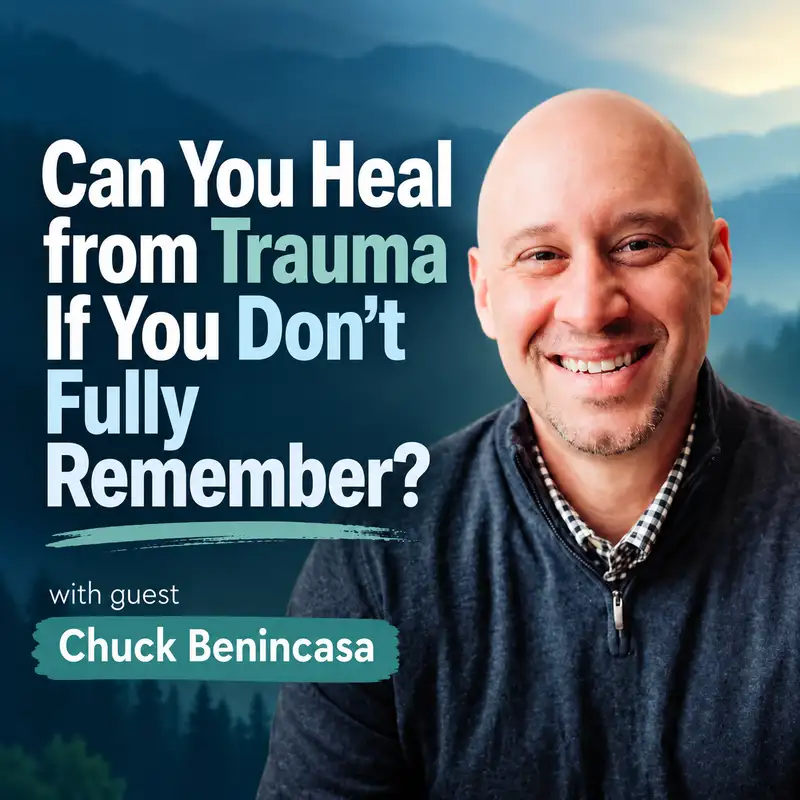
Can You Heal From Trauma If You Don't Fully Remember? with Guest Chuck Benincasa
Download MP3[Chuck Benincasa]
When people have those gaps in their memory, it is usually because they did not have available to them the support and the resources that we require biologically as humans to process terrible things when they happen to us. And so not remembering or finding a way to to make that go away is the only solution in that absence of resources. You're listening to The Recovered Life Show, the show that helps people in recovery live their best recovered lives.
[Damon Frank]
And welcome back to The Recovered Life Show. Can you heal from trauma if you don't fully remember what happened? That's what we're going to talk about today with my guest, Dr. Chuck Benikasa, a licensed clinical psychologist who specializes in complex trauma dissociation and extreme forms of abuse and neglect. He's worked extensively with people dealing with complex PTSD and dissociative disorders. And today we're going to unpack what healing could actually look like when the memories are incomplete, unclear or missing. Welcome to the show, Chuck.
[Chuck Benincasa]
Thank you. I'm happy to be here.
[Damon Frank]
Oh, I'm so glad that you are on the show with us today. It's your first time. And I was excited to have you because you have worked extensively in this field.
And, you know, I hear this a lot, especially on TikTok Live. It's like, I kind of remember the trauma. I don't fully remember the trauma.
Obviously, trauma happens sometimes when we're younger and we might not remember all of it. Is this a common thing that people will say? I have pieces of this, but not the full picture.
[Chuck Benincasa]
I think it's I think it's very common throughout our lives. Memory works different. And when we go through really stressful situations, memory also doesn't work the same.
And we think about memory as one way that we know stuff about ourselves or about our past or about our history. But it's not the only way. So sometimes people will have a sense of knowing of things that have happened to them, but they may not have that Polaroid snapshot of a particular moment in their mind.
And a lot of people who experience different kinds of trauma are responded to by the people around them in ways that communicate that it's better if you think that this didn't happen. And that can have an effect on how we remember, what we end up remembering and the doubt that we might have over.
[Damon Frank]
Those, yeah, those details, you know, and obviously some trauma happens through abuse and obviously, like you said, the abuser is not going to want to claim that they abused you. Right. And in memory is incomplete.
Can we dial in on that a little bit more about in your experience when people have incomplete memories? What does that look like? What does that look like when somebody doesn't fully understand?
Obviously, you've seen people who walk in, they're like, this is exactly what happened. This is what, what, what had, and this is why I feel like I have the trauma. But what about the people who don't, what does that look like typically when you're, when you're speaking with them?
[Chuck Benincasa]
Yeah, I would say that the way that this shows up in my practice is probably more than three categories, but the three categories that I think of right away are the impact of neglect, the potential impact of dissociation, and also the impact of development. So if I start with development, depending on how old someone is, when they have that traumatic experience, that traumatic experience is going to be remembered in the context of what their, how developed their memory capacities are at whatever age they are. And then with the, you know, the distress of the trauma on top of it, what we refer to as autobiographical memory, the ability to remember specific details or events or, or knowledge about ourselves, our own lives, that doesn't develop for a lot of kids until usually age four or five.
That's why if you ask someone their earliest memory, that's usually about the age that they go to. What's interesting is if you ask someone who's maybe six, what their earliest memory is, they might go back to two or three. And a big part of that is because what we consider valid memory as adults isn't necessarily the same criteria that kids use.
And, and a kid may not have that Polaroid picture in their mind because that autobiographical memory hasn't formed very much, but they have a knowing and awareness that, that it just, well, yeah, that, I mean, that's what happened because I know that that's what happened. And so that can, that can play a big part of it. The second one, dissociation.
Dissociation is a function of the brain that all mammals possess to different degrees. And it's one of the ways that the brain responds to significant distress, terror, inability to escape those kinds of things. And dissociation by definition is just the disconnection of things that we would otherwise expect to be connected.
And memory is a really big part of that. For those that have more dissociative abilities, they might be further down that dissociative continuum. They will be able to tell you the ways that their memory is affected by that.
And sometimes dissociation can affect memory because if they're having a dissociative response in the midst of a traumatic experience, that dissociative response might affect what aspects of that experience can even get encoded into memory. And it's also true that sometimes the protective dissociative response itself is the need to not remember. And so how it gets stored, how it gets pulled back up can look different.
And then lastly is the impact of neglect. And in the work that I do, working with abuse and working with neglect are really different. To some degree, all abuse has components of neglect, but abuse is a tangible, this happened and then this happened and they said that and then they said this.
There's stuff you can do with that. Neglect is an awareness of what didn't happen but should have happened. You don't know necessarily why it should have happened.
You just know that you know that it should have happened. And interestingly enough, when we look at the experiences in early childhood that are most associated with the development of dissociation throughout life, it's actually early childhood neglect more than anything else. So how do you remember what didn't happen when what didn't happen is the thing that affected you the most?
[Damon Frank]
I love that. Is neglect something more as you get older, you know better? You learn more, you see different things.
[Chuck Benincasa]
Man, I think that really depends on the person. I think that some people, the way that they might process or whatever their values are or their cultural background, the way that they kind of make meaning, they might look back on a situation and be like, wait a minute. No, I have a person in my life right now who loves me a lot.
This is what love is supposed to feel like. Why wasn't it there back then? You also have people that in that experience, when that becomes their normal, I use the line from Hamilton a lot of King George, I didn't know that was something a person could do.
A lot of people with neglect, as they get older, it affects their relationships because the way that a lot of people around them intuitively or naturally interact or engage in relationships is something that just doesn't make sense to them. There's, I think, a lot of other options in between those two, but yeah, it's really specific to the person.
[Damon Frank]
A very popular book, The Body Keeps the Score, everybody was talking about that a few years back and still talk about it now. You know, the nervous system, does trauma come out, this kind of repressed trauma or not remembering trauma through your nervous system and through your physical health? Do you see that?
[Chuck Benincasa]
Yeah. Does it go up there? It does.
I think if you look at what has been consistent across all of our diagnostic criteria, different versions of the DSM, the ICD, looking at PTSD, complex PTSD, dissociative disorders, all of them pretty clearly talk about the impact of dissociation on the resting state functioning of the nervous system, the baseline functioning of the nervous system. When we're talking about the nervous system, that includes a lot of different things. It can include the way that your emotions regulate and that you experience them, the level of intensity you experience them.
It is about the fear centers of your brain and how easy or difficult it is for those to activate and in response to what kind of situations there is sensory impacts, right? We experience the world through our senses and our senses can be affected by trauma. When we encode traumatic memory, those memories get encoded with all of that stuff potentially packed in there.
You might have somebody that says, I was assaulted, but I don't remember what he looks like. I don't really remember much about where I was, but I remember cinnamon. Then the rest of their life, they might be responding to things that are sensory cues that they're not even necessarily aware of are creating those types of responses.
There have been updates in research since that book was published and that's the way it's supposed to look. We learn new things and we adjust our understanding, but largely speaking, the idea that our body is impacted by the experience of trauma has continued to be validated by newer research. Even looking at something like the ACE's body of research, which has its flaws, but it still is another example of how trauma is is directly correlated with later health outcomes.
The things that happen to the bodies, thinking about trauma as a really, a really severe survival-based stress response. We've got tons of research that tells us about the impact of chronic stress on the body, right? So everybody's swimming in the same pool, so to speak.
It's just, there might be differences in how people talk about it, but we also, I think, especially in our culture, have a tendency to minimize the effects on the body. We also tend to minimize the effects on things like executive functioning, especially earlier childhood trauma, developmental trauma, as Bessel van der Kolk would call it, the way that it informs how our organs, our brain, our body develops. We've got research that shows differences in actual volume of the prefrontal cortex based off of different types of trauma.
One of our biases in this culture, which I think a lot of people with ADHD would probably tell you is true, we have a tendency to make effort the solution to everything. We have a tendency to minimize the systemic ways that our brain, our cognition, our bodies, our organs, our sensory systems are all constantly working together. When any one of those is disrupted, it's going to affect how we experience our surroundings, and it's going to affect what we're able to do.
[Damon Frank]
You know, the interesting thing is I saw this with working with people in early addiction recovery where, just on a peer support level, that they would be sober, let's say, the first year. They would go home for a holiday, Christmas, Thanksgiving, and nothing really would happen, but they would be triggered. So even though maybe the abuser or the trauma or the thing that created that trauma is changed, they still will be triggered from this.
And what's interesting, the reason I want to do this show is even people in the same family, some will remember the abuse and trauma, other people will not. Siblings just a couple years apart will not. Is this a common thing where these triggers are really subconscious?
[Chuck Benincasa]
Absolutely. Can I use an example that's close to what you were just talking about? So I was trained in Minnesota, and I did all of my early clinical training in different sites in Minnesota.
I was working with a client in Minnesota who had a ton of abuse in childhood. She was neglected in childhood. And in adulthood, she was in and out of abusive relationships, and she continually struggled throughout her adulthood with alcohol dependence.
And just as motivated as she was for all sorts of different reasons, she had a really hard time kicking it. There was a period of time where she was in one of her longest windows of sobriety. I remember I saw her on Mondays, and she came in every Monday, and she just kept talking to me about the week goes pretty well, and then Sunday comes along, and I am just so uncomfortable in my body because I'm just full of anxiety.
I have no idea what it's about. What is that about? In Minnesota at that time, liquor stores were closed on Sundays.
And I asked her, I said, how would you feel late Saturday night if you had already been drinking and you ran out of alcohol? And you could instantly see in her face the recognition of the feeling of that overwhelming anxiety that she would have at the idea of liquor stores are closed on Sunday, and I've been drinking, and Wisconsin is not a close drive, and all of those pieces, those things weren't things that she was ruminating on or preoccupied with or thinking about. They were things that her body remembered because that was one of the scariest things for her was the idea of running out, and then what do you do?
[Damon Frank]
I think it's so common. I mean, even with divorced families, Sunday nights tend to be very difficult because Sunday nights was a handoff night. So there was all this transition.
So most people are decompressing on Sunday night, getting the last little bit of their weekend before work and school, but if you're a kid that was in divorce and being handed off on a Sunday and transitioning, that would create a lot of anxiety.
[Chuck Benincasa]
Absolutely. Yeah. And a lot of that also comes down to what some people refer to as the pain paradox, which is at least when it comes to psychological pain, to heal it, you have to feel it, and hopefully feel it when you can tolerate it, when you have support, all of those other things, but we also do everything that we can to avoid it, and it's almost never conscious.
It's almost never a cognitive. It's almost never I'm avoiding this thing because I think I'm going to feel pain. The ways that are coping strategies, the ways that and I feel like coping strategies is just not a strong enough construct here of when you are moving through the world as a constant stranger in your own body or where your body is your arch nemesis, you're in constant discomfort, you're anxiety or fear or anger or sadness or the ways that we carry that trauma with us.
Trauma is one of those things that it's really unlikely based off of what we know about how it works physiologically to spontaneously go away or to heal itself. And a lot of people with complex trauma histories are really good at moving through the world as though nothing is wrong when on the inside, they feel like they're on fire. And without it needing to be a conscious thought, when that is your internal felt experience, your nervous system is going to do whatever it can to help you find things that are going to alleviate that pain that you're experiencing.
And the things that work the most and are most effective for you as a person are the things that are going to get reinforced. And I'm not necessarily trying to introduce a theory of substance use or coping or there's a lot of complexity there. But when I talk with people who are so frustrated with themselves because the behavior that's most getting in their way in their life, they'll come back and they'll be like, I did it again.
And if I ask them, okay, well, what was going on? What did you notice on the inside? And what were your other options at that moment?
Well, I don't know. Right. The moment that you're in a lot of pain or that you're suffering or that you're grossly uncomfortable is not the time that you experiment with new coping strategies.
You go back to what you know and you go back to what works. And again, I think because we are too quick to make something a character flaw or make something a, you're not trying hard enough or you're not committed enough or, you know, we offer those explanations from the outside, but we haven't spent a day in there.
[Damon Frank]
Yeah. We know it's interesting because you're saying something about this almost a program kicks in that on the outside, everything is okay. But on the inside, falling apart, I found with people with trauma, those are the people you want when shit goes down, Chuck, because they're in the line of fire.
Amazing. Three days later, a basket case.
[Chuck Benincasa]
Yep. Well, because, because when the ways that our body responds to trauma is exactly the way that it is supposed to, to further our survival, the, the differences that you know, when, when you look at sort of our, our evolutionary history or, or what might've been true even 10,000 years ago is not true today of, you know if you don't have a way to protect yourself from that thing out there, that's got huge teeth and is about to, you know, come in and eat your baby.
Your nervous system is not going to let you forget that because that's, that's your survival instinct. The thing that I think is sort of a paradox of you know, when I, when I make that commentary of how quick we are to kind of make things about, you know, personal choice and character and everything. And sometimes people have a strong reaction to that.
The, the paradox is the reason that we are so quick to make it an individual problem is because we don't want to sit with the discomfort of what becomes true if we have to hold the complexity of, of people suffering. And so we're actually doing the exact same thing in finding a way to make that uncomfortable feeling, make that pain go away by, Oh, well, if it's their problem, if it's their choice and all, they're just not trying hard enough, they're just not doing those things. I don't have to worry about it.
I don't have to feel those things. And, and it's always more complicated than that.
[Damon Frank]
If somebody has trauma and they're, they can't quite put their finger on it. Like, I love that you were talking. I never really thought about neglect being traumatic because it's not, it is being done to you.
It is, but it's in a very passive way. So, you know, I never really thought about that. And, but is there a point, especially in the culture we have now, trauma is being, this word trauma is being used so much.
You know, Chuck, if somebody comes and puts cliff on your coffee order at Starbucks, people say they have trauma, right? They got my name. You know, I don't, I don't believe that that's trauma necessarily.
But you know, this word is being used a lot. Is there a point though, when you just can't quite put your finger on it, you don't quite remember all of the trauma is there, is it damaging or helpful to just continue? Do you keep searching for memories?
Because I think, and I, I, we see this on TV all the time. We're going to search and we're going to find out the exact, do you really have to know honestly?
[Chuck Benincasa]
You know, and with all due respect to my, my professional colleagues, most of the time, the let's go digging for where this came from trauma memory is the therapist's idea and not the client's idea. Sometimes it's the client's idea. And you know, the, the most important function of knowing what we can about the traumatic memory that's causing the distress is to be able to reprocess that memory.
And we've got lots of different, you know, techniques to do that. But not, not every trauma needs to be reprocessed. I don't jump right in with reprocessing with people unless they're experiencing the kinds of symptoms that are usually present because the, there is a traumatic memory that is stuck, that is looping.
That's when you see more of the nightmares, the intrusive memories, the, you know, that the nervous system reaction, the, like those types of what we call intrusive experiences is the indicator of where, you know, we, we, we need to try to reprocess this. But if you ask people not based off of what they've been told about what they're supposed to do in order to feel better, but just like what they know or understand people, if they're not having, you know, those big intrusions, most people aren't talking about, you know, Oh, I need to go figure out what that trauma is working with, with people who've survived trafficking, torture, political violence.
Most of those people are, are missing whole gaps in their memory. And, and, and, and sometimes it's, it's days, sometimes it's weeks, sometimes it's years. Sometimes it's, you know, the, the first thing I remember wasn't until age 12, I have no idea what happened before that.
And, and vice versa. One, there's a reason they don't remember. And going digging for it is basically like, Oh, I, the therapist on the outside here, I must know better than your innate survival instinct, which is the only thing in the room that actually knows anything about what you survived.
And so let's go, let's go digging for it. I've never seen that happen without some sort of, of, of backlash that ends up being the client.
[Damon Frank]
Yeah. Cause you're just reliving, you're just reliving the loop over and over again, right? You're actually, you know, from a neuro neurological standpoint, digging that ditch a little deeper, aren't you?
[Chuck Benincasa]
Yeah. Yeah, absolutely. And, um, you know, one of my favorite lines, I think this is from, I think it's tick not Han, um, you know, if, if you, uh, if you have a plant and you are caring for your plant and I don't know about you, I have a black thumb.
I can follow every instruction to a T as though I'm making a souffle and what I'm offering my plant and my plant still looks like it would have much preferred going to a different home. Um, and when you have a plant that isn't growing the way that you would expect it to, what do we do? Well, what are the soil conditions?
Is it getting enough water? Is it getting too much water? Um, is there anything blocking the water from getting to the roots?
Is it getting enough sunlight? Is it getting too much sunlight? What kind of sunlight does it need?
How successful do you think you would be if you just came in and blamed the plant? You, you, you know, you, yeah, you wouldn't like the, when, when people have those gaps in their memory is usually because they did not have available to them the support and the resources that we require biologically as humans to process terrible things when they happen to us. And, and so not remembering or, or, or finding a way to, to make that go away, um, is the only solution in that absence of resources.
When we go digging, when we try to bring it back up without making sure that, you know, they have different resources, they have social support, community support. The same thing is, is, is going to happen. Um, but they're probably going to have a whole lot of distress.
Um, well, there's a point, right?
[Damon Frank]
There there's a, and I, and I see this every day too, where people are really hitting the.
Creators and Guests