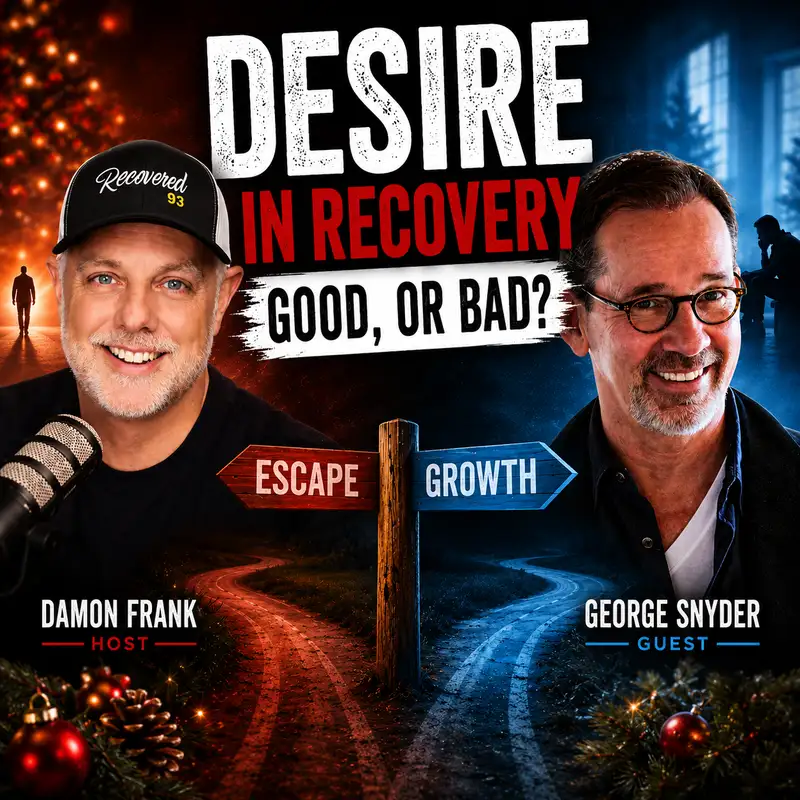
Desire in recovery. Good, or bad?
Download MP3This show is a proud part of Recovered Life, a media network and peer support community
dedicated to mental health and addiction recovery.
We bring together expert voices, real stories,
and a peer support community to help you live your best recovered life.
Join us at recoveredlife.tv.
You're listening to The Recovered Life Show, the show that helps people in recovery live their best recovered lives.
And here is your host, Damon Frank.
Welcome back to Recovered Life. It is Damon Frank, and I am joining you here on Recovered Life.
I have a very special guest today,
our very own George Snyder, life and recovery specialist. How you doing today, George?
Good to see you, Damon. All is well.
It has been a crazy week, hasn't it?
Yeah. Yes.
In the middle of a pandemic, and uh, I, you know, the reason why that I had you on today
is I wanted to discuss our Old School Men's Mastermind
topic that we had on Monday and kind of what happened
because it was one of those gatherings, George, where
all week I was thinking about what people contributed,
what I got out of it, how am I going to apply it.
And I really, and I got to be honest, going in, the topic, I'm going to give everyone the topic, what was the topic?
It was Desire.
I really, I, I wasn't expecting the, the amount of impact that that one had.
Agreed. Agreed. I mean, you think about it, it seemed like a natural choice.
It was the, you know, 'tis the season, it's all about giving and getting and shopping and one-click and
so it felt right, but also when you talk about recovered life, I mean, you're talking about what else
is that force both an obstacle and an enabling
energy? But desire, what do you want? You know? And there's so much about what do I want for Christmas.
All I want for Christmas, right?
So that, but the diversity of how people responded to it, I think that was what I found the most impressive
and how different ways of looking at what conceivably is the same issue and yet it's not, you know? It's a personal
Yeah. Yeah. Yeah, and I like it. You know, just a little background for the people who are new to Recovered Life,
the Old School Men's Mastermind group has been going on, it's, well, I want to say four or five months now?
Yeah. It's been going on for some time, I think since March
Really since the beginning of the, man, yeah, the beginning of the pandemic. It was really when we started to say,
want to get together. We wanted to get together and be a part of something.
Yeah, and George is the host of the Old School Men's Mastermind group. And I, I wrote down some,
uh, on my phone here, some notes that I wanted to ask you. And, you know,
why tackle the issue and topic of desire? Why tackle that?
It, like we said earlier, it's, it's about trying to look at if you're going to have a fully
a full life and, and in recovery a rewarding life, a recovered life, a real life, right? RL.
Um, it's about finding out what's in the way.
A lot of it is about understanding the language of what we're talking about when we talk about desire.
What do you mean when you talk about desire? What do you mean when you say you want? Right?
And how that can get in the way or propel you into productive action,
into getting more out of the life you're having, right? A lot of this stuff we carry around with us are these old ideas,
these conceptions about what it means, um, you know,
that recovery somehow a lot of people think recovery is about not being able to have what you want,
I have to give something up.
Yeah. And it's really, this, it's, they're not mutually exclusive.
And it's not, I think what we find in recovery is, and the recovered life is, that it's, it's not about either/or.
It's about both. You know?
It's about looking at your life and looking at the old ideas, identifying the old ideas, and then implementing new ones.
So the, the goal is about changing the, if you will, changing the narrative. And as people talked
about what they they saw, you know, you think a bunch of guys getting together talking about desire is going to be like a locker room,
and it was so far from that. And that too is about facilitating a space
where you get to be with people, you get to understand, to to feel like you can talk to people in a way that,
um, other men in a way that, um, helps you get to what what you mean when you say
I don't know what I want or I'm in that, uh,
wanting is a a prayer instantly answered. You are instantly in that place of want. And it's painful.
Desire Well, you know, you know, George, the, the thing that I got out of this, one of the things that I got out of it,
is that very early on, I, I noticed how I was even doing black-and-white thinking.
This desire good, this desire bad.
How, how do you determine what is a, maybe it's not even determining good or bad,
maybe it's determining what works for you and what doesn't work for you with desire and recovery.
Right. I think so much of what we're doing right now and what you have helped me so much in seeing is, is this is not about
either/or. This is not about this or that. It's about the human experience.
Desire's part of the human experience, you know? It's both
a as an obstacle if it's going to get in the way and make you unhappy, but it's also what a little bit of pain is going to go goad you further.
We had people talking about, hey, some of the older members, a lot of stuff is in the rearview mirror.
But what do I want today? What are my dreams and ambitions today? Very different thing.
But, you know, we get trapped in this thinking that, well, as you said, oh, that's bad, I can't think that, I shouldn't do that.
Those those are the sorts of ways in which you got to get past that if you're going to really have, uh, what you say it is you want.
You know, George, were, were you surprised by some of the responses in the group? I, I was, honestly.
And I think that's what, that's what kind of
I carried with me throughout the week. I had some preconceived notions, I think, of what people would think about desire,
and it was not that at all. No.
Were you surprised? Were you, were you surprised by the, yeah. Absolutely. And I think this is,
you know, when you get away from a model of teaching or a model of learning where, ah, the teacher has the answer and everybody's going to guess it,
you know?
And the most basic, to a place where there isn't any right answer, gang.
It's not about getting to the right answer. What's an interesting answer? What's what's, uh,
what's a beautiful answer? And so when you make that space where it's possible and feel people feel comfortable
about talking about what it is, then you get people, you know, you we talk about the the millionaires that sat sat around the table
and said, now write down what it is you want, and couldn't.
Yeah.
No, it's a genius story. Couldn't. Because so much of what we think
is what we want is in fact a pursuit of not even love. If it's, you know,
I I I I I'm a firm believer in, you know, we're here to love and be loved. But an awful lot of the pursuit in our world today is about
envy. We're pursuing envy. I'll have all this stuff
that will impress people I don't even like, um, and make them think something about me that isn't even true
just because they'll then love me. It's not love. It's kind of hate.
Yeah. You know, I think the, I, yeah. I think the breakthrough, really, to interject here, I think the, the breakthrough that was really interesting
was, is so many people, and I thought it was just me and I think everybody said, well, I thought it was just me that felt like that,
felt that they should be pursuing certain things or they had envy on certain things and desire about certain things that they really
never, ever wanted. It was an, you know, to quote an old idea, basically, in their head about what they thought perfection was,
but it's not really making them happy, is it? No. It's like I'm, I want,
I think I'm supposed to, I'm supposed to want this. I don't really want it, don't really like it,
but on the other hand, sometimes we have, uh, I'm going to say I don't because I'm afraid I can't.
And again, it's it's teasing apart. It's this big ball of stuff that we come in with, all these old ideas wrapped together
and starting to take take them apart. But it's in telling the story, to me,
telling your narrative and realizing maybe that's not even a true story about me anymore.
Mm-hmm. In recovery, I had a lot of ideas about who I thought I was, and I walk in in into this world
and talking to you, talking in in this group, finding out that's not who I am. That's not who, that's not even who I thought he was,
or he was, or he was.
And in that exchange, in that talking to each other, you get to realize, oh, you know what, I thought I wasn't supposed to say this.
And maybe there are other gatherings, other avenues where, no, it's not appropriate, right?
Maybe it's not a place where it's safe enough for me to share and fill in the blank in terms of where where
I can do that. This gathering, this old school gathering, was a place where people
could then say the unexpected, right?
And I think this leads me to another question that I had for you. What do you think it is, because week after week
after week we've been having these powerful experiences, what do you think it is about the Old School Men's Mastermind
that's drawing this out, this this transformation out?
I think we come from a common background, or a common understanding of certain
And there's a great diversity in our in our group, believe me, and you've seen it too, we know that.
Um, and some of it's unexpected, some of it is just uh, from different life experiences.
Some of us from exactly the same graduating class in high school. But our lives took radically different
directions. You know, some of us in the in the same, um,
community but in different directions. It
But what brings us together is a kind of certain a touchstone, if you will, of a certain understanding
of what it means to talk about spirituality, talk about a higher power, something bigger than me
that's operating. And that, that feeling comfortable, feeling that I won't make the room tip with all the eye-rolling
if I talk about a a a a spiritual path, um, is a is a really, to me, a really helpful
base from which we could
And we're able to talk about outside issues and I think, you know, for me, it's the collective of having 15, 20 guys,
the minds of 15 to 20 guys, and they actually tell you what they really think
about how you can get to where you want to go or find out where you want to go,
which is in some, you know, what what what was interesting is that the people that I thought had it the most together sometimes,
right, they had, man, they must really know where they want to go, sometimes are the people who are the most like, I have no idea
where I want to go next. I knew where I wanted to go 15, 20 years ago when I started this,
but I don't know where I want to go now. And I think, you know, George, that is the powerful thing
that we're getting uh, from from the Old School Men's Mastermind group. So we've got one left, right?
We've got one more left. One more left. Uh, with this group and, uh, I, I'm super excited about it,
it's going to be next week. And, I guess we will tell people how they can find out more in the next coming weeks
about the next cycle that we've got coming up, the next mastermind that we've got coming up for old school.
In the new year.
Yep. Yeah.
Well, George, have a really great day and a great weekend and, uh, I'm looking forward to talking with you next week.
Damon, thank you so much. Looking forward to. Bye. Bye.
Talk to you later. Bye.
Keep the conversation going. Join Recovered Life, a community of like-minded people who are looking to live their best recovered lives.
Membership is free and you can apply at recoveredlife.us.
Creators and Guests