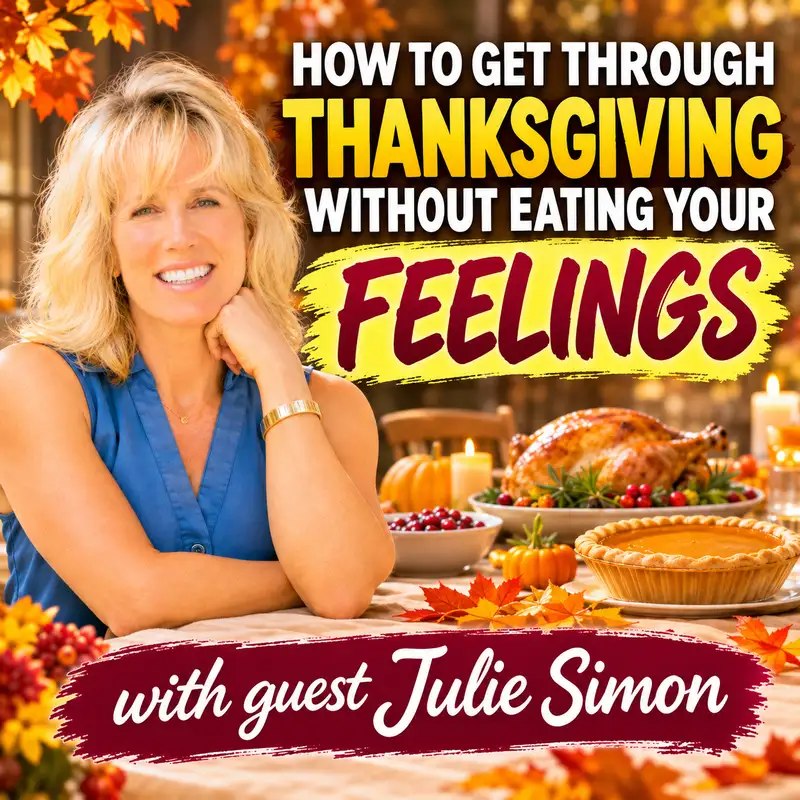
How to Get Through Thanksgiving Without Eating Your Feelings
Download MP3Here we go. And welcome back to The Recovered Life Show. I'm joined today by my guest, Julie M. Simon, a licensed marriage and family therapist here in West Los Angeles. She is the founder of Over-eating Recovery and the author of The Emotional Eaters Repair Manual and When Food is Comfort. Today, we're talking about how to get through Thanksgiving without your feelings. Welcome to the show. Hi there. Thanks for having me. Oh, so glad that you're here. Thanksgiving, we're in the season right now listening to this. Thanksgiving's going on. Over-eating, man, this is just such a huge, huge topic. And I know people in recovery struggle around this time. So I was so glad to have you on the show to discuss this. I hate to ask the big question up first up front, but I'm going to do it. How do you do it? How do you go through Thanksgiving and not just eat yourself a new oblivion, especially if you are somebody prone to addiction recovery or in addiction recovery? Well, you know, when you think about overeating, people typically think overeating is like a simple behavior, you know, and just stop it, kind of like drinking or whatever, you know, just stop it. But overeating actually is a complex behavior. And there are, we have to take a look at the mind, the body, and the spirit imbalances that underlie our turning to food, right? So we can take, we can take events like Thanksgiving, okay, when, when there can be so many triggers for overeaters, emotional eaters, so many triggers going on at those kind of events. And we can use those events to, to notice what comes up for us, right? When we, when we get around an abundance of food, it's kind of like, you know, we talked about an alcoholic, you know, getting around a lot of alcohol or a lot of your substance is there sitting on the table. How can you manage that? So we can, we can start by talking about just some simple steps that people can use, things you've heard of, things you've read about in articles that can help you perhaps get through that day. Little things to keep in mind. And then if you're unable to follow through on some of those steps, then we go deeper, you know, what's going on. So let's say for example, you're preparing to go to Thanksgiving and you, and I always recommend that people don't go ravenous, right? So often we don't want to eat anything before we go because we figure, I don't want to spoil my appetite and I want to eat everything that's there. But I always say to people, prepare, have a little something to eat before you go so you're not ravenous. When you're there, you know, eye the table, see all the things that you want, but, you know, commit to having one level plate of food. And hopefully you're putting some healthy, nutrient dense things like veggies on the plate as well. And then when there are, you know, desserts and things, try to have, you know, pick one dessert. And I suggest people try to have just three bites of something really sugary. You'll get the, you know, all the taste and everything that you're looking for all the mouth pleasure without all the body and balance. So, you know, we have all these steps. But, you know, then life gets in our way, right? We encounter, you know, aunt so-and-so who makes a comment about our body size, right? Or we encounter another difficult relative and we feel triggered, right? And all kinds of emotions are coming up. And now our whole plan has been thrown out the window, right? And we find we're grabbing the rolls off the table and we're, you know, eating anything in sight. And we kind of notice, uh-oh, it started to happen, right? But I don't know what to do about it. Yeah, that's the, that's the thing I wanted to talk to you about the emotions of it. Because I think, you know, I will tell you, I, you know, I never really battled with food until long-term recovery. And for me, it was sugar and light. And I realized that I was standing in front of the fridge. I'd already eaten everything in sight. And I'm, I'm there with this compulsion that I need to eat something. And for me at sugar, and I, you know, there's all these studies we're doing about what sugar does to the brain. And, and, and especially for people in recovery, it's not, not good. No matter how long you've been in recovery, that's what the science is starting to kind of say with this. And this feeling like I have to have this or like I should have this or I need this or I deserve this. And when I started to look at this, I was like, you know what, why am I doing something that's going to hurt me, rewarding myself with doing something that's hurting me? This, this is kind of, I realized this is not great thinking. Can we dive into the feelings of this? Because I think a lot of people are just on autopilot. Yes, but it's giving. Yeah, but I do want to say one thing and that is that, you know, and this is why the recovery from emotional eating or overeating, you know, is complex, because we do have to look at body and brain imbalance also, right? So if you have allergies, you know, or you have foods that you're addicted to, right? You may need to keep those out of the house. You know, you, we have to, we have to deal with that also that there's chemical imbalance. And there's also good things that we can take supplements and things that we can take that can help with the brain imbalances. But so we do have to take a look at that. And PS, as we deal with the emotional issues, it will be much easier for us to make choices to keep those foods that trigger addiction, you know, out of the house. So just as an example, highly refined pastry flour is like a, is like crack for my brain. Okay. And so, like, I can take and I'm, I consider myself fully recovered emotional eater. I can take a bite of a scone. And immediately my brain says, Oh my God, like, that's incredible. Buy more, right? To this day. But what recovery looks like is that, A, I probably won't take a bite of a scone. But you know, these days, because I know my brain reacts that way. And it's very easy for me not to take a bite of a scone, because I can say to myself, you know, I don't need it. My body doesn't need it. It's not good for my body. It's going to trigger. It's going to get that addiction monkey on my back. And then I'm just going to have cravings, right? And so because I know how to nurture myself and comfort myself and love myself and take good care of myself, I can make that choice not to indulge in a food that can trigger that, right? You know, just like, you know, the alcoholic knows that alcohol going back to alcohol will still do the same things to the brain, right? So the question is, how do we get to that place where it's actually a fairly easy and comfortable choice, you know, to say, I'm not going to indulge in that. You know, you know, I think Julie, one of the things that's so complicated about disorder eating or having any kind of food issue, right? Mental health food issue is that alcohol and drugs are really clear. Like I'm a recovered alcoholic. I can't drink alcohol. I can't drink a little bit. I can't drink it on two only Tuesdays. For me, I can abstain from drinking alcohol. Food, we have to have food, right? And so when we're around these holidays, like Thanksgiving, and we have to have it to survive, it's like we can't abstain from eating food, this is so tricky for people because it's such a fine, it's hard to, is it hard to find balance with that? Well, I think it is because, you know, like you're saying, I mean, and also it's sanctioned, you know, it's like sanctioned addiction. It's, it's everywhere and it's okay to indulge in all those foods. But I think most, you know, I've been doing this for decades and most emotional eaters have a pretty good idea of the foods that are trigger foods for them. So let's say, you know, you're heading into Thanksgiving. It's, it's going to be a very good idea for you to start, you know, whenever you're going somewhere where there's going to be a lot of food, to begin with being mindful, you know, okay, what, what's my goal today? You know, what do I want to do with this food? I know that grandma will have, you know, her incredible apple pie. I know there'll be this and that. So we want to prepare. Okay. We also want to know if, like what we just said, if there are certain foods that we have a little bit of addiction with, what are we going to do with that? You know, if we start, will we be able to stop? Is it going to lead to, you know, doing this for days or weeks afterwards? So of course, it's easy for me to say that. But if you have, if you're an emotional eater and you're not really in recovery, you may not be able to just use willpower, right? To say, okay, I'm not, I'm going to have one slice of pie and I'm not going to have any more or I'm not going to have any pie when I'm there. Because A, you're not in recovery. So what do I mean when I say you're not in recovery? What I mean is that you're, you haven't perhaps started or you're maybe in the middle of, you know, building self-care skills that help you take care of yourself and meet your needs, you know, appropriately. So let's take a look at something like that. Let's say, um, let's say you're at a Thanksgiving gathering and you've been doing a little bit of work on yourself. You're, you're wanting to become more aware of your emotions and what triggers you. So you're at Thanksgiving and someone makes a comment, maybe you put on a little weight and someone makes a comment about your body and you feel hurt and sad and ashamed, right? And you notice that you're looking at the table with where all the food is. So I'm going to make a suggestion that you head to the restroom, right? Head to the restroom first, take what I call a mindful pause, go in the restroom and have a conversation between what I call the feeling self. We used to call it the inner child. Have a conversation between the feeling self and what we're trying to build, which most emotional leaders don't have yet, is a, an inner nurturing voice. Okay. A voice that's capable of calming and soothing and comforting and regulating those behaviors and helping you meet your needs without turning to food. Okay. This is a skill that we have to build, but it has to start somewhere. So you go in the restroom and you say to yourself, okay, what am I feeling? Well, I'm feeling hurt. I'm feeling ashamed. I'm feeling really angry. I'm feeling kind of sad. Okay. So when I feel like that, it's this little three step process that I teach. It's called an inner conversation. When I feel like that, what is it that I need? What do I need when I feel hurt and angry and sad and ashamed? Well, I guess I need some comfort, some comfort, some soothing, some reassurance, calming. Okay. Now let's see if we can, if we can bring in a nurturing voice that says something like, I love you. I care about you. It doesn't matter if you've put on a little weight, you're always the wonderful, incredible Susie that I love. I'm here with you. It doesn't matter what people like that say. You know, there are people like that that say that are not kind and they're rude. And I'm here with you and we're going to be okay today. Now, if you are actually able to do that, this is a skill, it takes time to build this skill. But if you were able to do that in my own recovery, I was building these skills and I was building them long before the neuroscience, you know, supported these skills. Like I, you know, I literally, I'd be triggered in a restaurant by a friend that I'd be with and I'd go in the restroom and I'd be like, I want to eat the whole plate. And then I know I want to go home and binge, you know, because I'm so irritated and mad right now. So I'd go in the restroom and I'd start processing my feelings and talking to myself. And what research shows is that when we're doing this, we're building a part of the brain, the self regulatory part of the brain that is capable of comforting and soothing and nurturing. And, and, and we're wiring that part of the brain to the part of the brain, you know, with the feeling self that's getting all fired up. And we're able to comfort and soothe and regulate our behaviors. So if you're more advanced at this, you're in the bathroom at the Thanksgiving dinner and you're having this conversation with yourself. And then you're, you're able to say, you know what, I'm not going to overeat today. Like I'm not going to, I'm not going to do that just because, you know, Susie, you know, triggered me with what she said, I'm still going to take the best care of myself today. That's a muscle, right? You're building that muscle up in your recovery. Right. You're building that muscle up and you have to practice these conversations over and over and over again. What am I feeling in this moment when this is happening? What is it that I need emotions or precious signals from within? They're there to tell us if something's going on. What is it? They're there to point us in the direction of our needs. What is it I need when I feel this? Okay. And then bringing in that nurturing voice. You know, I always say, and I don't know if you agree with this or not, but it's interesting just seeing people in recovery and there's now addiction recovery, mental health, it's all become one big mental health conversation, which is positive. I think in a lot of ways. And what I've noticed is that it everybody that has addictions, it all comes down to one general thing. And people say, you know, is there anything that they'll have in common? The here and now is very uncomfortable. The here and now for people that suffer from addiction until you learn how to deal with the here and now, how to how to actually live in it and feel those feelings. It's everywhere and especially with this sort of eating because it's everywhere. You're being triggered everywhere. It's literally everywhere. And this is what I want to talk with you about with Thanksgiving. How do you escape this love language thing, Julie, because look, I know in my own family sometimes the holidays will become more about what is actually on the table than the reason we're there. And I noticed this and I tried to stop this. I was like, you know what, we're getting together so that we can be together and appreciate our family and interact, right? It's the love language doesn't always have to be food. It shouldn't be food. Can you talk about that? Because this is tough for people because it's like grandma's giving me the sweet potatoes because she loves me. But you know, I think the problem with that is that if we've been raised with the love language being food, I'm not sure we want that to stop. We might give lip service to saying I don't want this to be our love language. Perhaps, yes, we want our love language to be true love language and not really about food. But are those relatives that we're visiting, are they capable of what you're talking about? If the love language is food, maybe it's difficult for them to, maybe it's difficult for your mother to say, I love you. I miss you. It's so great to see you. Maybe she can't, doesn't know how to say that. So she says, I baked your favorite apple pie, right? So do we need other people to change, you know, for us to change our behavior? I don't think so. I think we can still go in because don't forget. Right. And also, don't forget that if we have, if we're struggling with addiction, it's because our brain is wired a certain way. I mean, we have some chemical imbalances, but also most likely, we didn't receive consistent and sufficient emotional nurturance in our early years. So that's our family. You know, we've come from this group that doesn't necessarily know how to nurture. And I'll tell you something. I've been running a 12 week program for over 30 years. And all of the people that come to work with me, even those that have come from a little bit more loving backgrounds, usually do not know how to nurture themselves. And most of them have pretty strong inner critical voices. Most of them have voices that are beating themselves up much more often than being loving. So that came from somewhere. And when we go to these family gatherings, we're going to encounter that same dysfunction. We're not going to change them. You know, I don't think it's good for us to go. I mean, it would be nice if we say, hey, how about if we all go around the table and give, you know, say gratitude. And if we can get it, you know, in a more positive nurturing place. But if those people don't know how to nurture, we're not going to change them. I mean, we all know in recovery that you work on yourself, right? So what I'm getting from you is that if you're around that and people are expressing their love language through food, you're going to have to learn how to love yourself. You're going to have to learn how to appreciate yourself. You're going to have to learn how to interpret what they're doing and maybe say no to the second piece of pumpkin pie or no to the first piece and still be able to learn to learn those skills to be able to communicate back to them that you appreciate it without actually having to eat your way through it. Right. And maybe say no to taking it home, you know, when mom or grandma wants to give you that pie to take home with you and you say to yourself, I'm going to be out of control with that, you know, all that sugar and flour is being able to say, you know, I love your pies and I so appreciate you wanting to give this to me. I struggle with, you know, sugar and flour allergies. So I'm not going to take the whole pie home, but I would love to take a slice with me. Right. And that forces you to be okay with that yourself. And also it forces you to learn how to articulate to others what your needs are, you know, like my need is to not go home with a pie. I mean, if you feel like your, some people will say to me, my in-laws, you know, would be so insulted if I said anything like that. Then I say, okay, then you can take it home and you can give it away or throw it out if you have to. Right. But we're still learning skills. We're learning how to take care of ourselves, maybe take the pie, but no, I cannot have this in the house. You know, I have some food allergies. I have some food addiction. And no, I always say, know where you are in your recovery. You know, if you are not at the place, you may become, you may end up at a place in your recovery where you could have that food in the house. You know, I have people further into their recovery where they'll say, you know what, I can't believe it. I have my favorite cookie, favorite addictive cookies in the house and they went stale. I forgot they were there, you know, and that's further along in recovery, but you need to know where you are. Yeah, I think, I think it's taking that, it's taking that, that first step. I mean, what I'm hearing from you is that there's like two different types of hunger. There's that physical hunger. I am hungry. I need food. And what are my choices going to be with that food, which is a whole, that's a whole other discussion, right? And then there's this emotional hunger. I just don't feel well. I don't feel like I'm getting what I need, which happens a lot on Thanksgiving. Yes. Throwing into, like you, you were talking, we're throwing into a lot of things. Somebody's listening to this right now, Julie, and they're saying, man, I, Julie's talking my language. Every single holiday I struggle, every single holiday I always end up in a bad place. How would you, what would you tell them to do as the first step here for healing with food? Well, I want to say one other thing, and that is that, just so we include this, that sometimes those emotions aren't negative emotions, right? So sometimes they're celebratory and happy and joyous emotions. Like I want to go to an event and celebrate and eat with everyone. And so, and that's okay too, you know, having those good, good kind of emotions coming up or I feel joyful and celebratory. So it's not always all just negative emotions, but, and, and even fear of missing out, right? Like FOMO, you know, I, I want to eat that because I'll miss out if I don't get it. So there's all kinds of reasons that we might overeat on those occasions. But, but to answer your question, what's, what would be good for us to do? I'm going to make a suggestion that, and I say this to all the people in my groups, that before you head to a holiday gathering, take some time with yourself, take some time alone, get clear on who you might be running into there, what kind of emotional triggers, and especially if you've had trauma, if you've had trauma in your family and you're going to be with those people, what kind of triggers might be coming up? Will you, will somebody make a comment about your weight? Will someone be, do you have some, are there some narcissistic members of your family, or maybe they'll be cold or arrogant? And maybe you'll slip into some codependent patterns, you know, eating and eating what they want you to, what they put on your plate to please people. What might you encounter? Okay. And what emotions might come up for you? And then I'm going to, I'm going to continue to, to share as I did before, the little three step process that I teach, it's an inner conversation. So ask yourself, okay, when, if I encounter mom saying such and such, if I encounter cousin so and so, or aunt so and so saying such and such, or that look that she, when she looks me up and down with my body, you know, what am I going to feel? Okay, I think I'm going to feel some shame, like I said before, some hurt, some anger, I always feel angry when I'm, when I'm with that group. Okay, so you're going to have, so those feelings are going to get triggered. And what do you need? We go back to what am I feeling? What am I needing in that moment? What do I need when I'm feeling that way? And then bringing in that inner nurturing voice, we're trying to wire in a nurturing voice, and we're trying to get in the habit of paying attention to our emotions, also our bodily sensations, I just want to throw that in there that when I'm feeling angry, how does it feel in my body, you know, infants and feel sensations long before they can label them as emotions. So what do I feel in my body? So when, when aunt so and so eyes me up and down, I feel, you know, fuzzy, fuzzy in my body, you know, I feel tension in my body. So I'm, there's a good chance I'm going to feel all those things when I'm at this gathering. All right. What do I need when I feel that? Well, I need, I need like a supportive person on my side, like I need someone to say, you're okay, you're great, you're wonderful, like maybe I need some cheerleading and some comfort and some soothing. So what could I, what can my inner nurture say when she looks me up and down? You know, my inner nurture can say, sweetheart, you're wonderful, you're incredible. Her opinion of you is none of what she, you know, in 12 step, what she thinks of you is none of your business. You know, like, and maybe you start laughing when you're doing that with yourself because you think, wow, you know, like, I actually can have some skills. I actually can have some armor. I can build some internal armor, you know, so that the stuff that comes at me doesn't penetrate so deeply and trigger very old wounds, right? Now, let's say you go there, you've, you've set aside some time at home to practice, you know, and you say, okay, I'm going to head off to the restroom if I get really triggered and I'm going to do this inner conversation and I'm going to try and soothe and comfort myself. But you find when you get home, you still got really triggered, like you're feeling very depressed when you get home and kind of hopeless about family and recovery and everything else. This is going to be another time to sit down. And I always suggest to people that they write because you stay so much more connected to your emotions and what's going on in your head if you write than if you try and do all this in your head. Write it down. When you get home before you, so we can come back from this. We prepared. We knew we might get triggered. We still overate a little bit. We didn't overeat as much as we might have if we didn't prepare. But now we come home and now we're feeling depressed and enraged and agitated. Okay, time to take that journal out. Time to, I call it self-connection, time to go inward and address the feelings that are coming up now that you're home. What are the needs? Bring in that inner nurturing voice. Now initially all of this, that inner nurturing voice may not feel all that comforting in the beginning. You have to stick with it. It's just like I say to people, you know, learning to play the piano, you know, and having your fingers have to stretch or learning to ride a bike. None of the skill building takes time and it's often awkward and uncomfortable in the beginning. But everybody who works with me and who sticks with the skill building over time says, you know, it's getting so much easier. I'm starting to build a nurturing voice inside my head and PS, that's the voice that also sets limits. So I always say to people that nurturing voice can become an indulging voice. It might be the voice that says, yeah, we've had a really hard day. Let's order a pizza, right? Or that nurturing voice can be a nurturing, can set nurturing limits and say, yeah, we've had a really hard day. But you know, pizza just, you know, it's got all those things in it that aren't so great for our body and kind of trigger a little bit of overeating. So why don't we select something else? So now we're building a voice that's capable of soothing and comforting and nurturing us, and also a voice that's capable of setting nurturing limits. This is where those good limit setting comes in is from that nurturing voice. Because your feeling self, the part of you that says I want what I want when I want it and I want it now is not interested in limits, right? So we have to have another part of the brain that's capable of setting nurturing limits, developing those developing that inner voice and having that awareness. So, so important. You have just given us so many great tips here about how to get through Thanksgiving without overeating, without eating your feelings. Julie M. Simon, thank you so much for coming on The Recovered Life Show. We're going to put links on how to get ahold of her and also links to our book. Thanks so much for coming on. I hope to have you back soon. Thank you for having me. It's my pleasure.
Creators and Guests