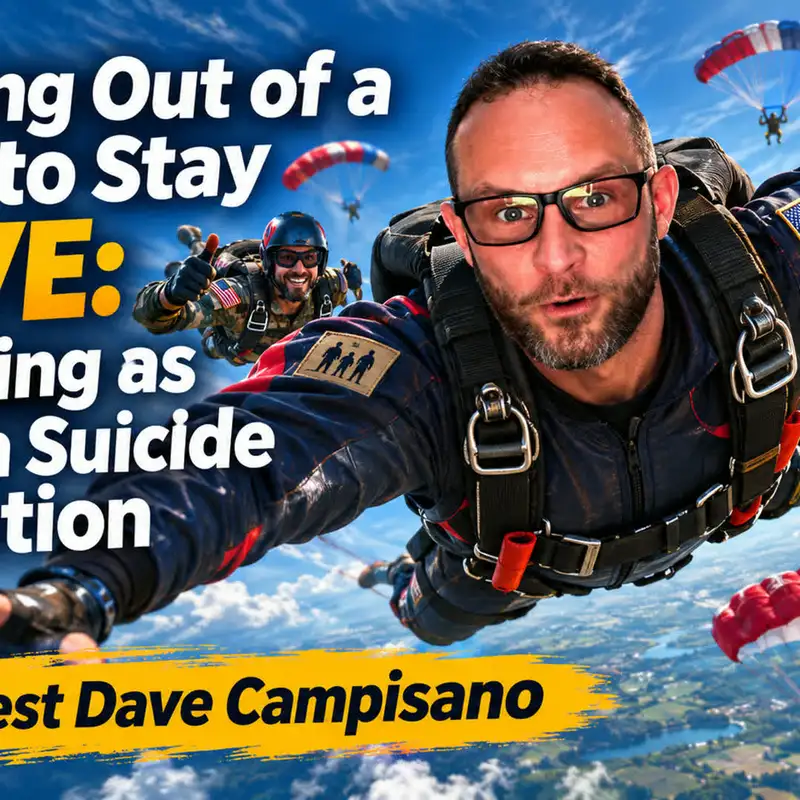
Jumping Out of a Plane to Stay Alive: Belonging as Veteran Suicide Prevention with Dave Campisano
Download MP3And welcome back to the Recovered Life Show.
Today's guest is Dave Campisano, founder and president of 22 Mohawks in Massachusetts.
His organization takes veterans static line parachuting, not as a stunt, but as a
suicide prevention.
The idea is simple and radical.
Shared challenge builds belonging and belonging saves lives.
For a Veterans Day feature, we're going to talk about what happens beyond the
jump, the evidence his team is now building with researchers, and what a veteran
listening today most needs to hear.
Welcome to the show. So glad to have you on.
Thank you so much, Damon. I really appreciate it.
Oh, I appreciate you coming on, Dave.
This is our special Veterans Day episode.
And when I saw this, when our team saw this, we said we have
to reach out to Dave right now. Now, because first of all, the name
22 Mohawks was cool.
And second, I read like five minutes into it, it was like you're jumping
out of planes. What's going on here with this?
It's mental health, suicide prevention, PTSD, and planes.
That's right. That's right.
All of those things combined, Damon.
Yeah. So, one, hey, I appreciate you reading the article.
We're really excited about the initiative.
So, we've the parachuting jump is we fly 20 veterans and first responders twice
per year to Florida to X35 Airborne School in Dunnellon at the Marion County
Airport. We have a hangar there.
And the idea is that these veterans come from all walks of life.
They get together. They don't know each other and they may or may not
have PTSD. We don't fully know, but the idea is to bring them in,
create community connection and belonging.
And we believe that's a protective factor for suicide.
Among many other things.
You know, I, I, you had me at the belonging.
I'm a big, uh, I'm a, I'm a very big proponent of participation in
a group saves people.
Whether it's recovering from mental health issue, addiction recovery, I see it every day
on the ground, especially with addiction recovery, is that people will come in, they
start to connect very leery, don't want to at first, but as they connect
more and more and more, their life starts getting better.
How did you, how did you think about this?
Were you looking around figuring, what are we going to do?
Like, how did you go from there's a problem to let's jump out of
a plane? Yeah, I mean, the experience of feeling that you have a place
with other people, you know, being included on a roster and feeling that you
belong are different things, right?
You can be on a roster and participate, but feeling like you belong is
definitely a, is different from that.
Loneliness is subjective, right? So you can be surrounded by people and feel completely
disconnected. But that's why, you know, counting just people showing up alone won't really
answer a question of belonging.
So we need to ask how people really experience their relationships.
And when I think about that and I think about suicide prevention, I think
about Thomas Joyner's Interpersonal Theory of Suicide, which kind of gives us a really
good framework for considering belonging and feeling like a burden, right?
That theoretical framework really helps us kind of decide what questions to ask.
But it doesn't establish really that the program works, but it does give us
a framework to go behind when we're asking questions about belonging and suicide prevention.
You know, you named it 22 Mohawks.
And I noticed at one point 22 was the number of people, veterans that
were committing suicide every day.
In the United States, I believe I have that correct, right?
That 22 every day were creating suicide.
This is a huge issue that we have here in the United States.
What have you seen over the years here as far as addressing this idea
of veteran suicides?
Yeah, I mean, yeah, the number 20, the offside of number 22, especially in
the military community, everybody knows that number.
I think the VA reported it's like 17.7 veterans die by suicide every day.
There's been a few private studies on it that actually show it's really closer
to 44. There's a study with like eight states that said it was really
closer to 44 when you determine the definition of a veteran compared to somebody
who's just a former service member.
I won't go into the details, but nonetheless, the number's high, right?
17, 22, 44.
The number's high. What I see, I mean, Names come across my desk every
day, right? I see names with first responders, veterans come across my desk.
And, you know, the biggest thing for me is, you know, we can tell
everybody every day, like, hey, reach out to your buddies, check in on your
buddies. And that's fine.
But if you're not the person, if you haven't become the person that is
on top of people's mind when they're having a hard time to call, then
it's, it's, it's hard, right?
You need to become the person that people want to rely on for issues
that they have. And that's kind of the advice I would have is just
like, try to become that person in the community where people like, I got
to call, I got to call Damon because I know Damon will listen.
He won't judge me and he'll give me good feedback or he'll just listen,
right? Yeah, I, you know, I building this community and we're all about that
here on Recovered Life.
And I think veterans have a particularly hard issue with that.
And let me tell you, my Feeling on this, Dave, is that there's a
much stronger self-preservation gene, I think, with people that are in the
military about like, I'm going to figure this out myself.
Right. Like, I have to be the solution to everything.
And being part of a group means that you're not the solution to everything,
that you're part of a bigger thing, right?
And I think it's very tough.
I think I could just imagine not having served, just imagine being part of
a group.
And no matter even if it was in the military for you're just administrative
assistant, right? Being part of a really group.
And then all of a sudden you're not.
You're no longer part of this group.
And now you, you know, if you have PTSD or anything else that has
happened, you're now outside of the group with this mentality of, I got to
figure this out.
And that tends to lead to not a great place.
I don't know what your thoughts are on that.
But I see that not leading to a great place.
You can't figure out PTSD by yourself.
Yeah, I mean, when you leave your tribe, so to speak, the military, and
you transition to civilian life, it's identity disruption, right?
Your whole self-identity has just been shifted and now you have to transition.
Think of like, think of an international student coming to university in the United
States. Like that, that's a transition for that person.
It's a big, now they have to like change their identity because they're, you
know, changing who they are and where they live.
It can be a massive shock to the system, but there's also a conditioning
process too. Like when you go through infantry school and you go through basic
training and these advanced trainings, you learn how to react to violence, right?
And a lot of the combat arms professions, we solve problems with violence, right?
And you have a stress response to certain things that while you're deployed and
while you're wearing the uniform, Uniform works.
It's a good system. It saves your life.
But those same stress responses that you have when you come home and you
take your uniform off don't work the same because you don't have the same
support systems.
And it's hard for you to explain actually what you're going through.
One of the biggest things is people just not understanding.
Vets don't want to talk because they don't think that people understand, which is
okay. Like it's okay if people don't understand.
You know, it's not our job to make people understand, but what we should
do is be okay with talking about things that bring us pain.
You know, there's a whole statement like, hey, boys don't cry.
I speak specifically for males.
Boys don't cry.
I hold in my pain. Like, I'm not going to, I don't want to
be a burden on you because I have pain.
And so they hold it in.
And then that turns into, hey, I'm going to go have a beer.
That beer turns to 12 beers.
And then that beer turns to drugs because they just don't want, they don't
want to cope. So it's just a system of just, you know, could lead
to bad things.
I want to get into the real.
Research part of this a little later in the conversation, but I want to
ask just a practical question here.
When you're bringing them through these airborne camps, not everybody, not every veteran has
experience doing this, I'm assuming, right?
Like you're bringing people that maybe never did this or people that did it
a lot. How does that work?
Yeah, so it's a lottery, it's a registration.
Right now, we have over 200 people signed up for the registration for the
next course. 90 days before the course, we draw 20 names or 25 names
because there's usually a small attrition rate.
We'll draw the names.
We'll alert everybody, let everybody know that I got selected.
And then we'll have a call.
And the first call is just a roll call.
And the second call is like, hey, if you're not on that call, then
you don't make it. And then we backfill.
A lot of the folks that register are Marines.
And one of the biggest reasons that they've said is because Marines don't have
the same opportunities to go to airborne school and parachuting courses like the Army,
right? Like the Army of the 82nd Airborne Division, right?
You have the 73rd, right?
All these airborne units, because they're in airborne, they're airborne divisions.
Whereas the Marines, if you're not, you know, Marshalk or reconnaissance unit, you're probably
not going to go to airborne school.
So a lot of these Marines want to get their jump wings and get
static line trained. So we pick the names, they come in and maybe one
or two per class have already gone through Army airborne school.
So they kind of know the deal, but the majority of them have never
done static line parachuting before ever.
So it's kind of a really new experience to them.
And they don't even know what they're walking into.
Yeah, that is amazing.
How have you seen this work?
How does it, because somebody's listening to this, maybe they have a loved one
that has PTSD and is a veteran or is leaving.
You know, the military services and concerned.
And they're like, we got to get, you know, we've got to put them
in a group. We've got to get them connected.
What is the benefit of this?
Because that would be the question that everybody's going to ask: is like, what
do you really see? What's working?
And what is different from the person who walks in to do that jump?
And when they leave, what's the difference?
Great question. Yeah. So, like, the parachuting gets your attention, right?
It's like, oh, you're jumping out of planes.
But to understand the program, we have to look at the entire week.
So at X35, veterans, first responders, they train to a demanding objective.
They learn procedures, practice parachute landing falls, and work with uncertainty together, right?
So they're getting brought back into an intense scenario, high-risk scenario that other people
are counting on them for.
And that's the military.
That's the military defined, right?
So it puts them back in the uniform, so to speak.
But my working explanation is that a shared task gives people a reason to
interact before they have to explain themselves, right?
So they know they're coming to train a parachute.
They get down in the nitty-gritty and learn how to parachute, but now they
start talking, right? So somebody helps you through a procedure.
You encourage somebody who's nervous.
And then trust has a chance to develop through what you do together.
And academically, like that's that's a question about the mechanism: which part of the
experience might produce a change?
Is it the accomplishment? Is it the shared responsibility?
Is it the communal living?
Because they all live together in a large Airbnb.
We have a program with several components.
So we need to examine those possibilities rather than just assign all the credit
to the one jump, right?
So they come in and they're getting reinvited back into the military mindset, high
risk, high-risk event.
And It's like your identity is reborn.
Day one, day two, it's people from all over the place.
They don't really know each other much.
They're not really talking as much.
And then the first time they get out of the aircraft, you see people
on the drop zone getting together, taking selfies of themselves, just smiling and happy
and feeling like they belong in a place that they haven't seen in 10,
20 years, right? We have some folks who are in their 60s who have
retired years before.
But to your question about someone who's just getting out, if you're about to
ETS from service, reach out as early as you can because it's those first
12 months of discharge that are the most critical for military members.
You want to get connected with the VA.
You want to get connected with local nonprofits and people that can really bring
you in under their wing and help you find and understand the resources that
are available to you because you may feel like you don't need them right
away. I sure as hell didn't.
But as time went by, I really needed assistance, you know, mental health wise,
with resources to get things like via veteran service officers.
So, the sooner you get in, the sooner you get engaged and start good
habits right away, the better off you're going to be and the more likely
you're going to be live a happier life.
Yeah, I, what you're doing is so amazing.
And I could see how it would help.
I mean, so post this, do people stay in touch?
How does that work?
So, up until this last cohort, we created text message cohorts.
So, we have this next one that we have in March will be our
10th, our 10th jump, our 10th time going down.
We go twice a year. So, we're coming up on this will be the
end of year five, beginning of year six.
The cohorts will message each other for like the first like two months.
It's nonstop every day.
Everyone's just messaging. And then it kind of falls off.
And then holidays will come around, people will check in on each other.
But this last cohort, so we're in the process.
Of developing a app called Frontline Connect.
And it's an app that all of our cohort cohorts can get on and
use and chat with each other.
And the app is designed, there's a small piece of AI to it with
human in the loop. So it's not directly AI, but it has a part
of AI that will alert a peer supporter or a clinician that's on our
team if someone has fallen off their consistency with chatting.
or if they've used language that may be that may guide us towards something
that could be risky, like they say guns or alcohol abuse or any type
of abuse or suicide.
It will trigger us to look at it and either give them a call
or have one of our peer supporters give them a call.
So that's in development right now.
This was our first cohort.
Our next cohort, we're going to launch it.
And that will help our groups stay in the loop because then we'll be
able to send them information. We'll let them know about the other jumps because
all these folks who come down and get certified.
Are invited back to jump again with us every time we go at no
cost. Wow.
So they can come back and jump.
Yeah. That is amazing.
That is amazing. How did you get now?
I know you have researchers involved now.
And this is what I found interesting.
I, for, forever, I have been saying the way to recover, the most effective
way to recover from a mental health issue or addiction recovery is belonging in
participation. Yeah.
I've been saying it. I see it over and over.
The people who choose to be a participant and participate with others are far
more likely. We see this, right?
But it's hard to prove this.
It really is hard to prove this because I want to see the science
of this. What show me?
And I'm like, I'm on the ground here as an advocate.
I'm helping. I've seen it over decades of this working.
And very time, it's frustrating sometimes, but it's interesting because now when I talk
to the scientists, the researchers.
The what I call the you know the super nerds about this, the neuroscientists.
When I say, Well, you've discovered this new thing, what do you think will
work? They all say having a network of people.
So, tell me a little bit about are you it looks like you're really
trying to prove this scientifically?
That's the biggest thing. Look, and you know, you're so right.
Like, everyone's like, Let me see the evidence.
I want to see the facts. Do you have it in writing?
Um, do you have IRB approval?
Right? And it's like we have you know, testimonials from people saying this event
changed my life, saved my life.
We actually have one of our guys actually had a very bad alcohol problem,
and he hasn't had a drink since, which was three years ago.
He came to like our third, third parachuting event.
He hasn't had a drink since because he wanted to prove to his wife
that he could do it after seeing, you know, reliving being around military friends,
which was amazing.
Um, but yeah, so the idea is we need to get.
Gather the evidence. So we have two things going on here.
We have an IRB approved qualitative data study between Suffolk University and another
university. And we have researchers that come down and they interview all the veterans
and first responders. This was our second time doing it.
So we have data from the first or from two jumps ago and then
this jump, Operation Medusa and Operation Vucovi.
And we're in the process of coding it and getting all the information together
so we can say, hey, this is working.
And here's the evidence for it, which is, it may take a little bit
longer, but we want to make sure that everything's dialed in on that.
But we also used the UCLA loneliness scale.
So internally, we use that scale to measure loneliness.
And obviously, loneliness can't measure suicide or suicide prevention, but it helps us kind
of identify somebody who really needs to connect.
And the results, you know, they're mixed and they're preliminary, but that's really the
most honest place to start.
When we use the UCLA loneliness scale, It measures reported loneliness and then higher
scores mean higher scores mean greater loneliness and lower scores obviously mean less loneliness,
right? So some of the participants had gone down, some of them went up.
But one thing to note is that two of the folks completed the survey,
the second survey, because we do one at the beginning, one at the end.
Two of the folks finished the second survey two weeks later.
And those were the two that scores went up.
which made sense. So they were experiencing more loneliness now that they've been away
from the group for a few weeks, right?
So it doesn't explain too much, but it's something we definitely want to hone
in on. So you think maybe possibly that that is a trigger as somebody
goes into the loneliness scale, the further they go into feeling isolated and lonely,
the more chance that they're going to commit suicide.
Yeah, it could at least, you know, yeah, I mean, it could make them
sadder, right? I don't want to throw around the D word, but it could
make them sadder. And just feel lonely, feel like they're not belonging anymore.
So that would be something that we could, if we can understand that and
really build a good evidence package on that, we could possibly use our app
to connect with them.
We could connect with them. We could invite them back because we have to
see, you know, where the inflection point is when they start to become, where
they fall off and become lonely.
And that's what the app's going to do. It's going to kind of dial
that in. Love that. Dave, what do you think that people don't understand about
PTSD mental health issues with veterans?
What do you think that people just don't get?
Because you hear a lot. Hey, thank you for your service.
I know people are very grateful.
I'm very grateful that you served.
I did not serve. I'm very grateful.
But I think we don't see a lot of actually what's going on.
What do you think people don't get about PTSD in veterans?
You know, one of the biggest things I see is like every way you
look, it's like, oh, another veteran died by suicide.
Another veteran's homeless. like that up here in New England.
But the truth is, no one really talks about the other side of the
veteran community, right? The other side of the veteran community is thriving, right?
You look at some of the top CEOs across the U.S.
and many of them are veterans, right?
So I think that so many people put veterans in this box of a
stigma of like, yep, that vet has PTSD.
They're probably on meds, like they probably have anger issues.
They're disabled, where it's true.
But there's another side of it too.
And a lot of veterans do try to take care of other veterans.
We do do a great job really trying to make sure that our buddies
are taken care of, right? They have the resources that they need.
So I think that's kind of one of the biggest misconceptions that all veterans
have PTSD and they're going to have flashbacks.
But it's not true. A lot of us are really, really, you know, although
we might be struggling, we're still like thriving in our communities and our professions.
Yeah, it does seem that there is, you know, that's all you hear.
When you look at YouTube, podcasts, the veterans that are incredibly successful.
And then you have some that are struggling as well.
And many struggling in silence, which is even more painful, which is even more
painful. What's next for 22 Mohawks?
What are you going to do now?
You've got the researchers.
You've got people jumping out of planes.
What's next for you?
Yeah, we're really trying to build out our data arm of the work that
we're doing because now we want to move into the Pups Revets program and
do some data gathering on that because there's not much data on veterans and
pups, parachuting and veterans and first responders.
We also have a performance arm where we do physical fitness.
And these events are small groups because the events have, you have to be
really, really fit to be part of them because we're trying to test folks.
who want to be really fit and people who are growing to be fit.
But the idea is, is that we want to get research on all these
areas within the veteran space so we can prove that these programs actually work
and make people's lives better so they don't die by suicide.
Because there's so many veteran nonprofits out there that have such great programs, such
great work. And like you said, it's so hard to measure a life saved.
Like, how do you measure that?
Right. A 988 dispatcher takes a call, talks somebody off the ledge, gets them
the help that they need. I'm going to say that that's a life saved.
There's one, right?
I would confirm that as maybe the scientists would argue with me, but I
would love to hear what they have to say.
But with the parachute jump, a veteran can say, hey, you saved my life.
You brought me down here. I'm down here twice a year now.
You saved my life. You give me purpose.
Can we call that a life saved? There's something to look forward to.
You know, I think in today's world, it's so fast.
It's so strange. And a lot of the times very Orwellian, you know, with
the technology. Technology and everything that it's like it's something to look forward to.
And I think that that is, you know, knowing that you're part of something.
That's why I love what you're doing.
You're part of something and people rely on you.
And it's analog, it's an experience that's not online.
I think that this is just an amazing thing.
You know, final question here.
There might be a veteran listening to this or somebody who loves a veteran,
and they're struggling and they just believe that no one's going to notice if
they were gone.
What would you like to tell them?
A veteran who thinks that no one's going to notice if they're gone.
Yeah, it's, you know, you beat yourself up over these things and you think
about them. And I mean, I've had friends that have said that and sadly
have passed. And even, you know, you tell them, hey, I'm here if you
need me. And it's, you know, the immediate reaction is, hey, reach out to
somebody. Right. I remember when my good friend John Hatfield died by suicide, I
was so mad that he didn't reach out to me.
And then I got mad at myself for him for me not reaching out
to him. I was like, well, I should have reached out to him.
But the truth is, is we all just need to become that person where
it's okay to speak to your vulnerabilities because if you do that, you're going
to give other people permission to do the same.
And you'll be surprised at the conversations that you will generate by sharing your
own vulnerabilities. You'll be shocked at the people who you look up to that
are like, I'm feeling the same way.
And I think that that's just a really powerful thing.
If you can become the person that people want to talk to about their
vulnerabilities, and it's hard to do because the stigma.
Yeah. Yeah.
Thank you so much for coming on today.
Dave from 22 Mohawks.
Guys, we're going to put links to.
How you can get a hold of this organization in the show notes.
I will, Damon. Thank you so much for having us.
Creators and Guests