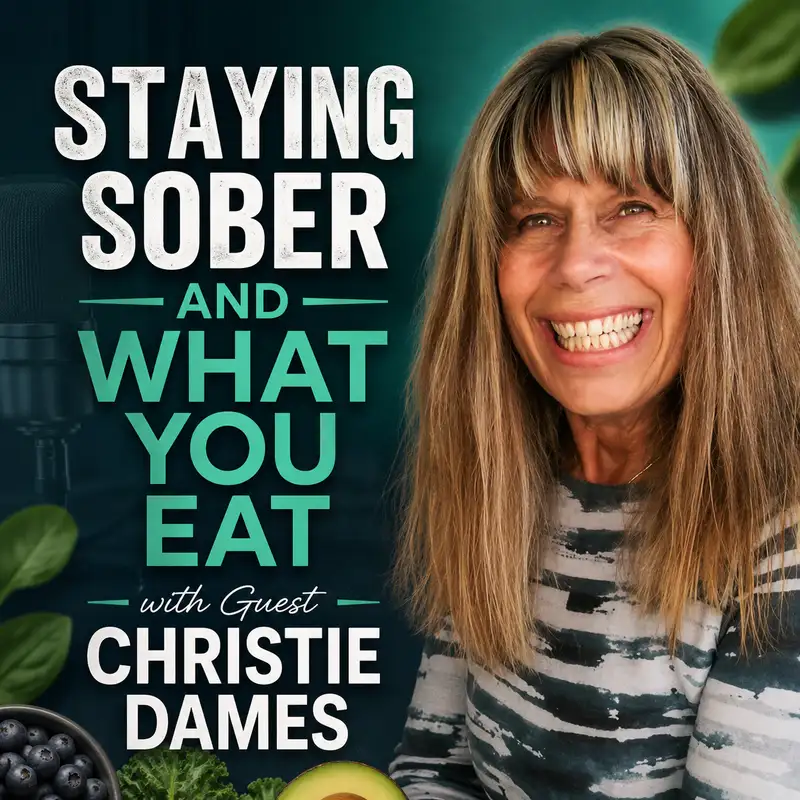
Staying Sober and What You Eat with Guest Christie Dames
Download MP3You're listening to The Recovered Life Show, the show that helps people in recovery live their best recovered lives.
And here is your host, Damon Frank.
And welcome back to The Recovered Life Show.
So great to be with you here today.
I am so excited because I have been trying to get this guest on forever.
He's probably one of the people who has influenced me, the top 10 who have influenced the Damon in his recovery.
And she's going to talk with us today about health, sobriety, staying sober and what you eat.
I am so thrilled to invite my friend to the stage, Christy Dames.
How you doing, Christy?
Hey, I'm great.
How are you doing?
I am doing so great.
I'm thrilled that you're here.
I know we had some scheduling issues.
I wanted to do it at the end of 2024, but we've got you now.
You're a jet setter.
You're doing the thing.
And I wanted to talk with you today.
You're my go-to when we're talking about nutrition and wellness and mental health and recovery.
And I know your background.
You have been sober for what?
Is it now almost 38 years?
Almost, in June, yeah.
Crazy.
And I've known you almost 32 years of that.
So I've seen you and your knowledge about nutrition and about what you eat, and the whole wellness and mental health thing just flourished.
So I'm so glad to have you on, and I want to dive in and really get into this topic of staying sober and what you eat.
You want to tell us a little bit of background about how you got into this whole thing?
Oh, yeah, geez.
You know, I'll be sober 38 years in June.
And you know, one of the big things that happens when you get sober, the very first thing you do, if you're going to AA meetings, you're going to have coffee, then you're going to have bread and cookies and all kinds of refined carbohydrates.
You're just going to douse yourself with that, right?
Well, you're already trying to deal with sugar.
And so it took me a long time to understand the sugar connection for myself and to see how that was playing out and then realize, whoa, you know, it's kind of like I was a sugar addict first and that was self-medication right there.
And then it transformed into other things, alcohol or whatever.
Right.
So so it took some time.
You don't see it right up front.
I didn't see it right up front.
But I really noticed it when I'm working really hard at my emotional health.
And yet, you know, there are blocks.
What is it?
And that led me to food.
You know, it's not uncommon for people to have emotional up and downs in early recovery.
Right.
Like that.
That's kind of part of the isn't that kind of part of the deal?
But the nutrition, I believe, as the years have gone on and been sober, I'm in agreement with you.
I think it plays a much bigger role.
Then we actually give it credit for it.
You talk about the whole culture of the 12 step thing, the 15 jelly donuts.
I call it stuck in the church basement.
You know what I'm talking about?
Like sober as a church mouse.
But on eighty five cups of coffee, you know, the artificial creamer, the you know, the jelly donuts, the really bad junk food, but sober, but miserable.
Yeah.
You know.
Oh, yeah.
That's a real thing.
Oh, it's it's it's totally, totally a real thing.
And, you know, I think about people getting sober.
OK, great.
But staying sober in those early days, months and years.
And if you're just carbo loading all the time, you're you know, you're creating blocks within the system for your own brain health.
And therein lies the end.
You know, we're operating still today, but all the new data is out.
But we've been operating on data that says, oh, yeah, I have all these grains.
Oh, yeah.
I have a whole grain.
Have the right.
But those things are not contributing and helping with metabolic health.
And metabolic health goes right to the brain.
So, you know, I knew or I knew about 20 years ago, feed the brain, feed the brain.
But I didn't know how.
Then it was like feed your mitochondria, feed your mitochondria.
Well, what is that?
Well, that's the little that's a little engine inside of every single cell that gives you a life force.
Right.
That's your life force everywhere.
But when those things are blocked and if you keep blocking them, I always say life is an access problem.
That's what it is.
And so if I'm sober and I want to access my highest self or source or whatever that is for someone, then I've got to remove those blocks.
And food can be the biggest block of all.
You know, and I think food and especially sugar.
And I want to talk with you about this right now, because on the live streams on TikTok, Christy, it's nonstop talking about sugar.
In an early recovery, it was always old.
And look, everybody's different and we're not diagnosing anybody.
And everybody, no doctors.
Right.
But we're just talking from our experience.
Sugar did give me a relief.
But at some point in recovery, it turned on me.
Just like alcohol did.
Yeah.
Yeah.
Oh, yeah.
And sugar, sugar is so, you know, the body operates in two ways.
You either get energy and fuel from sugar, glucose, or you get energy from fats.
That's the two ways.
Protein is different.
It's in the middle of something else.
But sugar or fat, glucose, fat, that's going to give you the life force.
And there's a lot of work right now.
There's some amazing people that are researchers, Metabolic Mind.
I always tell people, go to Metabolic Mind and look at what they're doing there.
And so quickly, Metabolic Mind is there is the son of the founder.
He had like a break, you know, he was in college.
He had a break.
He became bipolar, like suddenly out of nowhere.
And he ended up being homeless on the streets of Los Angeles.
And his mother tricked him into actually eating another way.
Like they had to work really hard to get him back up.
They live in the Bay Area.
And his story is fabulous.
But at the end of the day, he was bipolar.
Just medications, nothing was working.
Everything was bad.
She literally got him on a ketogenic diet, which has huge roots in history from way, way back for epilepsy.
It's a game changer.
It can stop epileptic seizures, period.
End of story.
And so this kid ended up doing the ketogenic diet.
Well, boom, he's totally well, healthy, healed, no bipolar, no nothing.
He's not on any spectrum of anything.
He's just a regular guy.
And you know, I want to dive into a little bit about this, about the mental health, because I believe one of the things that changed when I met you 32 years ago, mental health was something that people were talking about in recovery, but they weren't, they didn't look at sobriety as a mental health issue.
They didn't look at really now it's one thing.
And I think this is great because so many people come in with co-occurring disorders, depression, anxiety.
We're talking about bipolar, BPD, depressed, all this stuff.
Right?
And they're, it's, it's, they're not only dealing Christy with getting and trying to stay sober.
They're getting with other mental health issues.
And so much of this I'm finding is wrapped around what we're actually eating and consuming.
And I don't know about you.
I have seen people who have actually are doing the work and out of nowhere, their carb and sugar intake is like off the charts and out of nowhere.
They'll make weird decisions.
Yes.
And I'm like, it's not that they weren't doing the work.
It really shouldn't have happened that way.
But it's like they were drugged again through what they were.
The fifth big gulp at 11 o'clock.
Right.
And I've watched these guys at this treatment thing that I, that I would show up at every Sunday and they would literally go out spontaneously.
And I thought there's gotta be a link here to that sugar and carb intake and, and really crap they're eating.
It's not even really food and their ability to make good decisions.
Can you talk a little bit about that?
Because that is really what we're, how we feel because we're sober now we're like, we should feel better than we're feeling.
Yeah.
Oh yeah.
And you know, that, that ability to, to be able to make a correct decision, to be able to think things through instead of having something in the way that's hijacking our emotional health.
Right.
So there's all the different emotions, there's anger, there's rage, there's happiness, giddiness, there's all, all these different things you can be feeling.
And at the end of the day, you know, any one of those things can take us over and food can be, you know, food is such a, sometimes we need comfort.
Okay.
I want comfort food.
Well, what is that?
I, for me, it used to be like a muffin or a cookie or a cake.
And that's what I would eat to just literally not feel.
And you know, the whole point in, in having mental and emotional and spiritual clarity in life was to not have these blockages.
And sugar is that one thing or, and many things.
So sugar, we're looking at carbs and this is where it got so confusing for me.
Carbohydrates.
What are you talking about?
We're talking about all carbs.
So when you're talking about sugar, people think, Oh, just white cane sugar, no sugar, honey, molasses, all those kinds of things.
Then you have the pretend sugars like xylitol and erythritol and those can pose a whole other issue in and of themselves.
That can be a problem.
But then you have other things like, um, monk fruit and stevia.
They don't cause that rise.
But so you think if you're, if you're using all these things and you're getting a spike in your blood sugar, then, then all of a sudden you can actually react differently to things.
There are two people that I love.
Chris Palmer, he's at Harvard.
Love this guy.
He wrote a book called brain energy and he's looking all at, at addiction.
What happens in the brain?
What happens in the body?
Basically it always comes back to a metabolic issue.
Metabolism.
How does your body run?
Another woman, Dr. Georgia Ede and both of them have beautiful books out.
A lot of them, they're all dealing with mental health issues.
And part of the challenge today is we all get labeled with a name, right?
We all get labeled with a, you're a bipolar, you're schizophrenic, you're, you have, uh, all these disorders.
But at the end of the day, it's back it out.
It's all the same thing.
Yes.
Metabolic issues.
How's your body operating?
And then how am I going to be happy being a sober person?
Right.
And those two things are intimately linked.
You know, we talk a lot and I'm so glad that you brought that up.
We talk a lot on the recovered life show about being awake, aware, and alive.
Like what one thing that you get is when you get sober, you're awake or in your life, but being awake or in alive all the time can be painful.
And you talked about this experience with this muffin and I, I'm sorry, I got to go back to the muffin because I was picturing it.
Is it a blueberry muffin?
Is it a poppy seed?
Right.
And I remember it was much later in my sobriety and I had decades at this point and I had, um, had to give away, I had to stop sugar cause I've had some health issues and sugar was my first addiction.
Well, actually my second, it was escapism, sugar, and then alcohol.
Right.
And I share that a lot.
And I think it's important that it's kind of in that order for me because escapism was a for, and then sugar allowed me to escape more and then alcohol allowed me to escape even further.
Right.
And this whole idea of it being a comfort food and it having a reaction.
I remember when I had to give sugar up for a period of time, I had an experience where I was in the kitchen and I'd been off sugar for a while.
And I realized, Oh my gosh, I'm not anxious.
I can think clearly.
And you know, I have had my battle with anxiety.
You've been on the other side of that helping me.
And I literally, Christy, I said to myself, I was like, something's wrong here cause I didn't have the anxiety.
And I thought, no, sugar has been trapped.
It's been an illusion, just like alcohol.
It was keeping me out of the here and now.
Can, can you talk a little bit about that?
Cause I think this is mysterious.
How do we get into the here and now and recover?
Cause we know that's where the consciousness is.
Right.
Is sugar and eating crap really just keeping us out of that?
I, you know, for me, I absolutely believe that to be true.
Um, sugar is very, very powerful.
And you know, at a certain point in my life, I said, wait a minute, everybody's looking at using the word mental.
Well, I don't like the word mental.
I don't think we have mental problems.
I think we have physical issues happening that lead to emotional connections, uh, misdirections, outbursts, whatever that is.
Right.
And it, and you can call it mental, but that's just slapping a title on.
We're looking at the physical body, how it operates, what it needs to operate, what's your operating system.
And everybody's is different, right?
Everybody's is different.
And so some may need a certain amount of fat and like a lot of fat and others need just a little bit of carb.
So, but those things can then block.
I believe in my own experience and others I've seen that it can block things, but it can also trigger things.
And if you have traumas in your background at all, we all do.
If you have any kind of trauma related, anything, say you, you self medicated as a kid with cookies and cakes, or you were given sugar all the time, or, or you had, you were given lots of sugar.
You had lots of dental issues and you had all the dental trauma.
Like you have all these different things that contribute.
Right.
And that sugar, that food can, it seems like it's going to help at the moment, but what it does is it can trigger a whole cascade of other things.
And we think it's the, we think it's the thing happening or we think it's the moment, or we think, Oh no, I'm not doing enough in my sobriety.
Oh no, I'm a loser.
Oh no, I can't navigate.
None of that's true.
That the truth is in the moment, what are the things happening?
What are the triggers?
And, and here's another piece that's really key.
What you ate four days ago can be happening today.
So that's the key.
We always think, Oh, it's what I ate in the moment, or what I had.
I mean, dairy takes forever to leave the system, right?
Wheat and gluten takes forever.
So, and dairy can looks like an opioid, the way that it affects the body.
So that's going to affect the mind.
That's going to affect a decision, a reaction and boom, I'm off to the races.
I love how you've tied all this together.
When we come back after this quick break, we're going to really, we're going to go a little deeper on this.
Christy, we're going to talk a little bit about how to get that opening.
Because for me, I, I, you know, we talk in recovery like is, Oh, maybe I'm not my thoughts.
Maybe I don't have to drink.
There's like a little thing that I could hold on to.
And I want to find out how do you do this?
Because I found this harder to clean up my diet than really getting sober harder to stay on it.
So I want to, I want to share that because this is the audience that wants to hear it.
We're going to be back after this quick break and we're back with my buddy, Christy Dames.
We are diving into it today, guys.
We are getting deep about a topic that a lot of people don't want to tread down this path.
I'm going to be honest with you.
We're talking about staying sober and what you eat.
We know now it has a big impact and thank you, Christy for coming and sharing your experience with us and your knowledge with us.
And, you know, we're just going to say, this isn't, we might be talking about different diets, different co-occurring disorders.
That's between you and your doctor.
This is really just meant to be an educational thing for, to kind of turn people onto the idea of it.
So we're going to dive into real deep now here because I found it hard to find the opening, Christy.
I couldn't find, how do I stop eating sugar?
Cause you're talking four days.
You're saying four days with this.
How do you start this process?
If this is something you want to do, how do you do it?
You know, here's what I learned over all the years is this.
When you start to understand that, that all the foods that turn to sugar, right?
So carbohydrates turn to sugar.
So the first piece is back out of junk food, just back out of junk food.
And that's step one, stop having a, you know, fast food, stop having things with multiple things in them.
Just if you can stop that part, the other side of that is to eat cleaner food.
So anything with less ingredients in it is going to be better because ultimately you want to get to whole foods, right?
You want to get to, and I don't mean the store.
I mean, do a whole food.
You want to get to eating.
If you're, if you're a carnivore, you're going to want to have a piece of animal protein.
You're going to want to have really good fats.
You're going to want to have very little amounts of carbohydrates.
You're going to want to pay attention to any kind of starchy item too.
And this was big for me because I could see sugar.
Okay, fine.
I can back out of that.
But starch was my, that was my go-to if, you know, give me a piece of cake or, oh my gosh, I'll be in the corner.
Like, let me just go ahead.
And don't come near me.
Don't want it.
Don't take any of my cake, right?
The sugar and the starch together.
Then now you've got a magic combination.
Yes, exactly.
So, you know, basically you really want to, you, and you don't want to do everything like right away either.
I do though.
I mean, for me, I'm like, oh, okay, I'm just going to stop because I know something.
And for some people that works perfectly.
Other people you've got to transition into things and other people somewhere in the middle.
It's all about experimentation, but it's about seeing the trigger seeing and then trying things.
But again, the first piece is back out of the junk food, back out of a stuff that's got lots of chemicals in it.
Start to be a label reader.
Just get an idea of that.
The more whole foods you can eat, like a potato, asparagus, green beans, tomato, a steak, what, whatever that, uh, sunflower seeds, pumpkin seeds, right?
The more you can eat a thing, the better you're going to be.
Absolutely.
You know, I want to talk about this all or nothing mentality because I know this is what I thought, you know, and I did the show and we've got the recovery life community just because I had so many questions about how to live your best recovered life.
Right.
And I, and for me now, you know, nutrition has become one of the key components to living my best record.
It really is.
It is.
It is the game changer for me.
Now a lot of people ask, and this is my question too, is this an all or nothing?
If I give up sugar, can I have sugar a little bit for a birthday or for whatever?
Is this like alcohol or drugs where, you know, look, if you, I can't drink one drink, right?
Without that, without the phenomena, is it really that hardcore or can you live your life a little bit?
Because I think people in recovery think like me, I'm like, what more do I have to give?
Chrissy?
I've given everything.
I get rid of everything.
I have nothing.
Yeah.
Well, it depends on you.
Right.
So for me, I cannot have a little piece of cake.
Forget it.
It's over.
And because it, it's kind of like the first drink, right?
The, the first drink may be all right.
And then the second, and then you don't really see it coming to train.
You don't see it coming, but it's coming.
Same thing can happen with sugar that the first little bite, well seems okay.
I'm all right.
But over time, how that can build starts to create that dependence again and that wanting to have it.
And for, you know, for all kinds of conditions, you know, I mean, we're not just people who have an addiction, alcohol, a drug, whatever that is, pharmaceutical, whatever that is.
We are people that have, we come in with a past, we come in with issues, things we grew up with.
We come in with toxins in our bodies.
You know, one of the things I learned recently with a, from a doctor in in Arkansas, actually, who fabulous at a, at a medical conference.
And she's talking about fentanyl and she said, okay, fentanyl pretty toxic.
One, one time having fentanyl may not do anything.
What time do you, what, you know, is it the second, the third, the fifth, when is fentanyl going to take you out?
Well, the reason why it may not the first time is because it's stored in the fat in the body.
So now it's stored in there.
Well, you get fentanyl like the second, third, fourth time, all of a sudden it explodes, boom, you're gone.
You, and, and so you, you don't see that coming, right?
You don't see it coming.
So, so it's all about tolerance, what we have going on, what our metabolic state is at the time.
And that like, that is so key.
That is so key.
I love how you're saying that because now this is stuff new.
And it's funny because a lot of big 12 step hardcore people say, wow, you know, if it's not in the book, it's on this.
It doesn't really relate to our sobriety, but I find snow.
It's an overall wellness in our life.
And that's really, I think the new rebirth of recovery here.
And what we're trying to do here is like, you know what, let's look at our whole life.
Like if you need therapy, go to therapy.
If you need, you know, you have a co-occurring disorder deal, you can deal with that.
And you're still sober.
You're still doing it.
Right.
I got to tell, I got to share this experience with you because I, you know, I was asking about this black and white thinking, which we're prone to anyway, as, as people in recovery.
But I I, for Valentine's day, we got a bunch of little pieces of cake and I've been more, I've shared with you.
I'm more on this.
I'm moving into the ketogenic.
And when this airs, I will be on pretty much all of the ketogenic kind of Mediterranean thing.
And I, so we had some cake and the first night was, was fine.
And I, I ate it in the afternoons for my blood sugar to make sure it was good, but it dropped my blood sugar.
I almost passed out when I ate it.
It was so sickingly sweet that I was like, I, this isn't even enjoy.
This tastes like poison now.
Yeah.
It was very weird.
And, but here's the thing the next day, cause we got these little pieces of cake.
I thought, well, you know what would be good.
And I was having a great day.
I was thinking, you know, what would be better than perfect right here right now is to make it more perfect with a half a piece of this cake.
Right.
And I was like, this is insanity.
Why am I doing this?
Like mate, this literally I almost passed out.
Cause I ate this.
Like, why am I doing this?
And I was like, wow, this is such a metabolic addiction.
If, if, if that's even the right thing for it.
Right.
Right.
But realizing that it really kind of tastes like poison.
I know it sounds weird, but you know what I'm saying?
Like you taste, it's like, Whoa, this is, it changes off the chart.
It changes and it changes really fast.
Um, you know, so for instance, with alcohol, when you stop drinking alcohol, your body changes right away.
If you pick it up again in say a week, a month, six months, a year, your body has changed.
Every time you pick it up again, you are now re traumatized.
It's like having a mini traumatic brain injury.
That's what's happening every time we go back.
Right.
And so you, I kind of think about it the same way with sugar, because when you stop eating a carb, you stop eating breads and, and you know, that the, uh, refined carbohydrates, you literally change very rapidly.
And so when you start to eat those things again, they taste really strong, but isn't it funny how very quickly that changes?
And then you're like, Oh, wow.
Well now it just kind of tastes normal again.
So for me, I see that, that that is an injury.
Again, it's a metabolic.
I didn't even look at it like that.
I didn't even look at it like that.
And it is like when people stop drinking, they go out after 20 years, they get back on the train where they left off and it just didn't work.
Yeah.
And I think that that's part of why that happens.
It's, you've changed on so many levels, but, but that injury will come back.
You know, there's a, uh, a gentleman here that we're friends with and he, he's been sober a little while now.
He's beautiful man, married two kids, right.
And helps a tons of people, uh, has a really solid sobriety.
And, uh, but he went to the doctor and he had these like outrageous blood sugar, insulin readings and insulin is important to understand not just your blood sugar, but what's your insulin reading, right.
What's going on there.
And so he, he went and they're like, well, you're going to probably have to be on medication, right?
So he left, we put a whole plan together.
He did that plan.
He went, he got off all the refined carbs.
He got off.
Most of the carbs started eating all the really good, healthy fats, good protein.
Holy cow.
He went back to the doctor.
Numbers are all normalized.
The doctor was like, well, what's going on here?
He goes, well, you're actually really fine.
Now you do not have type two diabetes anymore.
And he's just like, Whoa, woohoo.
And he's doing it.
Right.
He's and, and, and he feels so empowered as well.
So now he had a diagnosis that he doesn't have anymore.
He's empowered because he did it himself.
Didn't take any medications.
And he's, he's doing it.
He feels great.
He can do all the, he thinks better.
He has emotions are stable and numbers are corrected.
Like, wow, how can that be?
And that's, you know, a key part here, Damon.
And, and I think people don't look at ketogenic.
We've been trained to think, Oh, be afraid, be very afraid of fats.
No, no, don't be afraid of fats.
Um, be very afraid of not being, you know, and, and by the way, there are people that are carnivore keto people.
There are people that are vegan keto people.
So you do not have to accept one or the other.
I love that.
You can find your way because the point is to operate from fats.
Your brain needs fat, needs cholesterol.
We've been told, Oh, cholesterol bad.
Oh, nothing could be further from the truth.
Creators and Guests