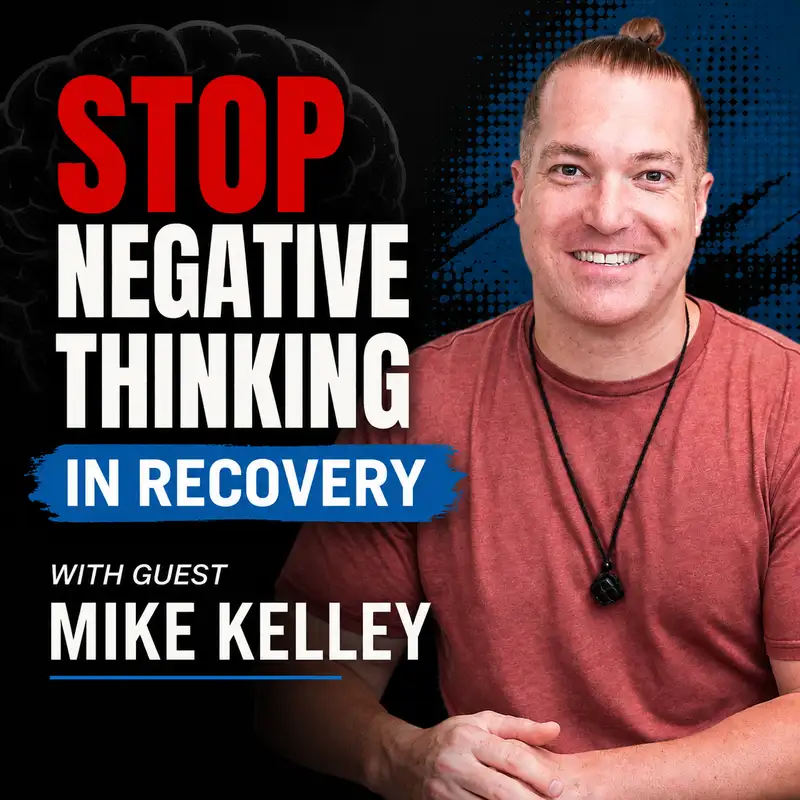
Stop Negative Thinking In Recovery with guest Mike Kelley
Download MP3You're listening to The Recovered Life Show, the
show that helps people in recovery live their
best recovered lives.
And here is your host, Damon Frank.
And welcome back to The Recovered Life Show.
We're talking about conquering negative thinking in recovery.
I've got mindset coach Mike Kelly with us
today.
How you doing, Mike?
I'm doing fantastic.
How are you?
I am doing so well, guys.
Mike Kelly is a mindset coach at Reworking
Mindsets.
Is that the name of your company?
Reworking Mindsets, right?
Correct.
Yes.
Excellent.
Excellent.
I was so thrilled to have you on
today, Mike, because this whole negative thinking thing,
everybody has negative thinking, but people that are
in recovery, especially people in early recovery that
are trying to rebuild their lives, or maybe
they've been in recovery forever, right?
They've been like me.
They've just been in it for a while,
right?
And they find themselves having negative thinking more
than they would like to.
This whole idea of how do you kind
of conquer this?
How do you get over this whole negative
thinking trap?
How do you know if you have it?
So I'm so glad to have you on
today.
I know you had your own kind of
path with negative thinking, right?
You've gone through it yourself personally.
What was your journey in this whole negative
thinking issue?
Absolutely.
First, thanks for having me.
My path is just realizing first what negative
thinking is.
And everyone has negative thoughts.
That's common.
That's typical.
That's okay.
But negative thinking is when those take over,
when that's a majority of your thoughts.
You focus on the bad, you focus on
the unfortunate, and it's tough to get out
of that kind of spiral and just that
constant snowball of thinking about what's bad, what's
not going well.
The negative aspects of life.
And your thoughts are kind of like a
snowball.
Whatever you focus on, whatever you give attention
to, they will just kind of continue, get
bigger, and keep that momentum rolling.
So if you find yourself thinking about negative
things and you continue to focus on what's
bad and further aspects of what's not going
well, what's not working out, just anything that's
not favorable for you, it will continue to
snowball.
So my experience of that, it's happened in
a lot of different areas, in career, in
sports, in social situations, just what's going on
in the country, in the world.
COVID was a big one for me personally,
and I think for a lot of people,
just with a lot of different unknown things
happening.
And what you give your attention to is
what will continue to happen and snowball, like
I was just saying.
You know what?
I love that when you say what you
give your attention to, because I found that
my path with negative thinking is I had
to kind of make a decision, right?
Very similar to people that are in recovery.
They have to make a decision.
It's like, you know what?
Hey, this doesn't work for me anymore.
I can't do this anymore, right?
So there's this demarcation line, kind of.
And I found that also with negative thinking.
I remember in very early sobriety, I said
to myself, you know what?
I've got to retrain the way that I
think because I'm constantly going to fear, anxiety,
worry.
And if I want to live my best
recovered life and be a high performer and
do all this, I'm going to have to
let go of this.
And for me, it was really, you know,
I just want to use the word neurologistic
programming because that's kind of what I had
to do.
So I kind of, in a way, brainwashed
myself to start looking at everything very positive.
And I've had people in my life to
say, you know, hey, Damon, even when things
are bad, you tend to will say something
like really super positive, even if it's realistic
or not.
But I kind of trained myself to do
it.
Is this a habit, Mike?
Like, is this just a, it's a habit,
right?
It's something that you could teach yourself and
to become a more positive person.
Absolutely.
Yeah.
And you said it perfectly.
It starts with being intentional and making that
choice.
You have to decide that this isn't working
for me.
Clearly this is not working.
I have to make a choice and do
something else.
And what is the flip from negative thinking?
It's positive thinking.
It's focusing on the good, focusing on what
you're grateful for, you know, all the things
in your life that are happening that are
good for you or even the bad things,
but there's a good aspect to it.
It's just shifting your perception and how you
view things.
And that's a big start and where to
go from there.
I love that about perspective, you know, and
really the gratitude part of it, you know,
in recovery, gratitude lists are huge.
When people come in, if they're negative, typically
a 12-step sponsor will have them write
a gratitude list with their gratitude.
So much so that it's almost like a
joke of like, oh my God, if I
see another gratitude list or another gratitude text
chain, right, I'm going to throw up.
It could be a little overwhelming, but it
is really a magic key, Mike, this whole
thing of gratitude, of being able to kind
of look outside of your current perspective.
You know, I found, and I'd love to
hear your personal experience with this because I
found that being negative shut me off from
opportunities that were just as prevalent because I
think it was easier for me to see
the negative.
So in a way, I became lazy and
it does take a little bit more, I
found, focus and willingness to sometimes pursue the
positive.
But when I do that, it's right there,
just like the negative.
So many times there's much more positive and
opportunity, I just don't see it.
Does that make sense?
A hundred percent.
And I think a lot of that has
to do with society.
There's so many shows and songs and just
what people talk about, what people post on
social media and it's complaining, oh, it's Monday.
Monday sucks.
Well, does Monday suck or does everyone else
say Monday sucks?
So you think it does, you know, you
could have the best day ever today if
you decide to and you focus on that.
But if you see 20 other people talking
about how awful it was and it's Monday
and I'm dreading this, then it's easy to
fall into that kind of trap of what
everyone else is doing.
And just like that list, it's kind of
funny that you say that it's almost frustrating
when you write down so many things that
you're grateful for.
But a lot of people do the opposite
and don't even realize it.
They complain about so much and this is
going wrong and that's going wrong.
And if you look at the world in
a different way and you focus on positivity
and gratitude, it's just as kind of sickening
and frustrating to see someone fall into that
too.
It is, you know, sometimes I, you know,
sometimes when I'm in the really positive space,
right?
And I could kind of see it and
things are really working when I'm around people
who will start the conversation office.
Let me tell you three things about what's
not going well for me, right?
Sometimes depending on my relationship with them, I'll
stop them and say, before we do that,
tell me a couple of things that are
going really well.
And you know, I've done that actually with
like family members and stuff and say, stop,
you know, tell me a couple of things
that went really well.
And you can hear their mind going a
little bit and usually their first thought is
like nothing.
And I go, nothing?
Like nothing?
You know, and I've had sponsees and people
that I've worked with in recovery, I'm like,
well, you ate today.
Yeah.
Oh, you have a house today.
Yeah.
Okay.
Well, that went well.
Like, you know, you were, you, you slept
all night.
Yeah, that went well.
Okay.
It's just like this training of yourself to
start looking at these things.
I think in today's society, Mike, we take
so much for granted.
Oh, I'm just going to be able to
sit my computer.
We're talking via, via zoom right now.
Right.
It's like, it's always going to work.
I'm always going to have running water.
You know, it's, I could take a hot
shower, whatever I want.
It's not until you don't have those things,
you're deprived from those things that you really
see the positives that are in your life
that are going on all the time.
Absolutely.
Yeah.
And a simple one that if we're here
listening to this today, we woke up today.
That's that's a privilege.
You know, a lot of people unfortunately don't
get that every day.
So that is a great start.
We wake up with one thing to be
grateful for and it just keeps going from
there.
I saw something the other day and I've
seen this before, but you know, the person
complaining about their job, there's people without a
job that would love that.
The person complaining about their home, there's people
without a home that would love that home.
It's, it's all perspective.
And we, we do take a lot of
things for granted and there are a lot
of people that would love to be in
our situation and focusing on gratitude and what
we do have, even if it's some food
to eat, air to breathe that we woke
up today, a roof over our head, that's
more than some people have.
And that perspective again, um, can do wonders
is really powerful.
Absolutely.
Absolutely.
It's not until you don't have those things,
uh, that you really notice them, right?
Until you really, really notice them.
And you know, I know Mike, there's people
that are listening to this, that they actually
tuned in because they actually saw the headline,
right?
They saw the episode title and they're in
maybe early recovery and they've had to let
go of a lot.
Right.
Like I know for me in early recovery,
I couldn't hang around the same people.
I had to let go.
Literally, I lost.
It was God doing for me what I
could do for myself.
Honestly, I just, everything, every day I woke
up, everything was leaving, right?
The apartment was leaving.
The friends were leaving.
I couldn't do my job anymore because it
was alcohol related, right?
Like, so I could, I couldn't do anything
right, right?
Like everything was, everything was going.
Now a lot of stuff was coming and
I had to train myself to see, Ooh,
this is an opportunity for me.
Right?
Right.
Loss is an opportunity for me.
But I think the peer group is the
biggest thing, right?
Like how, how important is it to surround
yourself and to start weaning out those habitually
negative people who just drag you into like
dust?
Like by the five minutes with them, you're,
you're, you're ready to like, you know, go
on a vacation and never come back.
It's so important.
Especially if you spend a lot of time
with those people and there's ways to do
it aside from just cutting people off to,
I know that's kind of the default and
what a lot of people think you have
to do, but you can slowly get there.
You don't maybe have to spend all the
time with that person, but limit that time.
You can direct the conversation just like you
said earlier, you know, tell me three things
that that's good that's happening for you right
now.
What I tend to do is if someone
tells me something negative, I kind of point
out the good, just like a subliminal, you
know, started going through that, but I'm glad
that you're, you're making some changes and things
are going well for you.
And they start to kind of look at
it and think, and anyone watching this will
probably think, Oh man, you've done that to
me before.
But I try, I try to do that
because that's what I do with myself.
When things go bad, it's just that little
shift of like, well, what is going good?
And even when a setback happens or someone
is negative, you know, things are exiting your
life, but what's the, what's the future look
like?
What's the real reason of that?
Is this bad?
It's bad.
Maybe in the moment where you think it's
bad, but what will come after this?
It's there's always two sides to it.
So no matter what is happening, there's a,
an alternate perspective and just taking a look
at that and analyzing, you know, is this
really a bad thing or will this help
me in the future?
Maybe it's tough now, but maybe I need
to go through something tough so I can
endure.
I can keep going.
I can, you know, keep that, keep that
up for, you know, much longer than just
today or this week or this month.
And your friend group and your, your social
group is a big part of that.
Um, we've all, I think heard the, you
know, you are the five people that you
surround yourself with the most.
I think a big part of that is
their mindset too.
Uh, not necessarily who those five people are,
you know, if you're trying to start a
business or something, of course you want five
successful business people, but do they need to
be successful business people or just someone that
has a great outlook on life and that
rubs off on you too?
I think that's equally as important and it's
good to have a mix of, of people
that, that think in a positive way and
can help you be successful, grow and be
the best version of yourself.
For all of you recovered life show listeners
who've battled in sobriety and are ready to
level up, listen up.
I'm offering a week of my accountability coaching
absolutely free.
This isn't just about day to day survival.
It's about aggressively propelling your life forward.
Whether you're new to sobriety or have been
sober for years and are struggling to elevate
your life, I'm going to be your partner
for a week and help you get on
track and start living the recovered life you
deserve.
We're not just talking about setting goals here.
We're going to pursue real tangible breakthroughs in
your personal and business life.
This is more than recovery.
It's about owning your path and seizing the
greatness you're destined for.
But hurry, spaces are limited.
Don't wait.
Go to DamonFrank.com and claim your free
week and start your journey.
It's time to transform survival into thriving.
Visit DamonFrank.com and book your free week
now.
Absolutely.
You know, almost I say like curating those
people and I kind of do that now
is finding people that really are going to
not tell me what I want to hear
because that that that that's dangerous.
Right.
But but have have that right mindset.
You know, you know, just a funny story.
Like when I was in early recovery, I
was totally blessed.
It was in San Francisco.
There was a group that I was involved
with that were as much older men than
I was for the most part.
They were 10, 20 years older than I
was.
And I would walk into this one meeting
every week.
It was actually twice a week I would
go and I would see the same group
of people.
They were very successful, like one was a
judge, business people.
They had everything that I wanted.
Right.
And it was a new sob story for
me every week when I walked in this
meeting.
Like one week I walked in as a
man, the girlfriend, me or whatever, they would
stand up and applaud.
They would stand up and it so pissed
me off, Mike, I got to tell you,
I was like, what is going like?
Oh, it looks like I'm going to lose
my apartment.
They said, yeah, you know what I mean?
Like and finally I was so upset.
And, you know, my sponsor pulled me aside
and said, Damon, the reason that they're applauding
is because God's bringing in new things to
your life and you had to let go
of these to get what's coming.
You're just focusing on what you're losing.
You're not focusing on what you're actually receiving,
which is far bigger.
And it's never going to work out for
you, obviously, holding on to those things.
So just let go of it.
You know, and that was a big lesson
for me about letting go.
We talk about that a lot on The
Recovered Life Show.
How important is that, Mike, like really understanding
that like some things are not meant to
be like you could pursue them, but sometimes
you're suffering with negative thinking simply because you're
creating it in your life by holding on
to things.
Absolutely.
Yeah, there's there's actual suffering and there's perceived
suffering.
And a lot of times our suffering is
perceived.
We create it.
We think that we're suffering because we lost
that job.
And maybe temporarily you are suffering because, you
know, income or trying to make things work.
But does another job come into your life
that's way better than the last one that's
more aligned with what you want and that's
a better opportunity with more people?
A big one is relationships, too.
You know, we've all had that heartache and,
oh, I can't believe I lost this person.
And and we broke up and this was
the best relationship.
And you find someone else down the road
and you don't even remember that last person.
You know, it's way better.
You couldn't even imagine yourself back then.
So a lot of it is just what
we're what we're thinking to be so rough
and so bad.
And if we really just take a step
back and kind of have a bird's eye
view of is this really that that tough,
that difficult or does it just feel like
it because it is right now, you know,
give attention to those feelings.
But look at it from the big picture,
too.
You know, this is a little speck of
life and I've so much more.
What's next?
You know, every time something some door closes,
another door opens.
So what opportunity is opening for me?
Yeah, and I think the most successful people
in recovery and in life, that's how they
look at it, they look at loss as
an opportunity, right, they don't look at it
as a deficit.
It's just part of life that things come
and things go and things change and change
is good.
You know, let's get into it, Mike.
Let's really let's get down to the nitty
gritty here.
If somebody is listening to this and they're
just a negative thinker and they're like, man,
I've always been a negative thinker.
My parents were a negative thinker.
My uncle's a negative thinker.
My grandparents were negative thinkers.
It's always the worst case scenario.
What's something what's some strategies that they could
deploy, Mike, right now that's going to help
move them out of this?
I you talked about the list earlier, it
doesn't have to be that extreme, but that
same concept, everything that happens that you find
yourself and you catch yourself being negative about
find at least one thing that's positive about
it.
You know, I had an argument with someone
today.
Well, I learned where we stand on this
thing.
Right now it's raining.
I live in Phoenix.
It's a beautiful, sunny place right now.
It's raining.
Well, that's probably good for, you know, vegetation
and other things.
We probably needed it.
It's very dry here.
No matter what happens and even really difficult
things.
And I've had to go through this personally,
even really tough things, tremendous losses, unexplainable situations.
There's always something that comes out of it.
You become a different person.
You become a better person.
You learn things.
You're more aware.
There's always something to take away.
So just looking at every situation, catching yourself
awareness is huge.
So just being aware in the first place
is a huge step in the right direction.
And then the next thing, just what is
one positive or potential positive that can come
from this and starting to actually believe that.
Another thing that I put in place, and
this has been huge and super helpful for
me, I brought it to to show today
is is a jar of sticky notes.
And when you feel like, you know, what
what could happen today?
Everything was bad.
What the concept is, is you take a
sticky note, you write at least one good
thing that happened that day.
I put the date, I put it in
a jar, I save it.
I look at it six months, a year
down the road, and I see, you know,
365 good things that happened.
Looking back at all the good things that
happened to you, even if you don't feel
like there's a hundred good things happening right
now, so much good has happened.
And then you get in that habit of
gratitude.
You have to, you know, with any other
habit, you have to practice it often for
it to become a thing.
So just focusing on the positive, focusing on
gratitude, what can I be grateful for right
now?
What is going good?
What good could come from this?
And then that starts to build that.
And again, back with the snowball, it starts
to build momentum.
And then you're thinking in a positive way
before you even realize it.
Yeah, I you know what, I love this
because you're really talking about habit, you know,
creating this.
This perspective in life that you're looking at
life as an opportunity and that good things
are going to happen, you know, I know
for me.
I remember a pivotal moment where, you know,
and where in my life I had to
make a decision.
To say, I'm going to go through life
and I'm going to start actually looking almost
like an Easter egg hunt, it sounds crazy,
but like, where are all of these amazing
things that are happening, they've got to be
around me somewhere.
And, you know, and where I where I
first started to have awareness of this, Mike,
was I wasn't able to see it myself.
But in a 12 step group, I was
able to see it in others.
I saw people recovering.
I saw people getting things.
I saw people having relationships.
I saw it working.
And I had to ask myself a question.
If I could see it in them, it
has to be possible for me.
And for that was a huge breakthrough for
me because it opened the door for me
able to start to kind of, in a
way, go on a hunt every day for
things that were coming into my life that
were right there that I just I just
needed to become aware of.
I love that.
I love that.
And that reminds me of a book that
absolutely changed my life.
And that is the power of now.
It's all about mindfulness and focusing on this
moment right now.
If you think about the past and worry
about the past, you're probably going to have
anxiety.
And, you know, why did I why did
I do this?
And this went wrong and I should have
done this differently.
And if you think about the future, you're
you're probably, you know, I think I switched
those.
You're going to have anxiety thinking about the
future and you might be depressed thinking about
the past because of all the mistakes and
things and things that you could have done
if you focus on that anxiety, thinking about
the future and what's going to happen and
oh, no, what could possibly happen if you
focus on right now?
And it's more than just yourself.
It's everything happening around you.
All the sensations, the smells, the sights, the
sounds, just you can try just sitting in
a room and just observing what's in nature
is great for this.
What's happening outside of me?
Birds are doing some pretty cool things, probably,
you know, the trees, the grass, the plants,
there's other people walking around and you just
notice things that you didn't notice before and
practicing mindfulness in that way.
And then when you're around other people and
you start to do exactly what you said,
you start to notice things in them and
people are smiling and they're so happy in
the corner.
When when you just focused about what could
happen or what did happen, you don't notice
those people.
You don't notice those great things.
And there's so many beautiful things that are
happy and positive and can improve your life
that we kind of have blinders and tunnel
vision.
But if we're just open to those experiences
and just see what else is happening, there's
so much more good out there than we
probably realized.
You know, I it's interesting because when I
look at people who are they have what
I want, right, like they're very successful, maybe
in business or in life or they're just
something about them.
They tend to take a lot of the
things I've noticed, they tend to take a
lot of the things that you're talking about.
And link them into a bigger life purpose,
right?
And I didn't get this till later in
my sobriety, but that really my life purpose
and one of the reasons I do the
podcast and, you know, I'm involved with Recovered
Life is that, you know, I really just
want to be of service to people, right?
Like, so can you talk a lot about
a little bit about that, about how.
Really taking this to the next level, because
it's not necessarily as much as, OK, well,
I'm going to wake up, I'm going to
do these practices.
And yeah, look, you start looking at the
pause, your life's going to change, right?
Like your life is going to change.
Things are going to come in your life.
You are going to have momentum that that's
just a fact.
Like I see that, like the empirical data
is there that I see that.
But what happens when you link it to
something bigger, a purpose, doesn't it just take
on a whole other meaning?
It does, and I think the new perspective
and what we're talking about becomes a kind
of search for purpose and your purpose just
kind of shows up because you're realizing your
own potential, your own value, your, you know,
what you can do, what you can contribute.
You realize how everything kind of plays together
and how many opportunities and great things there
are out there.
And when you're focused on negativity, you're you're
very limited in what your opportunities are because
you feel like maybe there's not that many
opportunities.
But when you focus on positivity and all
the good things that, you know, could potentially
be yours or you could contribute in some
way, you start to find your purpose.
You start to find what it is you
really want to do and how you want
to give back to other people.
And giving back is a big thing, too.
You understand how much it helped you and
you understand that there's a different life out
there.
That's why I became a coach, is you
want to help other people see that, too.
You don't want them to continue to go
through the struggle that they're going through or
maybe that you went through at one point
and you want to help them out of
that.
It's kind of I've seen a cycle of
you, you do some healing, you do some
growth.
And then the next step in that is
you want to give back and help someone
else do it.
And they just kind of repeat that cycle.
And it keeps going.
When you give to others and when you
focus on helping other people, you're outside of
yourself as well.
And the attention and the focus isn't on
you.
It's not about all of your problems and
all of the bad things.
It's about helping someone else.
And it's greater than yourself.
And I feel like that helps you really
find a purpose, too, because we're all in
this together.
And the more that you can connect to
other people, help them and help them see
a different, better way.
That's the most rewarding thing I've found in
life so far, is helping someone make a
change and seeing that joy when they're living
a happier life.
Let's talk a little bit about your perspective
of what happened in your life.
How has your life changed?
Because obviously you're a self-described, you were
a self-described negative thinker looking at the
negative.
How has doing this, what's been the ROI
for you?
The return on investment, right?
Like, was it worth it?
Like, what's the difference in your life?
I can't even measure the ROI.
You know, it's so much that you can't
even put something tangible behind it.
My life has changed in so many ways.
And mindset has been a huge part of
that and the way of thinking and gratitude
and positivity.
So many more opportunities have come into play.
So many more relationships, friends, other family.
Just I've connected with people in a different
way and a deeper way than I ever
thought before, because people want to be around
other people that are enjoying life.
They want to know how you're doing it.
They want to enjoy life, too.
And it just brings people together so much
more.
Business wise, people want to work with people
that are happy and positive and exciting and
happy to be around.
You know, if you know, nobody wants to
really be around like an Eeyore, everything is
kind of frustrating right now.
You know, you're not going to have those
life opportunities.
So so many doors have opened up.
And even just conversations are so much more
approachable.
You know, the energy just goes all around.
Other people feed on that.
I'm attracted to people that have that sort
of energy and just love for life.
And it's hard to even put into words
just how many more opportunities there are and
how much better life can be when you
just switch the way that you look at
it a little bit.
You know, there's a lot of I use
the I use the term trapped in the
church basement a lot, nothing to do with
churches or religion, but it's more like, you
know, a lot of 12 step meetings happened
in churches.
And I've noticed something with just, you know,
my three decades of doing this is that
there are some people who.
They physically get sober and then that's it,
right, they'll maybe improve their life a little
bit, but they're afraid it really comes down
to fear, Mike, you know, like if I
change anything, I might not be sober.
If I step out of my comfort zone,
it's too scary for me.
Right.
Like they're paralyzed, like just paralyzed.
Right.
And I think a lot of it after
the whole physical recovery side of it, after
you're physically sober and you go through any
program that you're going to go through and
you do the work, right, it does it
really is a mindset game.
It's all like, how can I get the
mindset?
How can I then execute these tasks?
A big one for me, like I found,
is that it would stop for me.
The mindset would stop working when I was
grabbing too much onto expectations of the way
that I thought things should go.
You know, and then later, Mike, you know,
learning that my way was very limited.
That there was a much bigger that I
had to be open.
Yeah, I had to have bumper rails.
Like if I wanted to go, you know,
out for ice cream, I sometimes didn't end
up at pizza like I could go to.
Right.
But I needed to be open a little
bit.
Right.
Like I needed to not so grab tight
to the way that I thought it needed
to happen because I was blocking off all
the great things that were.
Creators and Guests