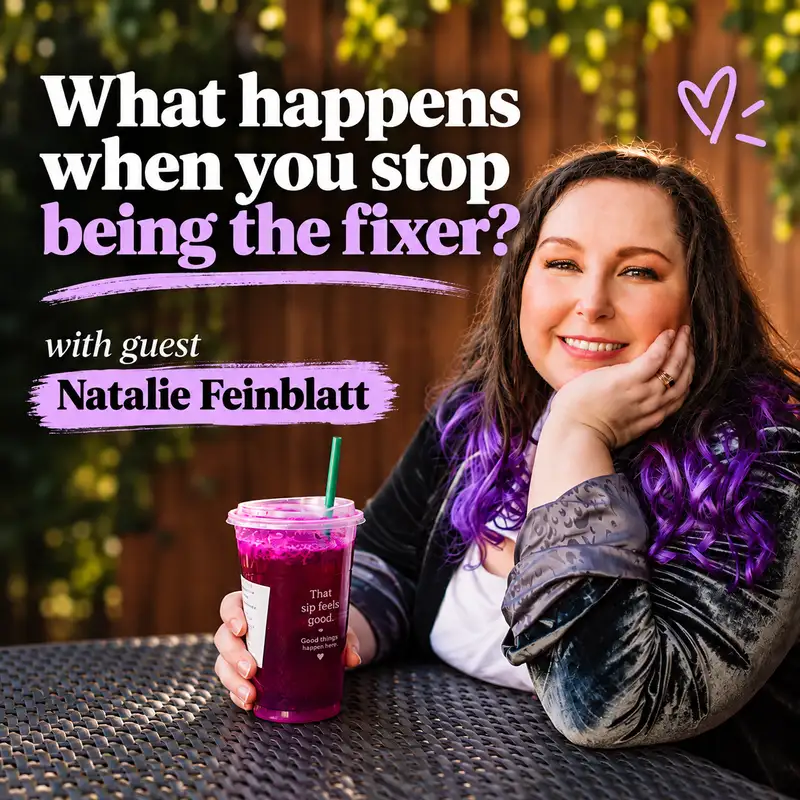
What happens when you stop being a fixer? with Guest Natalie Feinblatt
Download MP3[Dr. Natalie Feinblatt]
If you are finding that most of your relationships take way more of your energy than you get back, then it doesn't have to be a totally even 50-50. But like, if it's consistently an energy drain, that's probably a sign you should start looking into this. I would say, if kind of like the example you gave earlier, if you can go through your life and be like, all of these different people have these issues, right?
Addiction, mental health issue, there are so many people in my life with these issues, I'm the only one without issues, might be as uncomfortable as that might be. Like, you might say, okay, I don't have an addiction, or I don't have a mental health issue. But like, what is keeping me in this dynamic with all of these people that do, right?
What, what am I getting out of this that may not be the most healthy thing for myself or for them?
[Damon Frank]
Transcribed by https://otter.ai Welcome back to the Recovered Life Show. Today, we're talking about what happens when you stop being the fixer. You know, that person who steps in, solves the problem, keeps the peace, and takes responsibility for everyone else.
For a lot of us, especially in recovery, that role can become part of our identity. So stepping back can bring up guilt, anxiety, and even pushback from the people around us. My guest today is Dr. Natalie Feinblatt, a psychologist who works with addiction, trauma, and codependent patterns. And we're going to explore what it's like to be the fixer and possibly how to stop it. Welcome to the show, Dr. Natalie.
[Dr. Natalie Feinblatt]
Yes, hi. Thank you so much for having me. And you can just call me Natalie.
[Damon Frank]
I love it. Thank you so much. It's your first appearance on the Recovered Life Show.
So glad to have you on today. So being a fixer, this is a big, big thing. You know, many people in the recovery community were raised in codependent households, had addiction, had family trauma.
What is this deal with being a fixer? Is this a common thing?
[Dr. Natalie Feinblatt]
Do a lot of people have this? So yes, I would say, I mean, I know my view of it is probably a little bit skewed because people kind of come to me specifically to work on this. So maybe I see it more than the average person, but I would say it is pretty common, both in the world of addiction, addiction recovery, having a loved one who has an addiction or is in addiction recovery.
But to be honest with you, it can really also happen in families where maybe somebody doesn't have an addiction issue, but they have a significant mental health issue that everybody is struggling to deal with. But yeah, I think it's common and I think it's probably more common than people realize.
[Damon Frank]
You know, I always say it's like this compulsion to take responsibility for things that have nothing to do with you. Maybe you're in the orbit of it, but they don't actually belong to you. And I called it compulsion because it, isn't it kind of a compulsion?
I mean, I've never met an alcoholic or an addict that's not surrounded by codependents.
[Dr. Natalie Feinblatt]
Yes. And I've also never met somebody who, you know, has an addiction issue that doesn't have their own codependency issues themselves. It's just usually they need to be sober for a while for those to come out a little bit more.
But yeah, I would say that this is, you know, very common. And I would agree with the compulsive part of it as well, because when people, even when people want to work on this, like they come to therapy or to a support group wanting to work on this at first, especially it is very, very, very hard for people to resist that compulsion to jump in and help or save someone.
[Damon Frank]
Where does this come from? I, this is the magic because people will ask me all the time. They're like, you know, yes, I understand that I can't fix people, but I have this compulsion to do it.
And I always say it's so funny because, you know, I talk with a lot of people who are in early recovery and I talk a lot sometimes before, especially when we do TikTok lives with the family, they'll come in obsessed, you know, like, well, they have to do this. They have to do this. We're doing this.
We're doing that. And then I always say, well, what are they doing?
[Speaker 3]
Yeah.
[Damon Frank]
What are you know? And they're like, I didn't even, I didn't even think about this. So, you know, where does this come from?
This, this obsession to, to fix and I'm not okay unless they're okay. Yeah.
[Dr. Natalie Feinblatt]
I think it can come from a couple of places. Oftentimes when people are raised in a family where there's an addiction component or a dysfunctional component, they can kind of hop into that role of like, if I step in and try to help or fix the situation, things get more tolerable for a while. Right.
So people might just figure that out as, as a young child or, you know, as a tween or a teen that if they jump in, it makes things better temporarily. So they could very well just continue doing that. However, there are also instances, whether it's somebody grew up with, or that they encounter later in life where the person with the addiction or the mental health issues may just outright tell them, I need your help.
I need you to do this for me. I need you to not do this for me. And that can kind of raise the issue of like, what, what is appropriate help and what is not appropriate help, which we can get into if you want to.
But if somebody, you know, consistently, a loved one consistently puts you in that position of, Hey, you need to help me with this. It can be very easy to just get sucked into that in that relationship dynamic and to just take on that role.
[Damon Frank]
It is. And I, and you know, it's, it's strange. It's like the more you live, you start to realize it's like people who really need people to save, always find them.
And the people who always need to be saved, always find them. Right. How do you know?
Because I know a lot of people are struggling with this. They feel deep down inside. You know what it is, Dr. Now, I'm sure people come to you. They feel deep down inside. It's like, well, I'm a good PR. I'm a good person.
Damn it. Like, of course, I'm going to help them. They're my family member or best friend or my spouse, or I've been dating them for two years.
And of course, of course, I'm going to help them. I'm not a bad person, but when does this cross the line? Because I think everybody wants to help you and everybody should help people if they could win, win Dr. Natalie, the magic question, when does it cross the line into something that is not okay.
[Dr. Natalie Feinblatt]
Yeah.
[Damon Frank]
And it's just not okay.
[Dr. Natalie Feinblatt]
Sure. Yeah. A couple of things popped to mind for that.
First of all, one of them that I talk to a lot of my clients about is, is this person asking for your help? Right. Or are you just jumping in unsolicited to fix a problem?
Right. I would say if it's, if it's not that somebody has asked for your help, it's more just like a problem has presented itself, or you think they need help with something and you just kind of jump into that helping role without actually having been asked. I think that can cross the line a little bit.
And I also think that whether you've been asked or not, if helping someone is actually preventing them from dealing with the natural consequences of their choices, that can be a type of help that crosses the line, because especially when it comes to addictions, if people don't experience the consequence of their choices, they often won't get help. And if, if somebody is a part of helping them by, you know, making sure they don't have to deal with the consequences of their choices, that can really contribute to keeping somebody stuck in addiction longer than they might have otherwise.
[Damon Frank]
Yeah. You know, this, this feeling of I'm not okay, unless they're okay, is so unhealthy. And, you know, I think it's very, very tough because on one hand you do, you do want to help people, right?
You do want to help people. And I've noticed this in recovery and just the decades I've been sober and people that I've helped, there's a line, right? There, there's this line where, and I've even seen this in my own family too, this, this need, you know, to, that we're not going to be okay unless the other, unless a person's okay.
And I find this to be the biggest dysfunction. And this is where, this is where things really spin out of control. Is this really a control issue?
I'm just going to, I'm going to Are all codependents and, and, and over givers really control freaks?
[Dr. Natalie Feinblatt]
Um, I would say it, it's a good possibility. And, um, I say it like that because in the work that I've done with these folks over the years, you know, oftentimes when people are early in their recovery from, from codependency, they might be a little more hesitant to see this angle of it. It's usually folks who are kind of a few years in that are kind of more open to examining this, but based on what you said, I would agree because if you are a fixer, a people pleaser, whatever you want to call it, usually if that behavior is, you know, uh, investigated, people will say, well, I'm just trying to make other people happy.
Right. I want to make other people happy and okay. Like, yeah.
Okay. That's part of it. But why are you helping other people to be happy and okay.
Other than just, you know, it'll be nice for them. Right. And it is often because if they're okay, then I'm okay.
Right. Like you were saying. And so that's where the controlling can come in where it's like, okay, but you can't control other people to regulate your own mood.
Right. You need to work on regulating your, your mood as an individual person. So I would say that that's where the control angle is and it comes.
It, it, I would say it's the case a lot of the time. Yeah.
[Damon Frank]
Yeah. I love how you put that. You know, I always say to people, I love you, but not to death.
I will do everything I can to try to help you within the boundaries, but I'm not going to, I can't, I can't do so deplete myself. Right. And I mean, people listening to this, you know, if you know that the people, the over givers, right.
And it is kind of a compulsion, you know, I shared with you early on, I said, Oh, I'll probably share that. I, I never knew I was, you know, two decades into recovery, uh, before I really kind of fully understood what codependency was about. And I, and I, it was showing up in business relationships that I had and personal relationships that I had.
And I started to realize, you know, one day it was shocking to me. I woke up and I said, wait a second, this is super aggressive. This is not love.
I'm not doing this completely out of love. I'm doing that either for recognition. I'm doing it for, so I can somehow feel complete.
And I was like, there's something not. And that's when I really started to work with that. And you had mentioned, there's a lot of people that are in addiction recovery or mental health recovery and they have this, they don't realize they have it.
[Speaker 3]
Yeah.
[Damon Frank]
And it's a whole other, I call it the graduate level of the alcoholic of the out recovered alcoholic.
[Dr. Natalie Feinblatt]
Yep. Yeah, no, I would agree. I've heard, uh, I've heard people say, um, AA is the bachelors.
Al-Anon is the masters and CODA is the doctorate.
[Damon Frank]
Yes. Yes.
[Dr. Natalie Feinblatt]
You know, but, and I don't mean that in any sort of hierarchical way, but it's just peeling the onion layers. Right. Um, and, and I would agree.
I mean, most folks that I have worked with who, you know, have gotten sober and have stayed sober for some length of time, the codependency stuff will usually start to, to come out at some point or another.
[Damon Frank]
Like typically I'll say like, you know, not every person who has codependency has a chemical addiction, but just about everybody who has a chemical addiction has some degree of, Oh, and, and I would even say, I would even go even deeper into this as somebody who's in recovery that I think a lot of peer support groups, 12 step groups enable codependency.
[Dr. Natalie Feinblatt]
Yeah.
[Damon Frank]
They push it a lot. And you know, and especially people who have trauma, they have a hard time connecting. And then you've got the codependence in there that desperately need, right.
And so it's not always the most, uh, healthy situation. I think you have to be very, very careful on setting very clear, healthy boundaries. And this leads me to my next question, kind of the magic question here, how, and I know people are listening to this or going, Oh my God, I've been a lifelong fixer.
I fixed my family, my boss, my relationships, a workplace, my coworkers, my friends. Yeah. How do you start saying no as a lifetime fixer?
[Speaker 3]
Yeah.
[Damon Frank]
What's the first step here?
[Dr. Natalie Feinblatt]
The first step, I think, honestly, is to either with, if you have a therapist, with your therapist or with a friend or just on your own to really contemplate, like, you know, hypothetically, either playing it through in your mind, or maybe kind of doing it as a conversation or a role play with somebody. Like if I did say no in this situation, what would then come up for me? Right.
Because usually it's pretty strong feelings. Um, it can be guilt or, you know, grief or, um, you know, just frustration can come up for people and it's good to be able to identify like, okay, if I did say no, I would probably have strong feelings of X, Y, or Z. And then I would say, what coping skills can you bring into the picture to help you tolerate those feelings without just jumping back into the fixing behavior?
And I think that a lot of the time for folks, they find those feelings so hard to tolerate that they might never say no, or they might say no. And then immediately be like, nevermind. No, no, I can, I can help you.
I can do the thing. Right. Because those feelings are so uncomfortable for them.
And they've never had anybody kind of teach them like, well, yeah, these feelings are painful and difficult to tolerate, but you can actually get through them without doing the unhealthy behavior. So I would say figuring out what feelings would come up and then starting to even practice those skills. So the, you know, when you do actually give saying no, a try that you have those skills ready to kind of pull in there and see if you can get through to the other side of whatever discomfort comes up.
[Damon Frank]
I love that. You know, I think many people that have this feel afraid to do it because you start to realize there were some relationships that I had in my life where I started to realize my whole relationship with them is really is based on helping fix them.
[Dr. Natalie Feinblatt]
Yeah.
[Damon Frank]
Right. And I'm like, whoa, like I really have nothing in common. Yeah.
With this person, you know, and I'm thinking back to one situation of years and years and years. And I realized I woke up one day and I was like, and, and you know, what's even worse sometimes is you realize that some people really have no, they have really no desire to even help themselves.
[Speaker 3]
Yeah.
[Damon Frank]
And they're telling you that they're actually telling you that. Right. And, and we don't listen to that.
We, we don't what, why is it hard for people that have this to separate all this out in their mind? Because I had friends telling me, Hey, listen, this person saying it clearly. Yeah.
They're not interested in change. They're not interested. Yeah.
They're not, they're not going to stop you from saving them and bailing them out, but they're not interested in changing. How do you start to, how do you start to weed out this and to find out, oh my God, are all my relationships or some of my relationships really having really just about being the fixer?
[Dr. Natalie Feinblatt]
Yeah. I would say it would probably start with trying to figure out, you know, what relationships, if you just kind of saying to yourself, if you were to step back from the fixing role in any given relationship, what would be left? Right.
Like, would there still be some sort of common ground, common interests you know, a healthy history of, of, you know, enjoying each other's company? Or if you think about, well, if I wasn't there to kind of fix the things and they weren't there to kind of create the things for me to fix, would we really have much of a relationship or a friendship? Right.
Like, like you said, do we actually have things in common? Do we enjoy spending time together? That's not just focused on, you know, helping them fix their problems.
And I think kind of trying to be honest with yourself about if, if that is the case or not would probably be a good place to start. And, and it's also, it's almost like, you know, when you're in addiction recovery, people will often discover that certain people they thought were their friends were just people that they did drugs or drank, drank, drank with. Right.
Like they come to realize like, Oh, outside of that, I don't, I don't really think I would want to be this person's friend. Right. Like, or we don't have anything in common.
Right. So it's a similar sort of thing of like, if you really think if you took that element out of the relationship, what would be there, would there be something or not so much?
[Damon Frank]
Well, you know, it's this thing about being a fixer too. I think it's woven into people's identity. And I've noticed, um, you know, they come from, people come from fixers.
They have kids that are fixers. Those kids have kids that are fixers. Right.
And it's, it's just ingraining. It was like, well, this is what I am supposed to do.
[Dr. Natalie Feinblatt]
Right.
[Damon Frank]
And this is how I am supposed to live. Meanwhile, there's a lot of suffering I find because it is an addiction. I think it's to, if, if, if I have to change them to feel good about myself, if I have to love them to depletion, then that's not really a life, right?
I mean, that that's, that's not even a relationship that, that is just a, that is an addiction.
[Dr. Natalie Feinblatt]
Yeah.
[Damon Frank]
To control.
[Dr. Natalie Feinblatt]
Yeah. And it also means that you really don't get to know yourself very well. Right.
Because like, if you're so focused on other people and fixing their problems to make you just kind of feel calmer and more regulated, where is the space for you to pursue the things that you care about or to get to know yourself and your own thoughts and feelings? Like that's just kind of out the window in that case.
[Damon Frank]
You know, I had a, I had a, uh, a woman that came up on our Tik TOK live and I can say it cause it's public. It was on a Tik TOK live and I will have, you know, sometimes hundreds of people in there and people will come up and ask for advice and things. This person's like, I, you know, my husband, he won't stop drinking.
He's this, he's this, it's been decades of this. And I said, we'll leave, leave. I, you, you've put down a boundary.
You've told them the kids are suffering. Everybody's suffering. You even told me your parents are suffering.
And, and, and I'm like, and at some point you have a role in this, like at some point you ever, you know, you have a role in this. And speaking with somebody who had alcoholism, my family, I know this, like I've lived this. So they they'll swear up and down that they have no role in it.
I'm like, okay, wait a second. Your dad was an alcoholic. Your grandfather was an alcoholic.
Your mom, you say is a, is an overbearing fixer, which is basically a codependent. You're best friends and alcoholic. You had a husband before this husband died of alcoholism.
Okay. Three of your kids are alcohol. Possibly.
Do you have any, is anything possible? No. And this is the crazy thing.
And I'm going to ask you, and I'm not making fun of this because I see it's hard to see. They see the alcoholism and drug addiction. You can see schizophrenia, bipolar disorder, codependence have a very hard time seeing their role in it.
[Dr. Natalie Feinblatt]
They really can't.
[Damon Frank]
I mean, out of every addiction I've ever seen, I don't know if class, it's an addiction, but it's like every addiction I've seen, they don't, why can't they see it?
[Dr. Natalie Feinblatt]
Yeah. Well, because I think that it is often number one, it's often very effective for a long time. Right.
Like I think people can get away with being codependent for a lot longer than people can get away with, you know, being addicted to drugs or alcohol. And I also think that at least in our society and Western society that like being a helper, right. Quote unquote is generally looked upon as like a good thing, right.
That, that, that, Oh, you want to help people and you're really there for other people. And so it's, it's a hard thing even for society to recognize, um, as potentially having a downside or a problematic side. So I think that's, that's often why people have a hard time identifying it in themselves because it's, it's pretty insidious.
And unfortunately it has a, it has a, you know, pretty good cover on it at the very least of like, well, this is just a helpful person, right.
[Damon Frank]
Where it's like, but there's patterns, right? Like you, like, like if you see somebody, it's typically not a one shot situation that they're just codependent and it could happen. Like, look, not narcissists can run the show.
They can come in, create a lot of, maybe even somebody with BPD entry to BPD can start a lot of drama and you can get sucked into it here and there. But don't codependence. Typically people who have codependency and are over fixers on everything.
Isn't there patterns? Isn't this running in their whole life? They're fixing their workplace.
They're fixing their relationships. They're fixing their family.
[Dr. Natalie Feinblatt]
Yeah, I would, I would agree. I think that people who recognize that they have this issue or thinking that they might, they can see that it's either in every aspect of their life or like a great many aspects of their life. Like maybe it's not everything, but it's enough, you know, it's multiple aspects.
Um, and, and yeah, I think that while people who are struggling with codependency might, you know, have a healthier relationship here or there, it's usually more than one relationship. That's an issue.
[Damon Frank]
I love that. You know, um, I, you know, I'm going to ask you this, uh, Dr. Natalie, how people can maybe start this healing journey. Um, I, a shout out to Dr. Michael Beckwith at Agape. Actually, I took a class from him, uh, regarding energy years ago. And when I was in the middle of this and one of the things he talked about a lot was energetic exchange, which I use a lot because I'm, I'm varying energy and I live my life by that. And so when I start to feel that the energetic exchange is super, and it's not like I do something, they have to compensate me this way, but they're, that's one energetic exchange, but it could be in relationships.
It could be if I'm overgiving, I'm giving too much. Cause I will tend to do that. I will tend to do too much.
And I realized that something that doesn't work for me is an eventually get resentful. It's like, well, what happened? So I use an energetic exchange.
I kind of feel the situation. Am I giving to, is there an exchange here? You know, am I a good friend?
Are they being a good friend to me? Right. And so I, I do things like that, but how do you, how do you find your way back to this?
Because I find that a lot of women and men, forties, late forties, fifties, sixties, seventies, even eighties are like, Oh my God, something's not right here. How do you find your way back to this?
[Dr. Natalie Feinblatt]
I would say, you know, I, I love the, the energy exchange example in terms of like, if you are finding that most of your relationships take way more of your energy than you get back, then it doesn't have to be an E totally even 50 50. But like, if it's consistently an energy drain, that's probably a sign you should start looking into this. Um, I would say if kind of like the example you gave earlier, if you can go through your life and be like, all of these different people have these issues, right?
Addiction, mental health issue. There are so many people in my life with these issues. I'm the only one without issues might be as uncomfortable as that might be.
Like you might say, okay, I don't have an addiction or I don't have a mental health issue, but like, what is keeping me in this dynamic with all of these people that do right? What, what am I getting out of this? That may not be the most healthy thing for myself or for them.
Um, and then in terms of like the kind of help that you can get for this, I mean, it really depends on what's financially or geographically accessible to people. You know, it might be therapy, um, with somebody who specializes in this area, but if that's not accessible for whatever reason, it could be a support group. It could be, you know, reading books, listening to podcasts that are on this issue.
Um, that's, you know, that's a good place to start if it's, if it's what's available.
[Damon Frank]
So how do you do this as a therapist? Cause I'm sure you see a lot of people that you see it right when they walk in, you're like, oh boy, you know, and they're slowly waking up to the fact like something's not right. They're obviously sit in front of you.
They realize something's not right. And they might have some sort of role in it. What is the path in therapy for this?
Because a lot of people ask this, they're like, so what am I going to do? I'm going to go in and I'm going to allow people to not trauma dump on me anymore. And I'm going to stand like, what does this mean?
I'm going to start saying no all the time. Like people don't understand how does, how does therapy help with codependency or patterns of codependency?
[Dr. Natalie Feinblatt]
Sure. So therapy can help with recovering from codependency and the patterns of codependency because you know, it's helpful to have a professional there who is well-versed in all of these issues and who can kind of guide you through them in a, in a measured, you know, customized way for you. Um, and somebody, you know, the therapist can also play the role of it's a balance, right?
Because you don't want to just nod and smile and say yes, yes, yes. To, to everything that somebody says, but you also don't want to like challenge or push people too much at first. Cause then they might, you know, run off.
So as the therapist, it's, it's kind of a balance of like, let's look at these patterns. Let's look at this issue. Let's see what you identify with in it and what you don't identify with it.
And then the things you identify, what, what problems are these things causing in your life? Let's, let's get an honest look at, you know, the, the issues that this is causing you. And then what can you start to do differently in a, you know, measured paced way to start to undo some of this and see what life feels like without these techniques and patterns that you're stuck in.
And then like we were talking about earlier was saying, no, what is going to come up for you when you aren't doing these things anymore? Because generally much like with a substance use addiction, it's like, if we just take away this thing and have nothing to replace it with in terms of something healthy or ways to cope with life without this thing, you're not going to get super far, right? So the therapist is there to help you deal with what comes up and come and, you know, give you the tools you need to, you know, remove these patterns from your life and have something healthier to put there in their place.
[Damon Frank]
If there's people that are listening to this right now and they're saying, you know what? I've always been a people pleaser. My mom was a people pleaser.
My grandma was a people pleaser. This is just who I am. This is just my percent.
And yes, it causes me a lot of pain and I often feel empty, but this is just who I am. And I'm probably not going to be able to change that. What would you tell them?
[Dr. Natalie Feinblatt]
I would probably tell them two things. I would say one is that there is a really good quote. I'm blanking.
I think her name is Cheryl Richardson. She's an author who writes about this stuff. And I'm going to paraphrase it.
I'm not going to get it totally right, but it's something like when you, you know, when you
(This file is longer than 30 minutes. Go Unlimited at https://turboscribe.ai/ to transcribe files up to 10 hours long.)
Creators and Guests