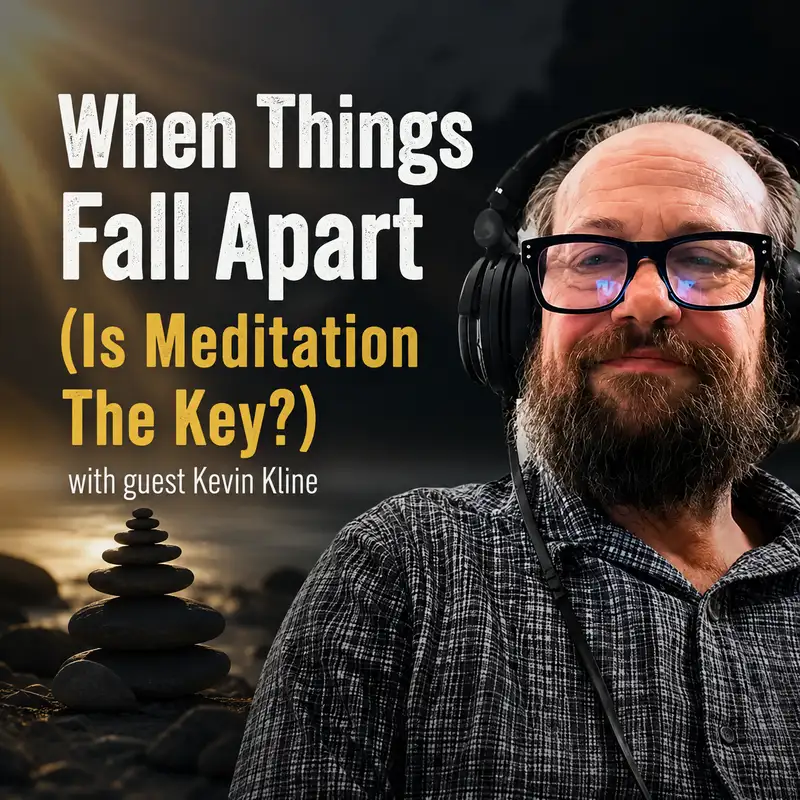
When Things Fall Apart (Is Meditation The Key?)
Download MP3This show is a proud part of Recovered Life, a media network and peer support community dedicated to mental health and addiction recovery.
We bring together expert voices, real stories, and a peer support community to help you live your best recovered life.
Join us at RecoveredLife.tv. You're listening to The Recovered Life Show, the show that helps people in recovery live their best recovered lives.
And here is your host, Damon Frank.
Welcome back to Recovered Life.
I am here with Kevin Kline, Spiritual Transformation Coach.
How are you doing, Kevin?
Great.
How are you?
Doing great.
And I'm thrilled to be back.
And we have been doing a whole series of shows regarding the book, When Things Fall Apart.
And this specific show is going to be very interesting.
I've been looking forward to this specific show because we're talking about meditation.
And what does meditation have to do when things fall apart?
Well, everything.
Okay, we can go home now.
She talks about meditation in the book.
And first, I just want to give homage to Pema Chodron for this book.
You and I have talked for a few minutes.
This is the sixth time.
And for anybody that wants to know more, and there's so much more in this book, and going through it and letting it teach you is a wonderful process.
It's wonderful.
And eventually in the future, I'm going to be offering this.
And I hope that those who are interested will follow through.
Absolutely.
We're definitely going to keep the conversation going on Recovered Life.
And if you're not there, RecoveredLife.us, become a member for free today.
You can access Kevin, and we're going to have a further conversation about the spiritual practices and how they apply to recovery.
You know, and one of the things that we were just talking about before the show that I found interesting, and when I said, what does meditation have to do with it?
And you said, man, it has everything to do with it.
And can you go a little deeper on that?
How can meditation help you when you really feel like things are just unraveling?
Well, things are always unraveling, and things are coming together.
You know, when I was really, really, really new, there was this person who I thought, you know, had more time than God because she was 13 years sober.
And what she said was, you know, this person didn't have a breakdown, they had a breakthrough.
You know?
I mean, really, a lot of it depends on how we look at it, right?
Just like there's no black and white.
It's like, okay, I'm having a breakthrough.
Are things really falling apart?
Or are we letting them release so that they can come back together again in a higher, more loving, more divine way so that they work better in our lives, right?
You can choose, right?
So anyway, with meditation, meditation for me and for people I work with, what it does is it sort of greases the wheels.
It helps me get out of the minutiae of my own head.
And I would love to tell you that after 34 years, I have no minutiae in my head, but every once in a while, the minutiae shows up, or as in her book, The Wild Dogs, which sometimes they feel like wild dogs, right?
Yeah.
And they're just, eh.
But the more that I meditate, and the more that I'm sincere about being willing to let go, right, and get into this, and just allow meditation to be, for me to be.
Meditation is not where I've got an expectation like, oh, I'm going to take this idea into meditation, and I'm going to manifest it like crazy, right?
Or I'm going to get all these answers, or I'm going to hear, I'm going to see things, and people are going to come to me with answers, or I'm going to hear music, and it's going to give me some great, you know?
Most time, nothing happens in meditation.
No thing happens.
And for me, after some time of practice, when I can go in, and when I'm really on my game with it, I block out time, like a sincere amount of time, you know, where I don't have to go somewhere, be with people, or whatever it is, so that I can just let it happen.
And I'll sit, and sometimes it takes 20 minutes for my head to shut up, and that's fine, right?
Because what's on the other side of that 20 minutes is really wonderful, you know?
It's really wonderful.
It's like, you know, when I can get into that, and it's like, all of the sadness, like, I'm floating, and I'm not, my head's not talking, and I'm just in a state of peacefulness.
Well, yeah, Kevin, I mean, we were talking about this before the show, and you know, I am a very type A person.
I have fought meditation for years, and you have been on me, on me.
You have to mention, I've been practicing it, and I've noticed how, when you say, grease the wheels, and I totally understand that now.
What I found is that when things fall apart, and I have been practicing meditation, what happens is it delays, there's a pause.
There's more of a pause before my reaction to it, and my framing of the situation.
Because the one thing that I really got from the series of shows that we've done on this, when this book is, so much of this, like you said, has to do with how I frame things, and what I believe, and what I think about situations, right?
And meditation gives me that pause, so that I can wait a second before I jump into this or that.
It's almost like it gives me a choice.
Does that make sense?
Absolutely.
And absolutely.
And what, and what, and I know people aren't going to believe this, and I don't care, it's true, that after someone has a meditation practice, where they sit every day, and they do this, right?
It isn't just like, I could be on the 405 freeway, and if you're not in LA, it's just like the worst freeway on the planet.
I could be on the 405 freeway, and it's not just that I'm not getting upset about traffic, or that I'm not moving, it's like, you know, I can pop in some music, and I can be singing, and having a great time, and people around me look at me like I'm crazy.
Like, okay, fine, whatever.
But after, after many years of meditating, what happens is that I am guided.
I'm not even on that freeway.
I'm not put into situations, which used to baffle me, right?
I'm not put into situations where I have to choose whether or not to get upset.
I'm just doing, I'm somewhere else.
Things are flowing, you know, here, flowing there.
And if I miss a day or two, wham, all of a sudden that 405, whether it's really the 405 or not, but that 405 mindset is right here in my face.
And it's like, okay, right.
Yeah.
Well, in early recovery, too, let's be honest, like, you know, one of the things that you get when you work with newer people in recovery, especially when you coach, usually the first part of the sessions are all drama, drama, they're in drama, things are happening to them, they're doing things to people.
Everybody around them is high in drama.
And just that pause for a minute that it gets you, and especially in early recovery, things are falling apart like crazy, right?
Hopefully things are falling apart like crazy.
And, you know, how do you practice this when you find yourself getting swept up in the fear of it's all falling apart, and I'm not going to get what I want?
What's the first step that you take, Kevin?
What do you do?
Well, at this point, I stop, you know, I mean, I just stopped.
It's like, I don't want to be on the roller coaster anymore, even if it's going like this.
I don't like this.
I don't like drama anymore.
I'm done with it.
You know, I like peace of mind.
And so I stop, and I look at where my head's thinking.
And I have to, because I'm a full responsibility guy, it's like, okay, is this live?
Or is this memorex?
Is this real?
Or is this something my head's concocted?
And chances are 99.9% of the time, my head has come up with it.
It's lying to me, right?
Because it's made something up to be afraid about, so that I could get into the drama.
It's like, no, I stop, and I look at it, and I laugh at myself.
You know, I know I talked about that before.
I still do it.
I laugh at myself, even if it's like, if I catch myself in fear, you know, the higher power that I have is bigger than any BS that I can take to it.
And going, okay, it's like, you know, we used to say, it's like, if you don't tell God how big your problems are, you tell your problems how big your God is.
And it's like, if you don't have a God, I mean, the God that made the universe, right?
If you don't have a God that can take care of some BS problem, and I'm not discounting anybody's life situation, right?
But it could be, oh my God, I got caught on the floor with my, it's like, so what, right?
You were in traffic, you know, you still got a roof over your head?
Are you still sober?
You know, I mean, get with it, right?
Well, you know, the drama is hypnotizing.
And I'll tell you, the thing that you mentioned about, is it real or is it memorax, it is so important, I think, especially with the topic, when things fall apart.
One of the things, if you're blessed in recovery to deal with new people, is that what you find is, is that they'll say, well, this happened to me and it fell apart, this relationship fell apart.
And they'll jump back, they might be 35 years old, they jump back to something that happened when they were 10 o'clock, 10 years old, like, oh, well, this relationship fell apart with a parent when I was 10 years old, right?
And they're back into being, they're not even in the reality of what's actually going on.
Maybe the relationship that they were just in needed to end, right?
Maybe it had, it reached its ending in that way.
And I love what you said about just really giving a hard look at like, is this real?
Is this or is this just some reaction I'm having off of a resentment or something that happened to me earlier on in life?
Right.
Earlier on in the day.
Yes.
Yes.
Right.
So bringing it back to meditation, is that the more I meditate, the less I'm going to do that to begin with.
The less automatic my head is about going to any place, I'll call negative, even though I don't want to go good or bad, but you know, that is non-fruitful, I'll put it that way.
That isn't in my highest good, isn't in my best interest.
You know, if my head takes off with something, chances are it's not necessarily a good thing.
So when I'm in a steady meditation practice, that stuff not only slows down, but it can disappear.
I know lots of people who have long-term sobriety, who when they talk, they are still saying that when they wake up in the morning, their head woke up before them, and it's already on go, and it's complaining at them, it's doing all this, and I'm like, really?
Yeah.
Really?
When I wake up, I wake up, and I look around, and I'm like, oh, okay.
Or I wake up, and there's a song in my head.
Or I wake up, and I've got sort of this prayer thing going on in my head.
I don't do that.
My head doesn't wake me up with terror in the morning.
That doesn't happen anymore.
And so much of my life is so much calmer and steadier, and I attribute that directly to meditation.
There is value.
When I have a client, there is value in going back and very purposefully looking at our childhood and looking where things came from, because those voices are still on a loop in our head.
Yeah.
Right?
Well, you know, Kevin, too, just to add something, you talked about people with long-term sobriety and time.
As you realize in recovery, time is not the only indicator, or maybe not the best indicator of whether people are free and have had an awakening, right?
It's not always, and are happy, right?
There are plenty of people that have long-term sobriety that are not happy.
You might be listening to it right now.
You might be listening to this right now, and not free, like, you know, you had an awakening.
Maybe it was 20, 30 years ago.
It's turned into a rut.
You're not.
You're stuck, right?
And what I found is that the clarity in the meditation, and, you know, I'm not the best
at this, but the clarity I get, the calmness that I get in the day-to-day activities of
my life, it just gives me that pause, and it gives me the ability to reframe things
in the right direction, not to jump on to resentments or things that have nothing to
do with the situation, and to be okay just in the here and now.
And I think if you're going to leave people with a big takeaway here about the book, When Things Fall Apart, what did you learn from it?
I mean, I could just, from our conversations, I've learned a ton, but what's the big thing that you learn and are applying now in your life?
Well, I'd say the most important thing that's in that book is really about learning how
to be compassionate for yourself, to understand that you're a human being, that you're doing
the best that you can, that, you know, there are tools in the book, it's like, you know,
let's start applying these, things will get easier, things will get better, you know,
but in the process, beating yourself up doesn't work.
Beating yourself up for beating yourself up, which usually happens when people have time.
It's like, well, I know better, I shouldn't have done that, right?
No, put the bat down, I'm taking your bat away from you now, right?
And just be gentle, and be gentle, and be compassionate, and be loving with yourself, and know that, you know, that you're going to get there, but that if you choose to not be gentle, or not compassionate, or not loving, it's going to be a really bumpy ride, and it's going to take forever.
Yeah.
Yeah, huge takeaway, Kevin.
Thank you so much, and, you know, we want to keep this conversation going, and please go on to recoveredlife.us if you're not a member.
You can become a member for free, join in on this conversation, and you can also contact Kevin there.
Thanks so much, Kevin.
We really appreciate you.
Thank you very much.
Thanks, David.
Appreciate it.
Keep the conversation going.
Join Recovered Life, a community of like-minded people who are looking to live their best recovered lives.
Membership is free, and you can apply at recoveredlife.us.
Creators and Guests