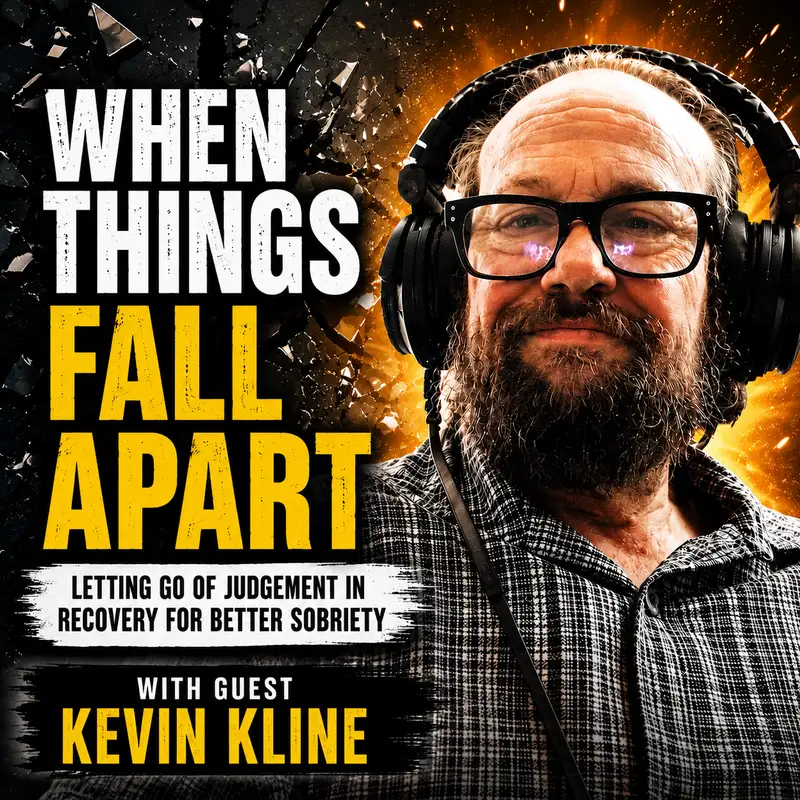
When Things Fall Apart - Letting Go of Judgement In Recovery
Download MP3Welcome back to another episode of Recovered Life. It's Damon Frank, and I am here with Kevin Kline,
spiritual transformation coach. How you doing today, Kevin?
Wonderful, thanks.
So great to be back and talking about this conversation that we've been having
about the book, When Things Fall Apart. And you know, I love the title because,
as we had said, you know, in our previous episodes and conversations, that things
are always falling apart in recovery, and it is how we kind of deal with those
things falling apart. And I wanted to talk with you today about a topic related to
this and what you've—what you can teach us about what you have learned in this book
in your spiritual practice dealing with people in recovery about the topic: letting go of judgment.
Yeah, um, yeah, I think I think that this is wonderful for people who, um, who are in recovery,
uh, because like, I see that it doesn't really even matter how much time they have,
they still have that little voice in the back of their head that, you know, wants to criticize.
Uh, so, we were talking before about the ego, and, and self-judgment can be
a big factor of that, um, and it has really interesting ways of sneaking in,
you know, even if we've, you know, worked, uh, character defects and things and we think,
"Okay, I'm golden now." Um, and then it just basically transmutes into a subtler way
of of expressing, right?
So, the, the learning how to let go of judgment, uh, is, you know, part of acceptance.
And, you know, when I said that, the ego, you know, is just trying to keep us safe,
and so, you know, it's like, "Thank you for sharing, now go to your room."
You know, that we can still have things like, if we have sticky areas in our life
where we still haven't quite let go of like our mother or father's voice,
you know, from when we were four, you know, that said, you know, "Oh, you should never do that.
That's bad."
You know, whatever it is, or, or, "If you could do that better," you know,
uh, with the inference that, um, uh, that perhaps you couldn't, that you're not capable of it,
that, you know, those those voices, those—
[sighs]
those diminishing voices that we can still have going on, even into long-term sobriety.
Yeah, you know, one of the things I wanted to ask you is, there's two types of judgment
that I see that pop up in my life. There is external judgment of what I feel, or my ego feels,
that other people will feel about me. And then there is internal judgment, what I feel
about me, right? Can you, can you talk about those, and which one's worse?
You know, what I found, and I'm just going to share an experience, is this is really—the
the internal and external are so prevalent when things fall apart, that I find that I will
always go first, my ego will always go first to the external. What are other people in my
life going to feel about this? What are people I don't know going to feel about this? And then it
immediately—and then I get past that fairly quickly, and then it's the internal. How do
I feel about this? That seems to get the best attack. When the—when the ego attacks
me, that's when it really gains some steam with me. So could you talk—could you address
the external and the internal?
Okay, let's let's be clear. There's no such thing as external and internal,
and it's never it's never really about anybody else.
So it's always internal is what you're telling me, right? It's always how I perceive it.
It's always—it's always our responsibility.
It's always our responsibility. It's always our voice. People—people come to us
and meet with us at the level of our own acceptance and experience and, um, and
and love or not love for ourselves. You know, we're like magnets. What—what we
really believe, not the things that we may, you know, say in a meeting or, you know,
yammer to ourselves, like, "Oh, I'm, you know, I can do," you know, it's like what that stuff—
you know, the kind of stuff you tell yourself at like 3:00 in the morning when, you know, when you're alone,
you know, and there's like nobody to lie to, you know, and it's like, you know, getting very real about,
you know, how we feel. That kind of belief.
That's what attracts people. You know, that's, you know, if if I if I think that I'm
bad at something, even if I don't say those words, I will attract people in my life that will tell me I'm bad at it.
Yeah, you know, I find that people in recovery will always use the thing, "I don't really know
what I really believe," when you're talking about that magnet, right? But isn't it really—isn't
the easy way to find out is to—when your ego basically attacks you, that feeling that you
have is really the core of what you really believe, right? Isn't—isn't that a really clear sign?
You know, to say to say we don't know what we believe, yeah, I think it's a little bit of a lie, you know,
whether we're conscious of it or not. You know, it's like if you if you want to know what you believe, look at what you have.
Okay, that's wow—that's powerful.
You know, if you have somebody coming at you that's [mimicking nagging], part of it is their stuff, and part of it is the fact that,
that, um, uh, you've got that magnetization to that, whatever that energy is, and that you're attracting, right?
Just like when we finally learn how to have boundaries, people don't cross them.
When we find to like really love ourselves, all of a sudden people are a lot friendlier to us.
You know, it's it's in the process of learning all of that stuff that, um, well, it can get dicey, emotionally, but,
um, in in in letting go of judgment,
it's about it's about first taking out the words "good" and "bad."
I love that, I love that, and I—okay, I'm going to ask the question that I know everybody's thinking right now.
How do you get rid of judgment? How—how do you do that?
Well, practice, discipline. I know that most of us don't like the D-word,
you know, we don't like to have repetition of things that we have to do, you know, but you don't have to do it.
You can keep the same stuff over and over again, right?
Um, but letting go of the concepts of good and bad.
You know, it's like, in spiritual law, there is no good or bad, but thinking makes it so.
If I think something is bad, then it's bad for me. If I think something is good, it's good for me.
Now, that has nothing to do with you, your experience.
You know, I mean, we do have things within society that say, "Oh, that's bad, or that's good," you know,
that can reinforce that, but within the individual, the only way to start to move past
some of the harder harder things, um, and to be in acceptance is to let go of the concept that, that
that, you know, I need to to make something good or bad so that I can either compliment myself
or or discipline myself,
right? Because, you know, I think I need to do that. That's the ego, you know, other than, "I told you so," right?
It's like, "Well, gee, that was a good job, or that wasn't so good, you know, we need to do that better." My grandfather had this phrase when I was growing up
that's like, "That's half a job."
You know, so here comes this little kid that does this thing, and they're like so proud of them—everything, and, you know, or—and
and it wasn't—it didn't rise up to his expectation, so he would say that was half a job.
And that's, you know—
so, but when we can let go when we can let go of the concept of good or bad—of good and bad,
and just that what is, it's just what is right now.
It just what is. And so, if we,
if we practice a behavior that really doesn't, um, serve us anymore, because that's a better way of looking at it than,
"Oh, that's bad, I got to stop that," is this serving me?
If it is, great, continue. If it isn't, well, then, you know, then then we need to, you know, move in a different direction.
Yes, yes, and you know, I find that so—I find that so powerful. Just to jump in here real quick,
you know, in—in the coaching that I do a lot of times, what we do is we just do three-by-five cards
writing down all of the thoughts and things that we're doing, right? And then we go through one by one
and not say so much, "This is good. This is bad." Take it out of there. "Does this—
does this work for me? Does this serve others?" You know, and if I know what I want to try to achieve,
that's a really easy answer. And it takes it out of the good-bad paradigm of judgment
and allows me to think clearly about the decisions that I'm making.
Right. It's more empowering, too. You know, being caught up in the good-bad concept
is is very limiting, it's very restrictive, you know, it's it's really an old paradigm whose time has come
to like be let go of, you know. It it it doesn't serve us as a race.
You know, moving away from that and moving into into, um, uh, non-judgment
about ourselves, about other people, um, so that we can focus on,
you know, what better serves. You know, it's like the pandemic. You know, more and more people are going,
"Wait a minute, what's really important?"
Right? Okay, it's like, "Okay, this doesn't work anymore. I don't want to do this anymore," or,
"You know, let's not do this anymore," like as a group, you know, at whatever size that group is, right?
Hopefully, it'll end up being like the entire country going, "No, we need to like really start shifting how we're doing some of these things," you know?
Because everybody deserves food, and clean water, and clean air, and a planet that's not about to explode, you know?
So, as as long as, well, not as long as, um, when we can move into
a real acceptance of non-judgment,
and then a real acceptance of human—of our own humanity,
and and knowing that that at this moment, at this moment, we are doing the best that we can.
Yeah, yeah, that's powerful. If we could do better, we would.
You know, why wouldn't we, right?
And I think that's what we learn in recovery is that, uh, we learn to do better in recovery,
right? Step by step, we learn to do better. And, you know, I think the big—the—
the the big takeaway that I've gotten from this episode is learn how to let go of your judgment,
right? Work on letting go of your judgment day by day.
Yeah. And it's not "better." "Better" is still part of the good-bad paradigm.
Exactly. Well, Kevin, thank you. Thank you very much. This has been a great episode,
and, uh, you can reach out to Kevin here on Recovered Life. I will tag him here in the stream.
Thanks so much, Kevin. Have a great day.
Thank you. You too.
Creators and Guests