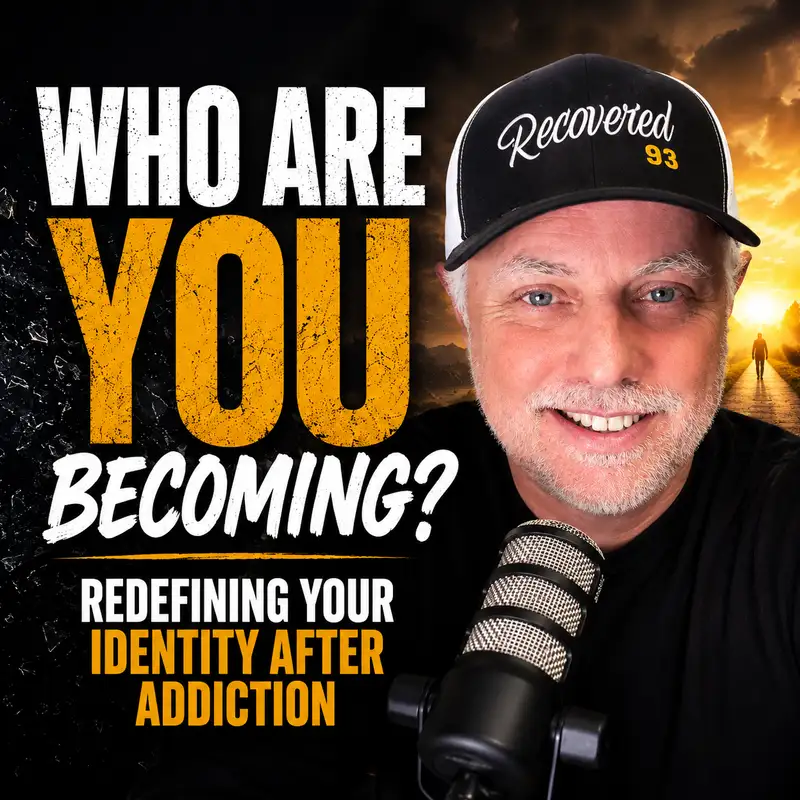
Who Are You Becoming? Redefining Your Identity After Addiction
Download MP3You don't reinvent your life overnight. You reinvent it one action at a time. It's what you do.
Sometimes I see people in recovery and I feel like I want to shake 'em, I want to say your past does not get the final word about you. And when I look back at people who I really admire and I really trust, these people were quote "the most broken of all of us."
And I look at that and their path, and because they started to take action and because they no longer identify with that label, they have amazing lives and help other people.
You're listening to the Recovered Life Show. The show that helps people in recovery live their best recovered lives.
Hey, and welcome back to the Recovered Life Show, so good to be here with you today. Wanted to talk about reinvention. Reinventing yourself in recovery.
You know guys, one of the interesting things have been my small career on TikTok where I go live, and one of the most common things that I hear is "I'm broken. I'm broken. I don't like who I am, I'm broken, I'm never going to be able to be fixed,"
and I always say the same thing over and over, you know, I don't believe that God makes broken people. I think people do broken things.
And for many of you that are listening to me, maybe you're in addiction recovery, maybe you're in mental health recovery. Maybe you are recovering from something else in your life.
And you've gotten to a place where you just feel you need to reinvent yourself. And I will say this is a common theme with everybody who goes through addiction recovery,
I know I went through it, I've been through it several times with trying to reinvent myself, I feel like in a way if you're living a recovered life, you're always in a way reinventing yourself.
Letting go of old ideas, letting go of things that no longer work for you, identifying things that no longer work for you. But what I wanted to share today is that I think a lot of people say they need a new life.
And I say really it's probably not true. Your life and the skills that you have and who you are is more than enough, you just need a new direction.
So I want to talk about the art of reinvention in recovery. And one of the biggest questions people ask after they get sober is: One, how do I stop drinking?
Or in mental health it is: How do I kind of get a grasp over this, what do I need to do? And then the next thing is, well who am I without this?
If you've always been the depressed person and you're no longer the depressed person, who are you? If you were always a troublemaker in your family, always the person causing a mess, and you're no longer that, who are you?
And for many people there is an emptiness that comes with this. There is a, "Well, I just don't know who I am. I just don't know who I am."
And I don't think that that's a horrible place to be honestly, I think that's the beginning of starting to let go of who you're not. I think most of a great recovery is asking different questions.
And if I keep saying "well who am I, who am I, who am I," sometimes the universe is going to give me back things that I don't understand, things I'm not comfortable with, things that might confuse me, or just not the truth.
I think a bigger question is: Who am I not anymore? Who am I not?
And for many people they did things when they were in the height of addiction or before their recovery that they're not proud of. You're just not proud of it.
Or like many, you're like, not that you did anything, not that you have regret or not that you have regret over something that you've done, it's maybe that you didn't do something.
You didn't go to school, you didn't get that education you really wanted. You didn't try to get a career, you didn't... you were just stuck. And now you have remorse for that.
And you're trying to figure out, well who am I? If I'm not the person who is addicted, if I'm not the person who is the struggler, if I'm not this person anymore then who am I?
And there's a bit of emptiness there. I'm going to be honest, there's a bit of... for everyone. I mean, I could still remember this 30 plus years ago when I first came into recovery, I was like who am I?
I'm not this anymore, I'm not the person who hangs out there with these people anymore. I can't be the irresponsible person, but who am I?
And I think for many of us in recovery, this is where we come up with this idea that we have to pretend to be something that we're not. Because when you've spent years identifying as the drinker, the depressed one, the anxious one, whatever that might be, whatever you're recovering from.
Now that it's hard to kind of imagine something different. And here's what I've learned with more than three decades of recovery. You are allowed to reinvent yourself. Not once, but over and over and over again.
And I think one of the biggest mistakes that people make is when they start to kind of realize what their world class and when they start to realize what their gifts are, they say well this couldn't be enough, I have to be something else.
And we start this concept that we have to pretend to be the uber responsible person. Well if I was bad with money, now I have to be a CPA.
We do these huge pivots sometimes and we try to pretend to be something that we're not. Instead of just saying who we are and where we're at with it.
I think one of the hardest things to do especially in recovery is to be able to say, you know what, I'm not that anymore, I'm not the drunk, I'm not the active addict, I'm not the depressed person, I'm not the anxious person, I'm not the screw-up, but I'm not quite totally responsible.
I'm not... I don't not show up, but I don't always show up. Right? It's shades of gray.
And I think a lot of times we think, we pick this up, that we have to pretend to be something that we're not. We have to be the opposite of whoever we were.
If we were the person that was unemployed, then we have to be overemployed. If we were the person who never said yes to every anything, we have to say yes to everything, even though that's probably not in our best interest.
And what we have to learn how to do in recovery is to become intentional. And I think it's hard because we look into the world and we say, man look at that person, look what they're doing.
But every person that we see and admire has had to reinvent themselves probably multiple times. Business leaders, athletes, artists, parents, people in recovery. Your 12 step sponsor. Life changes.
The question isn't really are you going to reinvent yourself in recovery. The question is whether you're going to do it on purpose, or you're going to let life do it for you.
And this is what I found when I needed to reinvent myself the most. And I would put it off and I would ignore it and I would pretend that it's not happening and I would do everything I could to not change in that area.
I mean, I'll share one with you guys right now. For years and years and years in recovery, I had a really bad sugar addiction. I would eat sugar, I would go, I would ebb and flow with it, I would eat it, I would not feel good.
You know, this it was no longer working for me, and I knew I had to reinvent myself and I just, I just wasn't there yet. And I remember being honest with myself and saying, you know what, this just doesn't work for me.
And I knew someday I would have to do it. But life put me in a position with health wise where I had to do it.
And what I'm learning in recovery is when I feel that thing, it's like oh, you know what, this no longer works for me, I'm going to have to reinvent myself in this area of my life. Whether it's friendships, relationships with other people, family, even my recovery about what I believe, about what I need, what works for me.
When it starts to become uncomfortable and I know that there's work to be done, now I'm much more apt to say alright, I'm willing to do it now, instead of having life drag me through it and then end up in a place that I have to do it where it's less convenient with for me.
I want to say, you know, recovery gives you permission. For so many people that are in recovery, either an addiction or a mental health issue, that made all your decisions.
It was where you were going to get the next drink, how you were going to be able to manage your moods, how you were going to be able to handle and keep all of it together. But in recovery, it gives you permission to be able to change.
And I remember so much parts of my personality, when I realized it was like, you know what? In recovery, I can't flip the guy off in the parking lot. It no longer works for me, time to let that go.
It was painful friends. You know if you know. It was painful. I can't be the guy who acts out like that. It no longer, it's time to give this up.
I don't know what that guy is going to be when he's frustrated with the guy who can't park. I don't know who this person is going to be, but it can't be that anymore.
For years addiction made your decisions, where you'd go, who you'd spend time with, what mattered, what you believed about yourself. Recovery gives you something addiction never could: choice.
Choice. And with choice comes reinvention. The big question is what needs to change? What version of yourself are you still holding on to that no longer works?
Maybe you're still introducing yourself by your mistakes. "Oh yeah, I'm that guy." But you're not that guy anymore. You're not that woman anymore.
Maybe you're still going along with other people who introduce you by your mistakes and not intervening and saying "please don't say that, that's not who I am now."
Maybe you're still carrying shame from 10, 20 years ago. And it no longer fits into the world that you have. Maybe you're living according to labels someone else gave you.
I see this a lot in recovery. Somebody told them that they were the problematic one, even though they have not been the problematic one for decades, they still take that label.
"I'm the slow one, I'm the person who doesn't get it, I'm the person who's always angry." Whatever label that is, is it true anymore? And if it's true and you know it no longer works, have you given yourself permission just to drop it?
Maybe you've been sober for years, you've been in your recovery for years but you're still thinking like somebody who isn't free. I see this a lot in 12 step groups.
"Well I changed, but you know, I'm an addict." "I changed, but you know, I'm a recovered alcoholic." So what? Don't have that be an excuse.
If you're sober for 5 years, you can't use that excuse anymore. And so many people create a label, "well you know, you know, I am an alcoholic in recovery." So what?
Can you reinvent yourself? Can you be the responsible person? If you're still thinking like somebody that's not free, that's not recovery. That's surviving. And I don't know about you, but I did not get sober to just survive. I wanted to be free.
The big question people always ask me is how do you do it? How do you reinvent yourself? Do I just take these big, it just seems so impossible, do I take these big steps?
And I always say no, reinvention starts with one huge breakthrough that it's going to happen in small actions. Not small thinking. One healthy morning routine.
Maybe you're somebody who's too apathetic, maybe you have to be more outgoing. Maybe you have to participate more with a group. Maybe you have to look for a job.
Maybe you have to actually get out there and start doing things. It's going to be small actions that get you there.
One of the things that I see that happens over and over in recovery is people identify with their thinking. "Well I'm thinking about taking an action." And I always say thinking is not an action. Thinking is thinking.
And sometimes thinking is not the friend we think it is. Our thinking is not the friend that we think it is. Make a decision. Maybe you want to have one honest conversation with somebody in recovery.
Maybe you want to go to one meeting. Maybe you want to work on one boundary. Maybe you want to just go on one walk, create one new friendship, one job application, take one class. One act of service.
You don't reinvent your life overnight. You reinvent it one action at a time. It's what you do.
Sometimes I see people in recovery and I feel like I want to shake 'em, I want to say your past does not get the final word about you. And when I look back at people who I really admire and I really trust, these people were quote "the most broken of all of us."
And I look at that and their path, and because they started to take action and because they no longer identify with that label, they have amazing lives and help other people.
If you think your past has the final word, this is what's slowing you down. Say to yourself, I've reinvented myself several times. Not because I'm pretending to be someone else, because every season required a different version of me.
Maybe you first started out in recovery as an employee. Maybe you were the person taking orders, but now, after a decade of being sober, you're the person giving the orders.
The season changed. You grew. Your talents grew. You became more consistent. It began with you showing up and being the best employee you could be. Not pretending to be someone else, just showing up where you're at.
Every season is going to require a different version of you. Recovery isn't really the finish line friends. It's the beginning.
The person you need to become at one year sober is different than the person that you need to become at five years sober, and ten years sober, and twenty years sober and beyond. It's going to change. Reinvention is not a one and done.
If you're listening to this today, if you were going to ask yourself one question: Who am I becoming? Who am I becoming? Not where was I, who do I identify... who is the, who are you becoming?
This is a super powerful question. Because recovery isn't about leaving addiction behind. It's about creating a life you don't want to escape from. That is the real miracle of recovery.
Thanks so much guys, thanks for joining me today on the pod. I'd love to connect with you guys on my private group @recoveredlife, I'm going to go ahead and put the link in the show notes here. Reinvention. Who are you becoming? Talk to you next time.
Creators and Guests